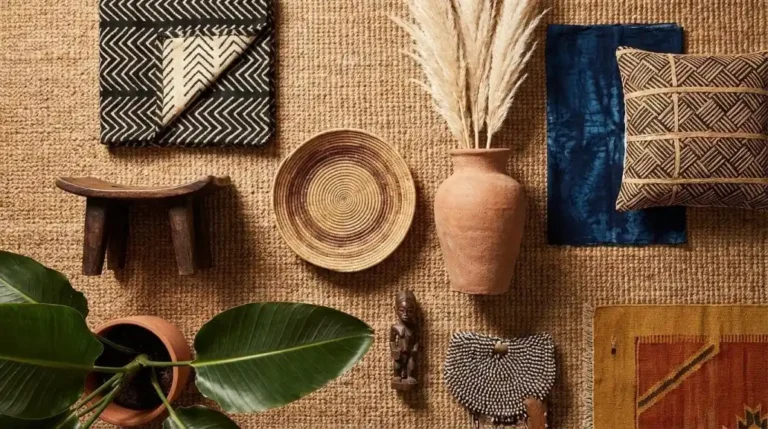
Afro Bohemian Wall Art Must-Haves for Beginners
The most common beginner mistake in Afro Bohemian wall art isn’t buying the wrong pieces.
It’s buying the right pieces in the wrong sequence.
A mud cloth panel purchased before the primary textile anchor is mounted has no composition to join — it reads as a second wall piece placed beside the first rather than as a gallery layer responding to an established center axis. A Tonga basket cluster mounted before the figural imagery is in place creates a three-dimensional element with no flat layer to project from — the depth effect disappears because there’s nothing for the baskets to read against.
Sequence is the system. This list gives you both the pieces and the order — with the reason behind each one so the logic is clear rather than prescriptive.
Quick Takeaway:
- The Kuba cloth or mud cloth textile panel is the first wall purchase in any room — its scale, position, and colorway set the center axis that every subsequent piece responds to.
- The Afro Queen portrait is the second purchase — the figural identity layer that anchors the gallery’s cultural heritage dimension at the human scale before any three-dimensional or detail pieces are introduced.
- The Tonga basket cluster is the third purchase — the three-dimensional layer that extends the gallery from the flat wall surface into the room’s physical depth and most clearly differentiates the Afro Bohemian gallery from a standard print collection.
The Four-Layer Framework Before Any Purchase
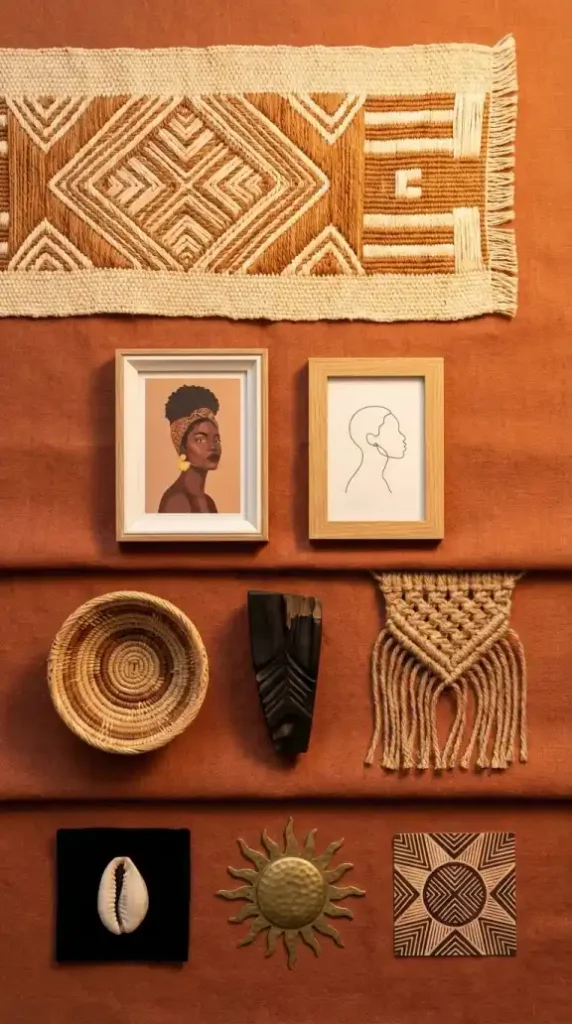
Before buying anything understand the four-layer framework and what each layer contributes.
Layer one — the Symbolic Textile Anchor — is the gallery’s largest piece and primary focal point. The Kuba cloth panel, the mud cloth hanging, or the Ankara framed print at architectural scale. This is the piece the eye enters on first from the room’s entry point.
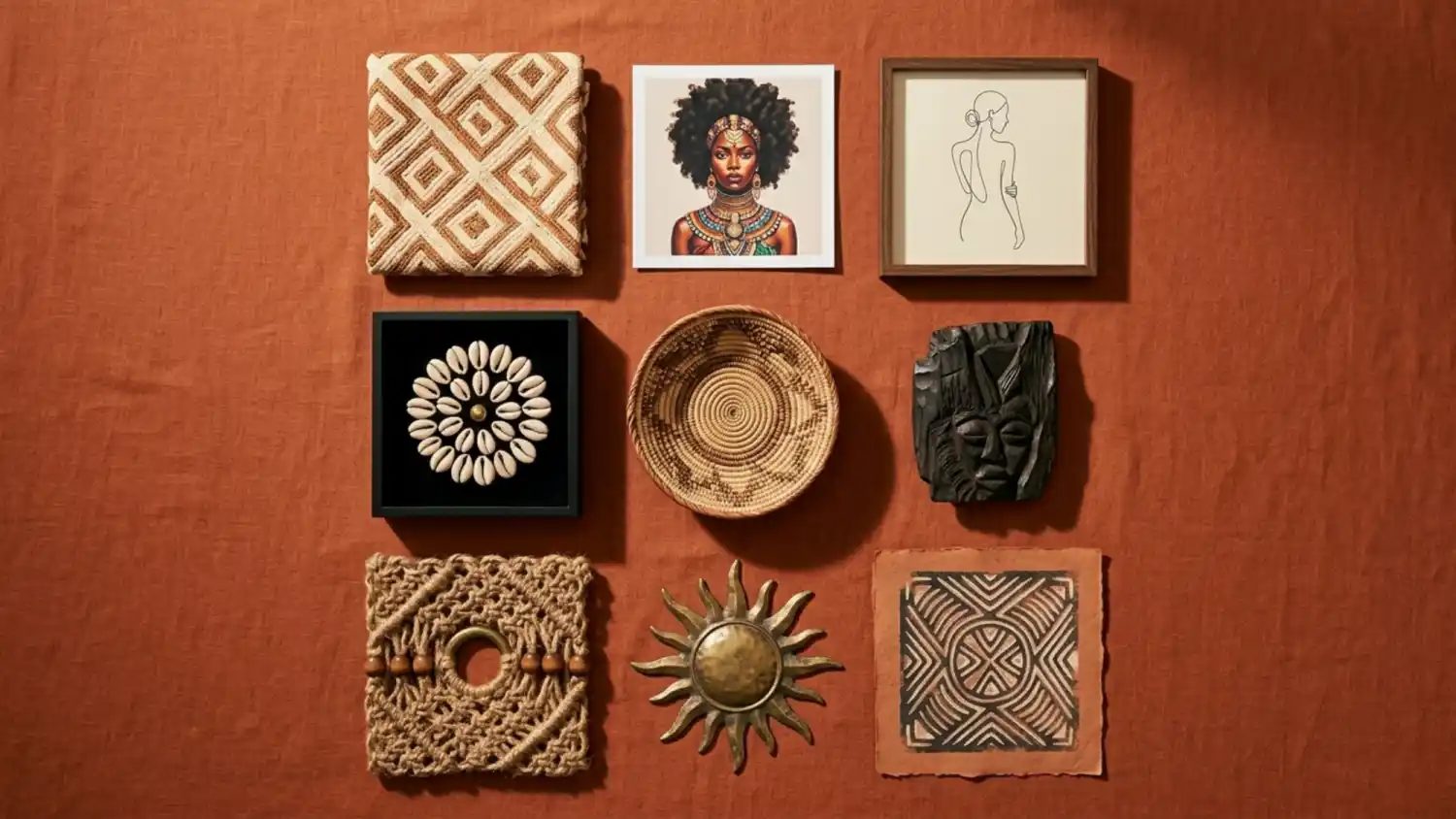
Layer two — the Figural Imagery — is the gallery’s identity and heritage layer. The Afro Queen portrait, the line art silhouette, the cowrie shell or Afro pick cultural artifact. These pieces provide the human and cultural dimension that abstract pattern alone can’t deliver.
Layer three — the Three-Dimensional Textural Elements — extend the gallery from the flat wall surface into the room’s physical depth. The Tonga basket cluster, the carved ebony wood relief panel, the jute macramé fiber art hanging. These are the pieces that most immediately differentiate an Afro Bohemian gallery from a standard print collection.
Layer four — the Detail Accents — reward close inspection with cultural specificity at the smallest scale. The celestial brass motif, the abstract geometry scarification print, the botanical monstera print. These pieces are discovered rather than immediately seen — the gallery’s close-range reward for sustained engagement.
Every purchase on this list sits in one of these four layers.
Buy in sequence — one layer established before the next is started — and the gallery builds itself into coherence. Buy across layers simultaneously without establishing each one first and the gallery reads as a collection of individually interesting pieces rather than a composed system.
First Purchase: A Kuba Cloth or Mud Cloth Primary Textile Panel
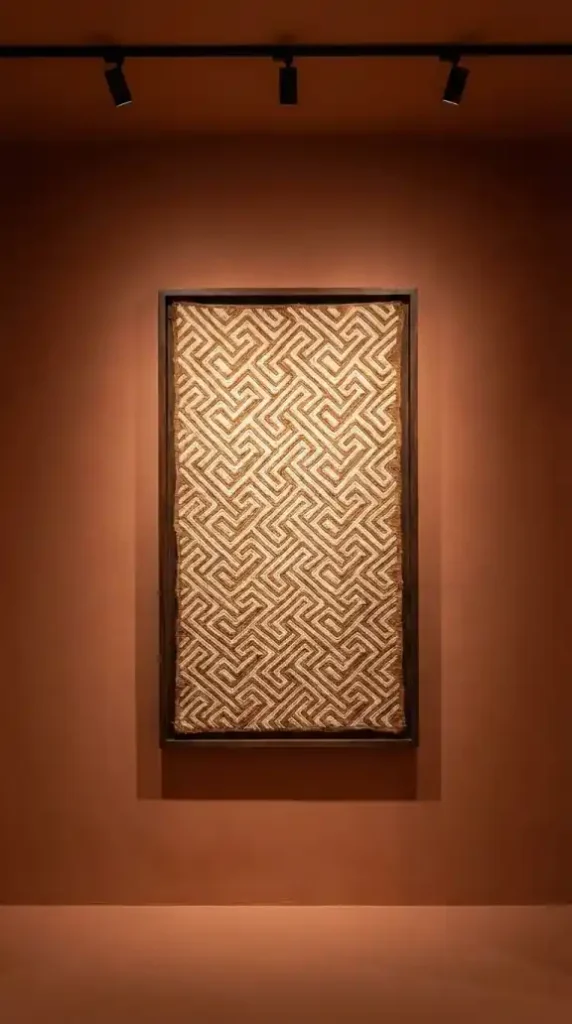
The Kuba cloth or mud cloth textile panel is the first wall purchase — and it’s mounted alone on the wall before any other piece is bought.
This is the sequence rule that produces the most consistently correct gallery results — and the one most beginners reverse by buying multiple pieces simultaneously and hanging them together.
Kuba cloth panels — handwoven from raffia palm fibers with complex improvisational geometric patterns and a cut-pile velvet-like surface texture — are the most materially distinctive primary anchor available in the Afro Bohemian wall art system.
The raised raffia weave surface catches 2700K track light in a way that no printed canvas can replicate — creating shadow depth across the panel surface that shifts with the light source angle and makes the piece read differently at different times of day.
Buy at 90cm wide minimum stretched on a dark wood frame.
Smaller reads as a secondary gallery element rather than a primary anchor — and a primary anchor that reads at secondary scale will be overwhelmed by every subsequent piece added beside it.
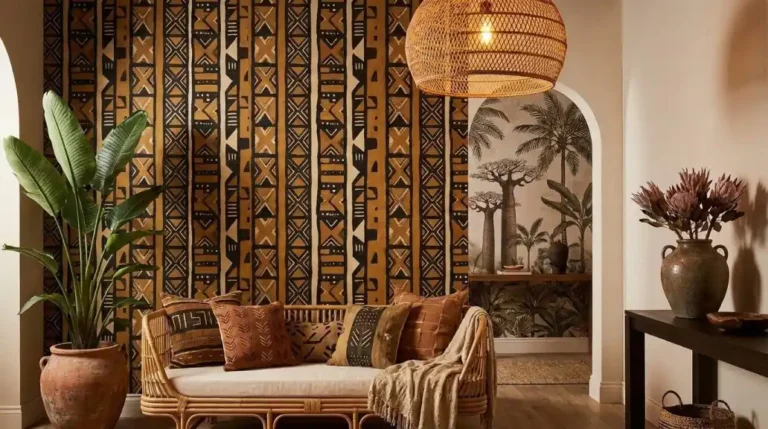
A mud cloth panel hung from a dark wood dowel rod is the alternative primary anchor — its bold black and cream linear geometric patterns delivering the High Contrast component at the anchor position where the Kuba cloth delivers the earth-tone raffia component.
Mount it. Live with it alone on the wall for one week. Then and only then buy the second piece.
Second Purchase: 2700K Track Lighting
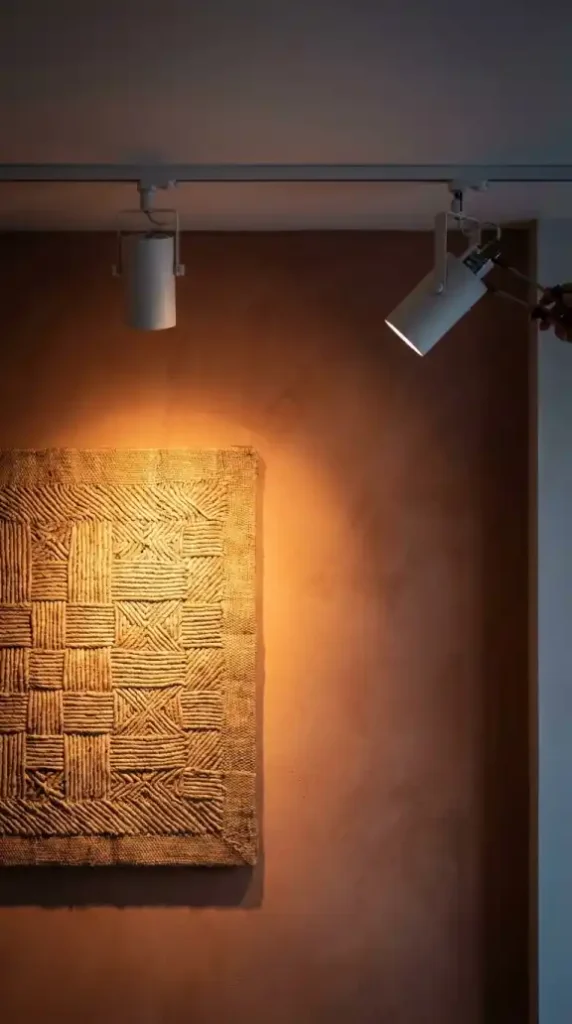
Track lighting at 2700K is the second purchase — before the Afro Queen portrait, before the basket cluster, before any additional wall piece.
This is the lighting rule that gallery wall guides consistently skip and that consistently produces galleries where the pieces look correct in isolation and flat in the actual room.
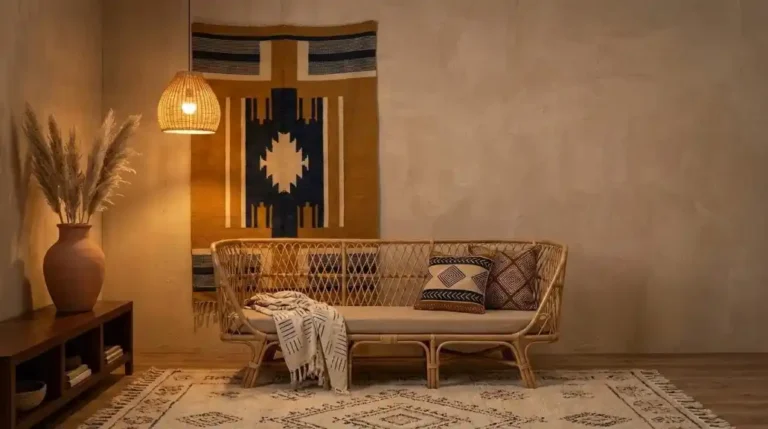
The Kuba cloth panel you just mounted will reveal its full surface depth only under correctly positioned 2700K track light. The carved ebony wood relief panel you’ll buy later will only create the dramatic highlight and shadow variation that makes it read as sculpture rather than decoration under directional warm light at the correct angle.
Buy the track lighting system and install it before evaluating the mounted Kuba cloth panel under its actual conditions.
Two track light fixtures angled toward the gallery wall’s center zone. Both at 2700K warm LED. The angled directional light raking across the Kuba cloth surface from above should reveal the raffia weave’s surface relief immediately — if the panel reads as flat under the track light the fixtures need to be angled more steeply toward the wall surface rather than pointing straight down.
Confirm the track light is performing correctly on the anchor panel before buying any subsequent gallery piece. Every piece you buy after this will be evaluated under the track light’s actual conditions — making every subsequent purchase decision more accurate than it could be under any other lighting condition.
Third Purchase: An Afro Queen Portrait Print
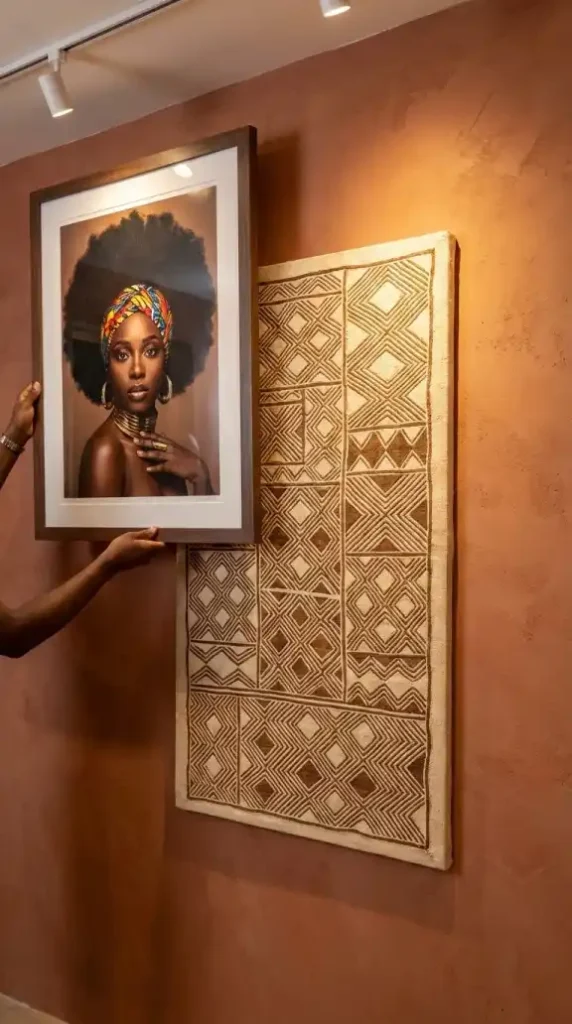
The Afro Queen portrait is the second wall piece mounted — chosen and sized in response to the Kuba cloth anchor already on the wall rather than selected independently.
Stylized portraits of Black women featuring intricate natural hairstyles — Afros, braids, locs — colorful headwraps, and vibrant jewelry are the gallery’s identity and cultural heritage layer. They provide the figural human dimension that the Kuba cloth’s abstract geometric pattern doesn’t deliver.
Buy at 60x80cm minimum in a wide dark wood frame.
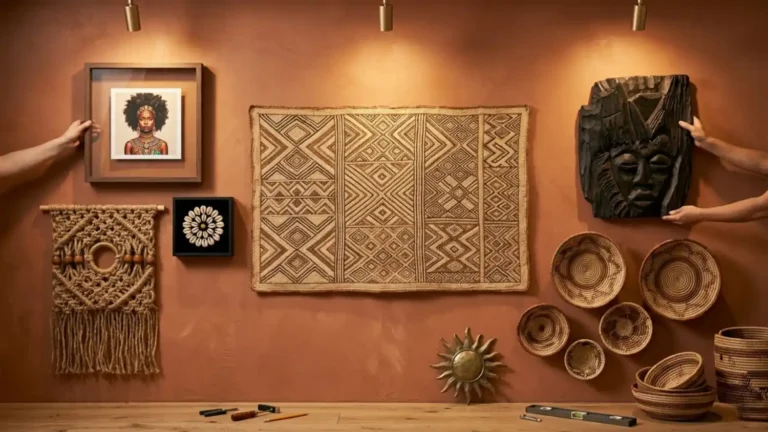
Stand the portrait against the wall at the planned mounting position — upper left of the Kuba cloth anchor — before drilling any holes. Evaluate the scale relationship between the portrait and the anchor from the room’s entry point.
The portrait should read as clearly smaller than the Kuba cloth anchor — the secondary figural piece responding to the primary textile piece rather than competing with it for the gallery’s center. If the portrait reads at the same visual weight as the anchor from the entry point the portrait is either too large or positioned too close to the anchor’s center axis.
The portrait’s warm skin tones, colorful headwrap pigments, and gold jewelry introduce the Vibrant tone palette category at the figural layer — the mustard yellow, emerald, and muted gold within the portrait connecting to the broader palette system and providing the color vibrancy that the Kuba cloth’s earth-tone palette doesn’t.
Fourth Purchase: A Tonga Basket Starter Cluster
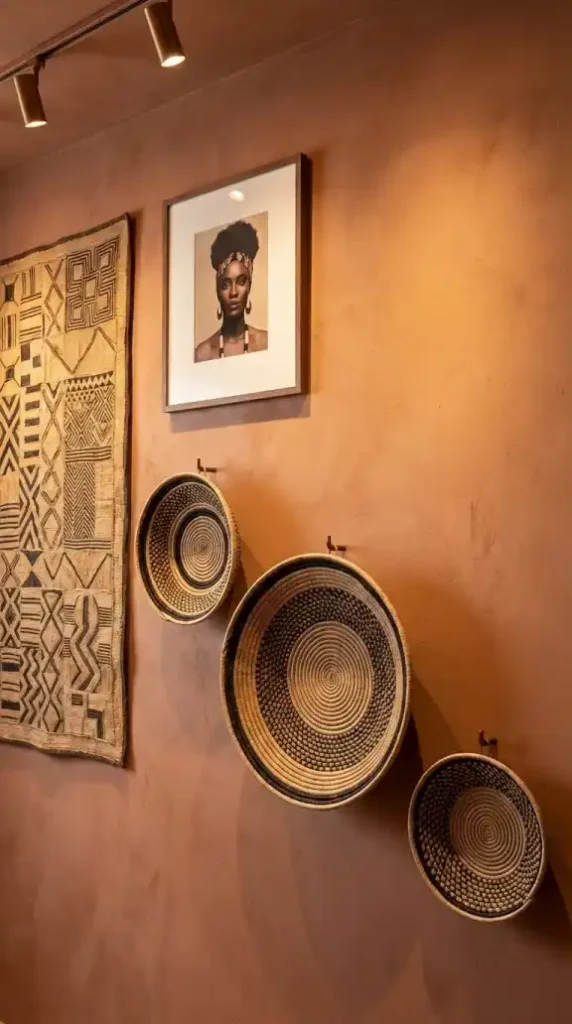
The Tonga basket starter cluster is the third wall purchase — the three-dimensional layer that extends the gallery from the flat wall surface into the room’s physical depth.
Start with three baskets in graduated sizes — one large, one mid, one small — rather than buying the full seven-basket composition immediately.
Three baskets mounted asymmetrically at the lower right of the Kuba cloth anchor creates the gallery’s first three-dimensional element and reveals the correct scale for the full basket composition. Living with three baskets on the wall for two weeks before adding more tells you whether the cluster needs to grow upward, outward, or at a different scale distribution than the initial three-basket arrangement suggests from the floor layout.
Position the three-basket starter cluster at the lower right of the anchor — the diagonal opposite of the Afro Queen portrait at the upper left. The basket cluster’s circular organic forms create the compositional counterweight to the portrait’s rectangular frame through material contrast rather than scale symmetry.
Mount each basket on a small bronze hook — not chrome, not silver. Bronze sits within the warm metallic vocabulary of the gallery’s muted gold and brass accent thread.
The three-dimensional depth of the baskets projecting from the wall surface is the quality that most immediately differentiates the Afro Bohemian gallery from a standard print collection. Even three baskets in a starter cluster create this depth effect — the gallery is already operating across two spatial planes before any subsequent pieces are added.
Fifth Purchase: A Carved Ebony or Mahogany Wood Relief Panel
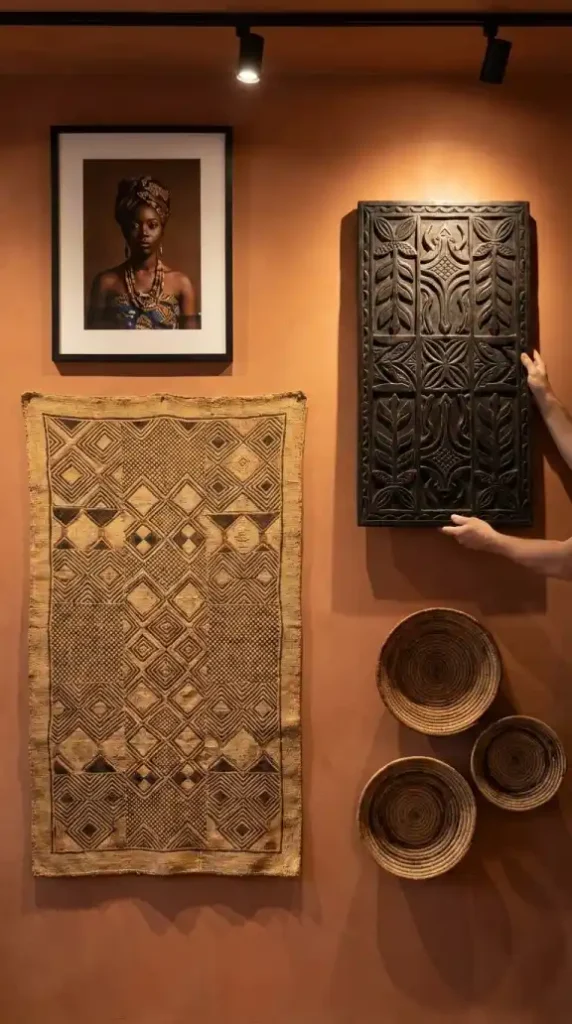
The carved ebony or mahogany wood relief panel is the fourth wall purchase — completing the gallery’s four-point diamond composition at the upper right position and adding the sculptural three-dimensional layer at the formal art scale.
The carved relief surface creates dramatic highlight and shadow variation under 2700K track light — the deep recessed areas reading as near-black shadow and the raised carving edges catching the warm amber light in strong highlight. This light-and-shadow behavior is what makes the carved panel read as sculpture from across the room rather than as a decorative flat piece.
Position it at the gallery’s upper right — the fourth point of the diamond composition with the Kuba cloth anchor at center, the Afro Queen portrait at upper left, and the Tonga basket cluster at lower right.
The four-point diamond structure creates directional movement across the gallery — the eye travels between the four primary elements in a circular pattern rather than reading the gallery as a static rectangular field.
Dark ebony or mahogany — the deep near-black wood tone provides the High Contrast Grounding element at the gallery’s three-dimensional sculptural layer. Against the warm terracotta plaster wall the dark ebony relief creates the strongest value contrast in the gallery composition — anchoring the lower right zone with visual weight equivalent to the Afro Queen portrait’s wide dark wood frame at the upper left.
Sixth Purchase: A Jute or Black Cord Macramé Hanging
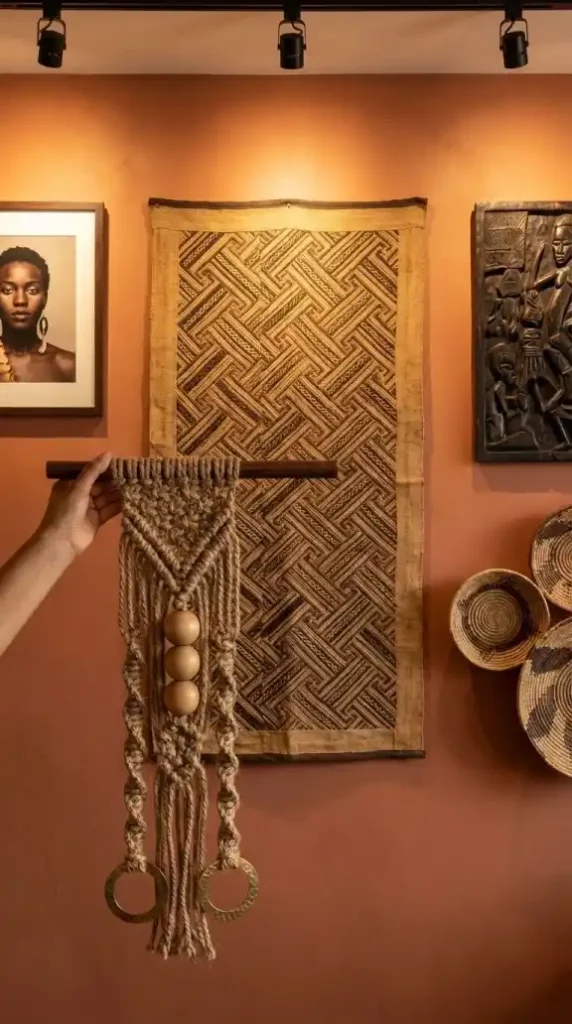
The jute or black cord macramé fiber art hanging completes the gallery’s four-point diamond composition at the lower left outer edge — the fifth primary gallery element that closes the compositional structure and extends the material vocabulary into the fiber art register.
Jute cord in its natural honey-brown tone sits within the Grounded palette category — cohesive with the Kuba cloth raffia surface and the Tonga basket weave within the natural fiber vocabulary.
Black cord macramé delivers the High Contrast component at the fiber art position — the dark cord reading as bold against the warm terracotta plaster wall and echoing the mud cloth’s black and cream colorway at the fiber art medium.
Wooden beads and hammered brass rings incorporated into the knotwork extend the material vocabulary into the macramé piece itself — smooth wood beside rough cord, warm brass beside matte jute. The brass rings connect the macramé to the gallery’s broader metallic accent thread — the celestial sun motif, the thin brass picture frame, the bronze basket hooks.
With the macramé in place the gallery’s five primary elements are all mounted. Step back from the full entry point distance and evaluate the complete five-piece composition before buying any detail accent pieces.
The five primary pieces should read as a complete gallery at this stage — if the composition doesn’t read as resolved from the entry point without the detail accents the primary layer has a scale or positioning problem that adding smaller pieces won’t fix.
Seventh Purchase: A Cowrie Shell and Afro Pick Shadow Box Set
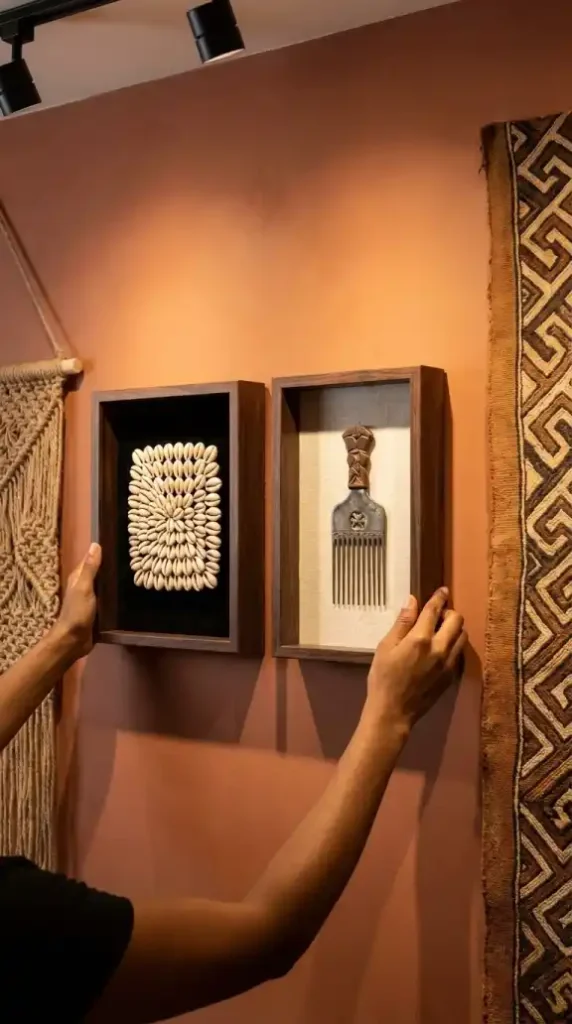
The cowrie shell and Afro pick shadow boxes are the seventh purchase — bought together as the gallery’s cultural artifact detail layer and positioned at the same eye-level zone for close viewing.
Cowrie shells on black velvet backing in a deep dark wood shadow box frame. The cream-white shell surfaces against the deep black velvet deliver the High Contrast palette component at the detail scale — the most intense value contrast in the gallery at its smallest piece scale. The three-dimensional shells cast small shadows onto the velvet beneath them under track light — a depth effect visible only at close inspection range.
A vintage Afro pick with a decorative handle mounted on textured cream fabric backing in a dark wood shadow box frame. The Afro pick as a framed cultural artifact brings the specific symbolism of natural hair celebration into the gallery at the object scale — an everyday object with deep cultural resonance treated with the same museum-bracket intentionality as a ceremonial mask.
Position both shadow boxes at the gallery’s detail zone — between the anchor’s lower edge and the macramé hanging’s upper portion at eye level. The two cultural artifact pieces form a close-range sub-composition: cowrie shells referencing wealth and protection, the Afro pick referencing natural beauty and cultural identity.
These pieces are not visible as primary gallery elements from the entry point. They’re discovered — the gallery’s reward for moving closer. Their cultural significance communicates most fully at the close viewing distance where the cowrie shells’ individual forms and the Afro pick’s decorative handle detail are readable.
Eighth Purchase: A Continuous Line Art Silhouette
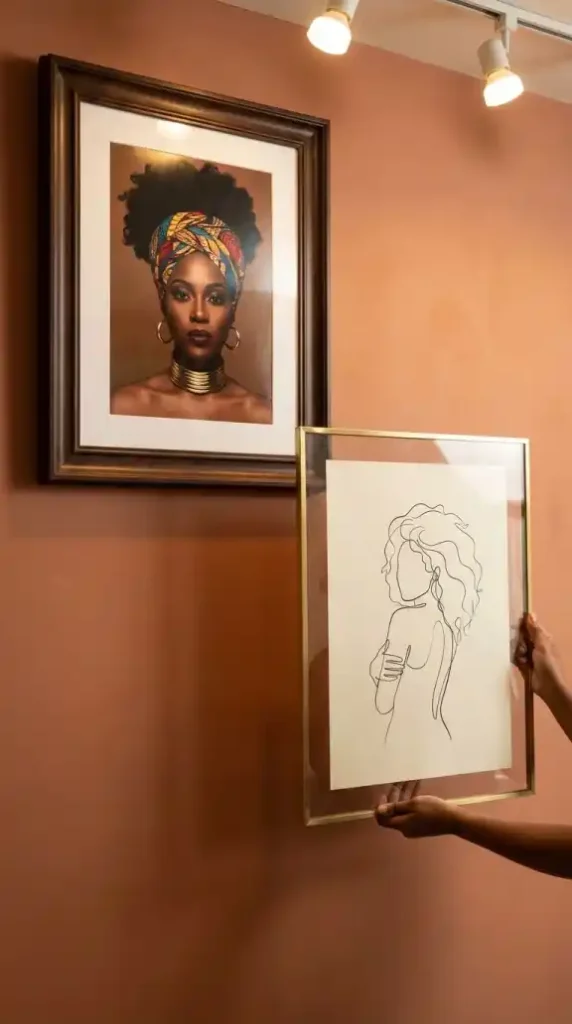
The continuous line art silhouette is the eighth purchase — the second figural piece that completes the gallery’s figural sub-composition at the upper left zone beside the Afro Queen portrait.
A minimalist single-line drawing of a female figure — one unbroken ink line creating an elegant organic silhouette with natural hair movement suggested in the line’s flow — provides the gallery’s visual breathing room at the figural layer.
The clean minimal line art contrasts with the bold colorful complexity of the Afro Queen portrait — giving the eye a rest within the figural zone before moving to the three-dimensional elements on the other side of the gallery.
Thin brass frame rather than a wide dark wood frame — the slim contemporary metal reads as lighter and more contemporary than the portrait’s heavy dark frame, reinforcing the scale and visual weight hierarchy between the two figural pieces.
The charcoal ink on cream ecru paper delivers the High Contrast Neutral component at the figural detail scale — the crisp black line on cream ground echoing the mud cloth’s colorway at the drawing medium rather than the textile medium.
Position it beside and slightly below the Afro Queen portrait — the height difference creating the first asymmetric movement within the figural sub-composition.
Ninth Purchase: Detail Accent Prints and Celestial Motif
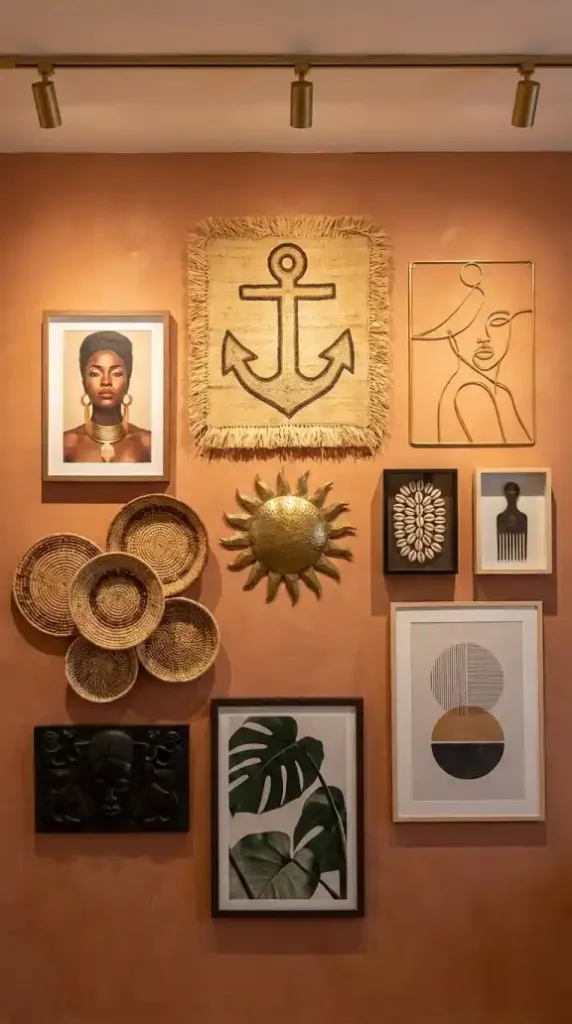
The detail accent prints and celestial motif are the final purchases — completing the gallery’s fourth layer and filling the compositional gaps that the primary five-piece diamond structure revealed when it was evaluated from the entry point.
The hammered muted brass celestial sun wall sculpture fills the compositional gap between the Kuba cloth anchor and the Tonga basket cluster. Its circular form echoes the circular basket forms at a smaller scale. Its muted brass surface connects to the brass ring accents in the macramé and the thin brass frame of the line art silhouette. It functions as a compositional bridge between the primary anchor and the three-dimensional basket layer — not a standalone accent but a linking element.
The abstract geometry scarification print — spirals, triangles, and dot patterns referencing traditional body marking traditions — goes at the detail zone beside the cowrie shell and Afro pick shadow boxes. The three cultural artifact and motif pieces now form the gallery’s close-range sub-composition: cowrie shells, Afro pick, and scarification geometry — all carrying cultural references that communicate most fully at close viewing distance.
The botanical monstera leaf and bird of paradise print on a terracotta background fills any remaining compositional gap at the lower gallery zone — connecting the wall art system to the living plant layer elsewhere in the room and delivering the lush botanical motif at the gallery’s most accessible viewing position.
What to Expand Later — Not Buy First
Three gallery elements that beginners consistently buy too early:
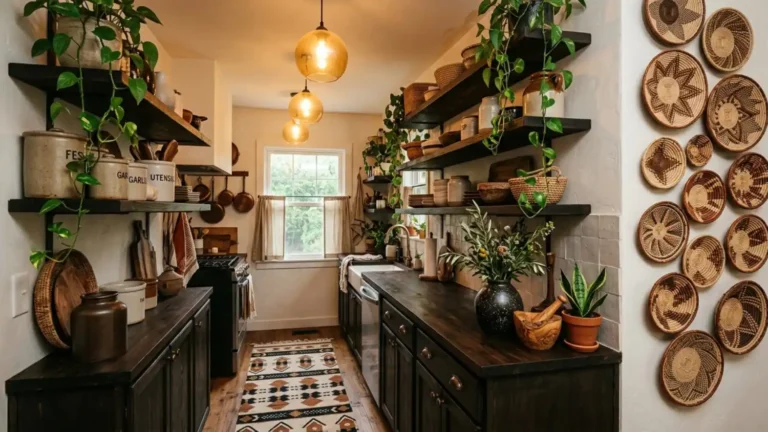
Additional Tonga baskets beyond the starter three.
Buy three baskets first and live with them on the wall before expanding to five or seven. The starter cluster reveals the correct scale distribution for the full composition more accurately than any floor layout or mood board. The additional baskets are chosen in response to the three already mounted rather than as a pre-planned set.
Ankara and Kente print panels.
Both belong in the gallery’s secondary textile layer — but both are chosen in response to the primary Kuba cloth or mud cloth anchor already mounted. Bought before the anchor exists they have no primary textile reference to respond to and will likely be chosen at a scale or colorway that competes rather than complements.
The carved ebony relief panel.
The most expensive single gallery piece on this list — buy it after the five-piece diamond structure is confirmed as correctly scaled and positioned. The relief panel’s dark tone and three-dimensional depth interact with every surrounding piece in the gallery composition. Buying it before those surrounding pieces are in place means choosing it without the reference conditions that determine whether its size, tone, and relief depth are correct for the specific gallery.
The Beginner Buying Sequence at a Glance
Before making any purchase answer these questions:
- What is the primary gallery wall’s width? Measure before buying the Kuba cloth or mud cloth anchor panel. The panel needs to sit at 90cm wide minimum with at least 60cm of clear wall on each side for the adjacent gallery elements to read correctly without crowding the anchor.
- Is 2700K track lighting installed and confirmed as performing correctly on the anchor panel? If the track lighting isn’t in place before the second gallery piece is bought every subsequent scale and color decision is being made under false conditions.
- Has the primary textile anchor been mounted alone on the wall for at least one week? If not the week hasn’t happened yet — delay buying the Afro Queen portrait until after the one-week solo evaluation period. The decisions made from a mounted anchor are consistently more correct than the decisions made from a floor layout.
- Is the primary gallery wall the wall the room’s main seated position faces? If not identify it before buying anything. The gallery wall’s viewing distance from the primary seated position determines the minimum scale of every piece in the gallery — pieces that read correctly at a 4-meter viewing distance may be too small at a 2-meter distance and too large at a 6-meter distance.
- What palette category is currently most underrepresented in the room beyond the gallery wall — Grounded earth tones, Vibrant cultural accents, or High Contrast black and cream? The gallery wall art selections should prioritize the underrepresented category to balance the room’s overall palette distribution rather than doubling down on the category already dominant.
- Is there at least one wall section of at least 30cm width left bare beside the gallery composition? The bare terracotta plaster wall visible beside the gallery is the visual breathing room that makes the gallery’s edges legible as intentional boundaries rather than as space that ran out before more pieces could be added. Plan the bare section into the composition from the first purchase rather than discovering it’s been fully activated by the time the ninth piece is mounted.
Nine pieces. Four layers. One gallery wall building sequence.
The Kuba cloth or mud cloth primary textile panel sets the center axis and primary anchor. The 2700K track lighting reveals it correctly and confirms the conditions under which every subsequent piece will be evaluated. The Afro Queen portrait delivers the figural identity layer at the human scale. The Tonga basket starter cluster introduces the three-dimensional depth that extends the gallery from the flat wall into the room. The carved ebony relief panel completes the four-point diamond composition at the sculptural three-dimensional scale. The jute macramé hanging closes the diamond at the fiber art outer edge position. The cowrie shell and Afro pick shadow boxes deliver the cultural artifact detail layer at close-range viewing distance. The continuous line art silhouette completes the figural sub-composition at the breathing-room scale. The celestial motif, scarification print, and botanical panel complete the detail accent layer and fill the compositional gaps that the primary five-piece structure revealed.
Each piece earns its place by doing something no other piece in the gallery is already doing.
And the gallery earns its place on the wall by reading simultaneously as a composed heritage display from across the room and as a collection of culturally specific objects with individual meaning at close range.
That dual legibility — immediate visual impact from the entry point, deepening cultural discovery up close — is what makes an Afro Bohemian gallery wall the most compelling single surface in the house.
Expand your Afro Bohemian wall art knowledge:
- Afro Bohemian Wall Art: The Complete Guide — Study the full four-layer system behind symbolic textiles, figural imagery, and three-dimensional pieces as a unified cultural and material framework.
- 11 Afro Bohemian Wall Art Ideas for a Warm and Layered Home — Browse 11 specific wall art moves organized by layer, scale, and material register — each one building the conditions for the next.
- How to Style Afro Bohemian Wall Art in Any Room — Walk through every gallery wall decision in the sequence that produces a composed result — from lighting installation to the final detail accent.