11 Afro Bohemian Wall Art Ideas for a Warm and Layered Home
An Afro Bohemian gallery wall is not assembled. It’s built.
The difference is in the sequence. An assembled wall puts objects in positions that look considered. A built wall adds each element in response to what’s already there — so that by the time the gallery is complete every piece is doing something the pieces beside it can’t do.
These 11 ideas follow that building logic. Each one is a specific wall art move at a specific scale and material register — from the symbolic textile panel that anchors the composition to the cowrie shell shadow box that rewards close inspection at the detail level.
Quick Takeaway:
- The symbolic textile panel comes first — Kuba cloth, mud cloth, or Ankara stretched at architectural scale is the gallery’s primary anchor and center axis that everything else organizes around.
- Three-dimensional wall pieces — Tonga baskets, carved wood relief panels, jute macramé — extend the gallery from the flat wall surface into the room’s physical depth and are what most clearly differentiate Afro Bohemian wall art from a standard print gallery.
- The figural layer — Afro Queen portrait, line art silhouette, cowrie shell cultural artifact — is the identity and heritage layer that abstract pattern alone can’t deliver.
1. Anchor the Gallery With a Kuba Cloth Textile Panel
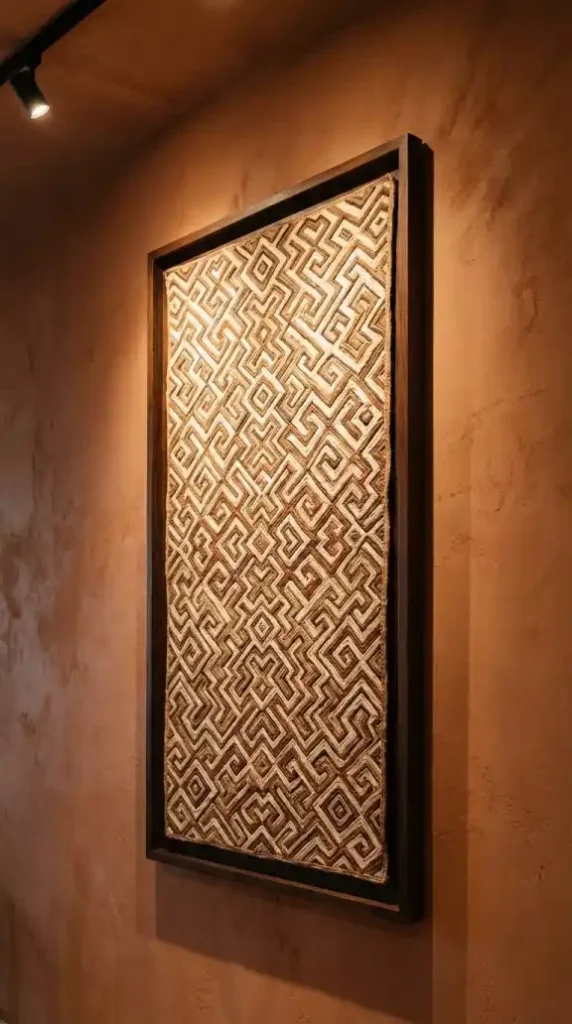
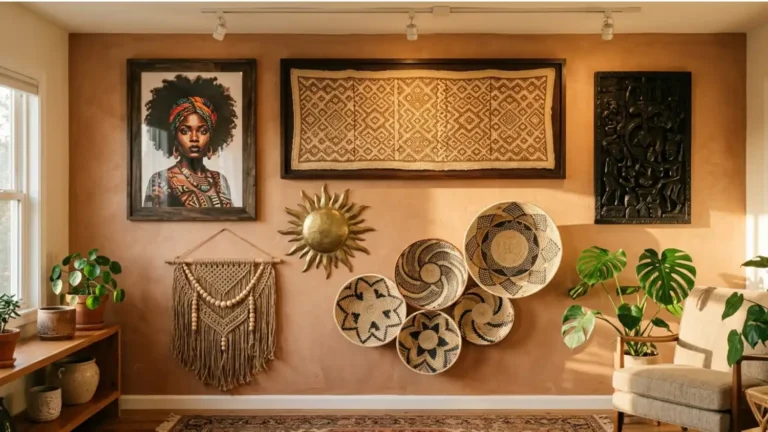
The Kuba cloth textile panel is the gallery’s primary anchor — the largest piece with the most visual weight that sets the center axis everything else organizes around.
Handwoven from raffia palm fibers in the Congo, Kuba cloth carries complex improvisational geometric patterns and a cut-pile velvet-like surface texture that no printed canvas can replicate.
Stretch it on a dark wood frame — 90cm wide minimum — and mount it at the gallery wall’s visual center before adding any other element.
The surface depth of the raffia weave catches warm track light in a way that flat canvas can’t — creating shadow variation across the panel that shifts with the light source angle.
This is the piece the eye enters on when it first encounters the wall.
Everything added to the gallery after it is chosen and positioned in response to its scale, colorway, and geometric pattern register — not independently of it.
2. Hang a Mud Cloth Panel From a Dark Wood Dowel
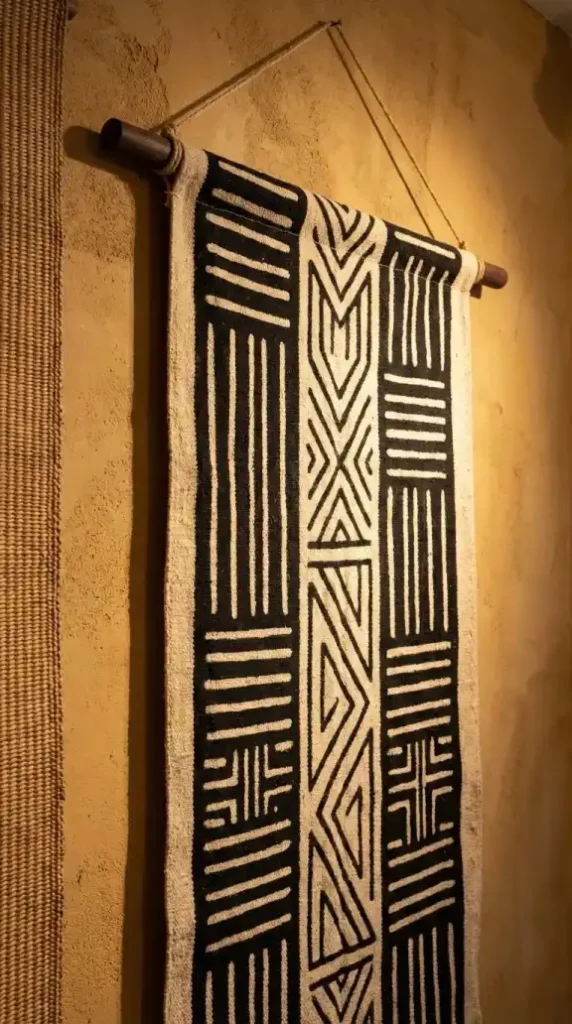
A mud cloth panel hung from a dark wood dowel rod is the gallery’s secondary symbolic textile layer — positioned beside the Kuba cloth anchor at a different geometric scale and visual register.
Bògòlanfini from Mali carries bold linear symbolic patterns in black and cream — the High Contrast Neutral palette component at the gallery’s secondary textile position.
The dowel rod hanging method is intentional — it reads as a textile object rather than a framed art piece, maintaining the material honesty of the fabric rather than containing it behind glass.
The mud cloth’s bold linear geometric patterns sit at a distinctly different scale from the Kuba cloth’s dense interlocking repeat — creating the scale differentiation between the two textile panels that makes each legible at its own viewing distance.
Position the mud cloth panel to one side of the Kuba cloth anchor — not directly above or below, but beside it at a slightly lower or higher height to create the asymmetric movement that keeps the gallery composition dynamic rather than static.
3. Frame an Ankara or Kente Print as a Statement Art Piece
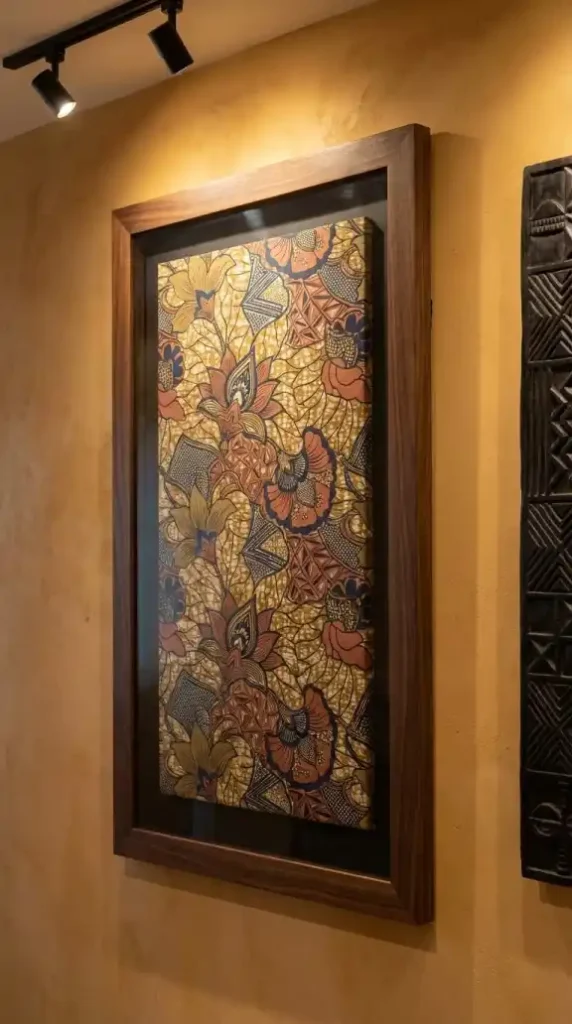
Ankara wax-print fabrics and modern Kente-inspired prints framed under glass as statement art pieces bring the vibrant maximalist side of the Afro Bohemian textile vocabulary to the gallery wall at the primary art scale.
Modern Kente interpretations in muted gold and terracotta translate the structured geometric weaving tradition of Ghana into a wall art format that sits within the earth palette while delivering the Vibrant accent tone category at the gallery level.
Ankara wax-print fabrics in muted gold, terracotta, and abstract floral-geometric patterns introduce the wax-print tradition as a contemporary art medium — the bold pattern behind the glass frame reading as a deliberate art choice rather than a textile application.
Frame these at 60x80cm minimum in a wide dark wood frame — the width of the frame grounding the vibrant pattern in the gallery’s dark wood element vocabulary.
The glass-fronted surface provides the one flat reflective element in an otherwise entirely textural gallery — the contrast between the Ankara print’s smooth glass surface and the rough Kuba cloth panel beside it makes both pieces more legible by material opposition.
4. Hang an Afro Queen Portrait as the Figural Anchor
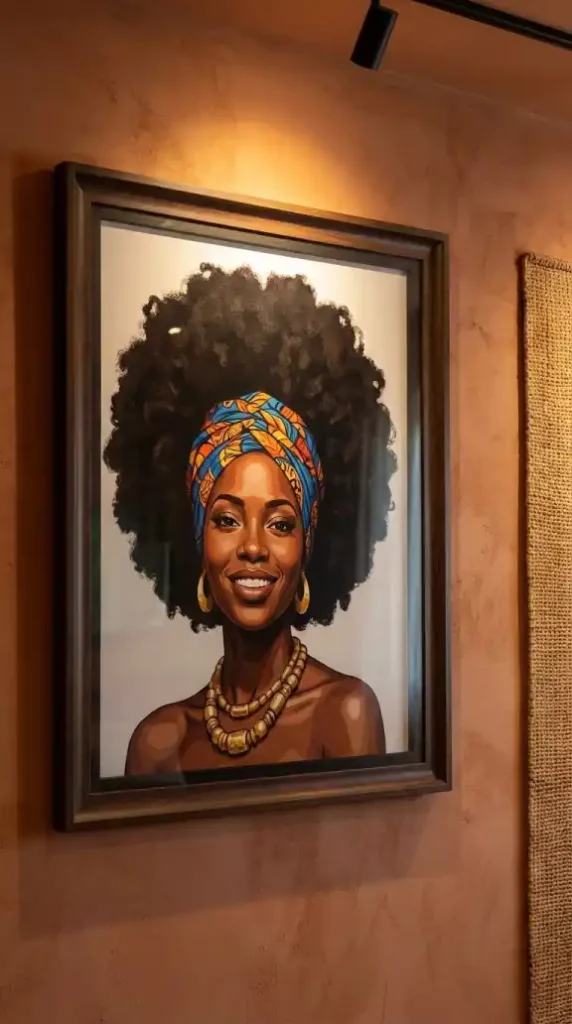
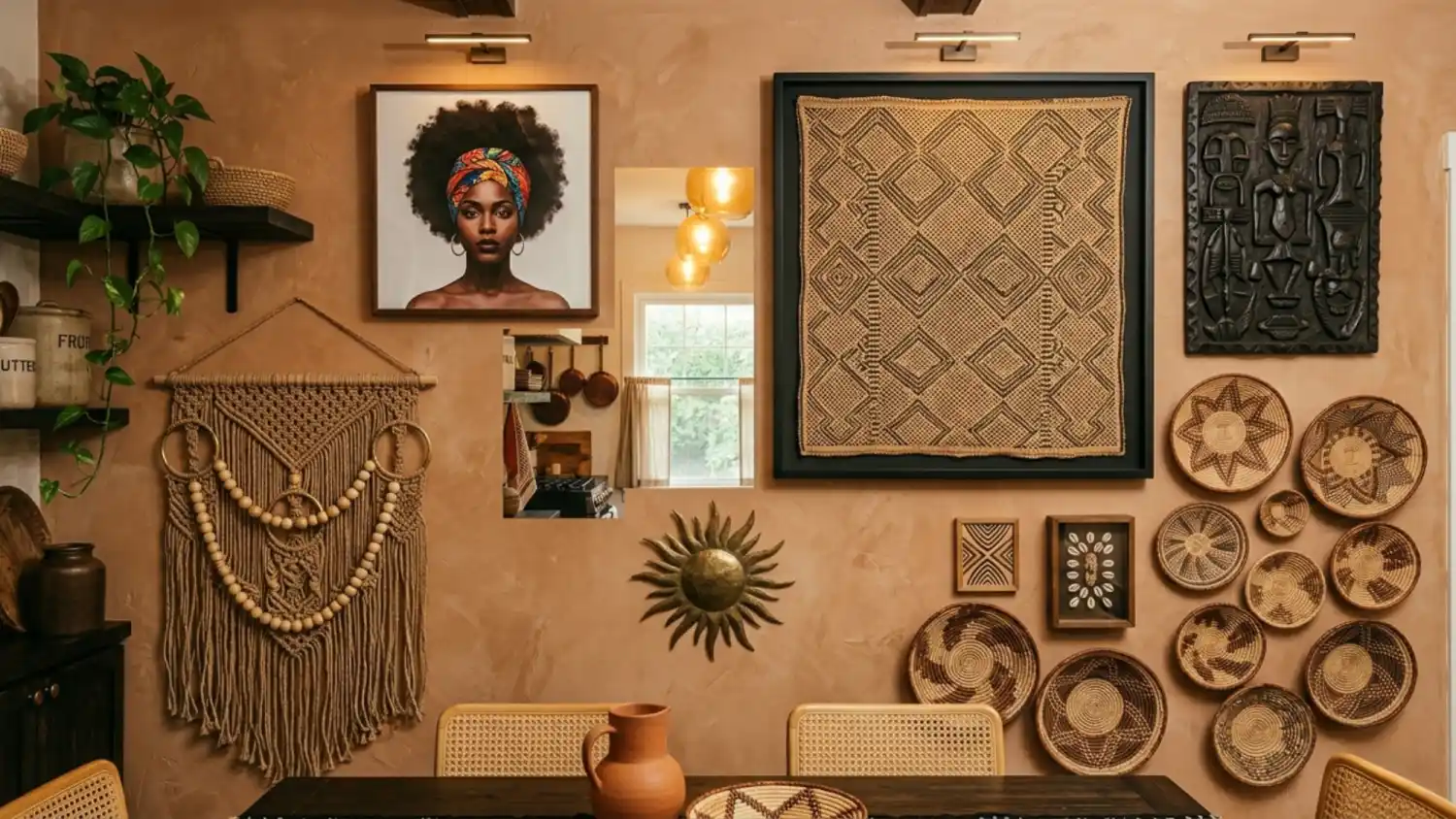
The Afro Queen portrait is the gallery’s identity and heritage layer — the figural piece that anchors the wall’s cultural celebration at the human scale that abstract pattern and decorative motif can’t reach.
Stylized portraits of Black women featuring natural hairstyles — Afros, braids, locs — colorful headwraps, and vibrant jewelry are not decorative prints. They are cultural statements about representation and beauty that carry weight beyond their visual appeal.
Buy large format — 60x80cm minimum in a wide dark wood frame.
The Afro Queen portrait needs to read as a primary gallery element from the room’s entry point. At smaller scales it recedes into the gallery rather than anchoring its figural layer.
Position it at the gallery’s upper left or upper right — not centered, which would create direct competition with the Kuba cloth textile anchor at the gallery’s center axis.
The portrait’s warm skin tones, colorful headwrap pigments, and gold jewelry accents introduce the Vibrant tone palette category at the gallery’s figural layer — mustard yellow, emerald green, and muted gold appearing within the portrait’s color vocabulary and connecting it to the broader palette system.
5. Add a Continuous Line Art Silhouette
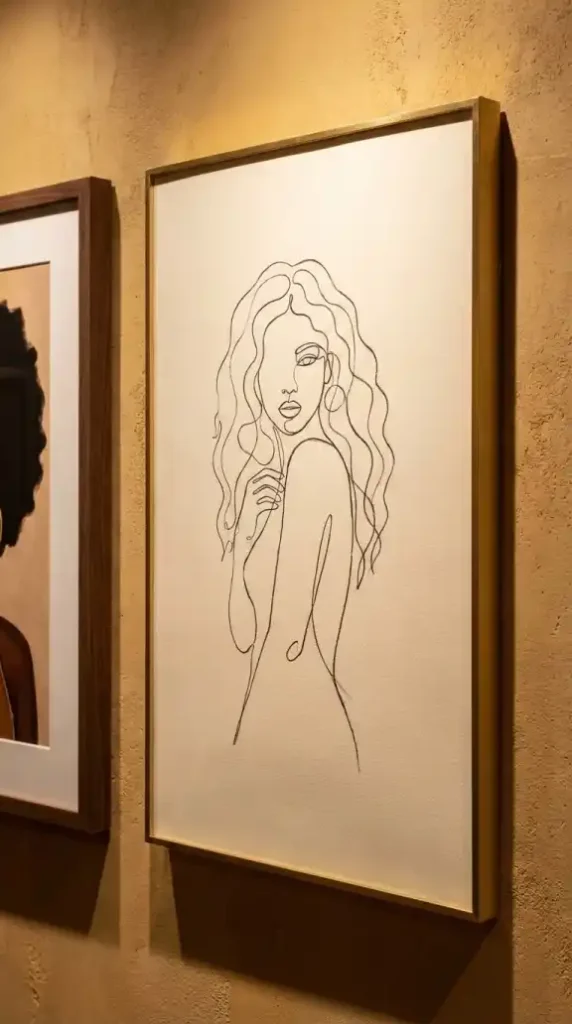
A continuous-line drawing of a female figure — a single unbroken ink line creating an elegant organic silhouette with natural hair suggested in the line’s flow — provides the gallery’s visual breathing room at the figural layer.
The minimalist clean aesthetic of the line art silhouette contrasts with the textural density of the Kuba cloth panel and the Tonga basket cluster — giving the eye a rest within the gallery’s complexity.
Thin brass frame rather than a wide dark wood frame — the slim contemporary metal sits within the gallery’s brass accent thread and reads as lighter and more contemporary than the heavier dark wood frames of the primary textile and portrait pieces.
The High Contrast Neutral palette of charcoal ink on cream ecru paper delivers the black and cream contrast component at the gallery’s secondary figural scale — echoing the mud cloth panel’s colorway at the drawing medium rather than the textile medium.
Position the line art silhouette beside the Afro Queen portrait — the two figural pieces at distinct scales and tonal registers creating a figural sub-composition within the larger gallery arrangement.
6. Build a Tonga Basket Gallery Cluster
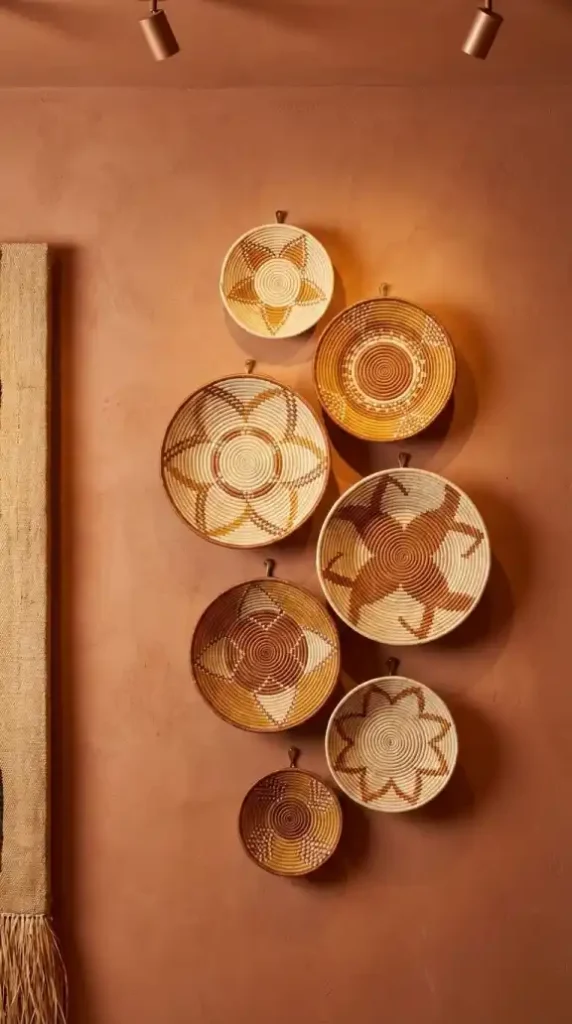
A Tonga or Binga basket gallery cluster is the three-dimensional layer that most immediately differentiates Afro Bohemian wall art from a standard print gallery.
Seven baskets in graduated sizes arranged asymmetrically — not in a grid, not in a straight line, not in a mirror-symmetrical arrangement.
One large anchor basket. Two or three mid-size at varying heights. Two or three smaller at the outer positions.
The circular basket forms break the gallery’s rectangular geometry — introducing organic circular shapes that the eye moves between rather than reading in a single rectangular sweep.
The radial geometric patterns of Tonga baskets carry the same design tradition as the mud cloth panel below at a three-dimensional woven material scale — the geometric vocabulary appearing simultaneously as textile pattern and as woven object form.
Mount each basket on a small bronze hook — not chrome, not silver. Bronze reads as warm metallic and sits within the gallery’s muted gold and brass accent thread.
Position the basket cluster to one side of the Kuba cloth anchor — creating the gallery’s primary asymmetric movement at the three-dimensional textural layer.
7. Mount a Carved Ebony Wood Relief Panel
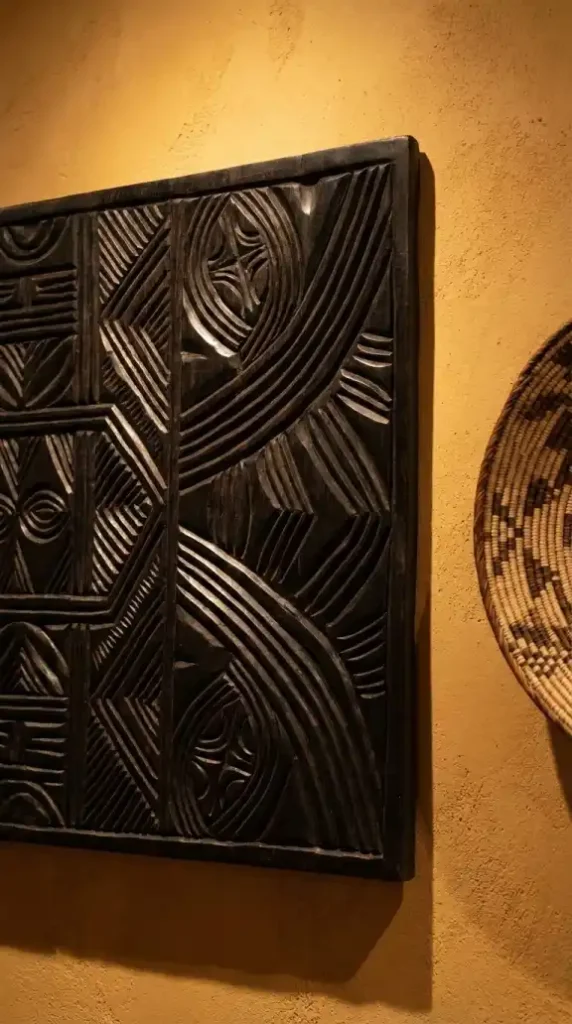
A carved ebony or mahogany wood relief panel brings the ancestral craft tradition to the gallery wall at the three-dimensional sculptural object scale.
The carved surface — geometric motifs, organic forms, relief depth — creates a wall piece that the warm track light reads as sculpture rather than decoration. Deep highlight at the raised carving edges. Deep shadow in the recessed areas. The light and shadow variation shifts with the track light angle — the panel reading differently at midday versus 7pm versus candlelight.
Dark ebony or mahogany provides the High Contrast Grounding element at the gallery’s three-dimensional layer — the deep near-black wood against the warm terracotta plaster wall creating the strongest value contrast in the gallery composition.
Position it at the gallery’s upper right — creating the compositional balance to the Afro Queen portrait at the upper left through material contrast rather than symmetry. Two distinct three-dimensional objects at the gallery’s upper zones on opposing sides of the Kuba cloth anchor.
8. Hang a Jute or Black Cord Macramé Fiber Art Piece
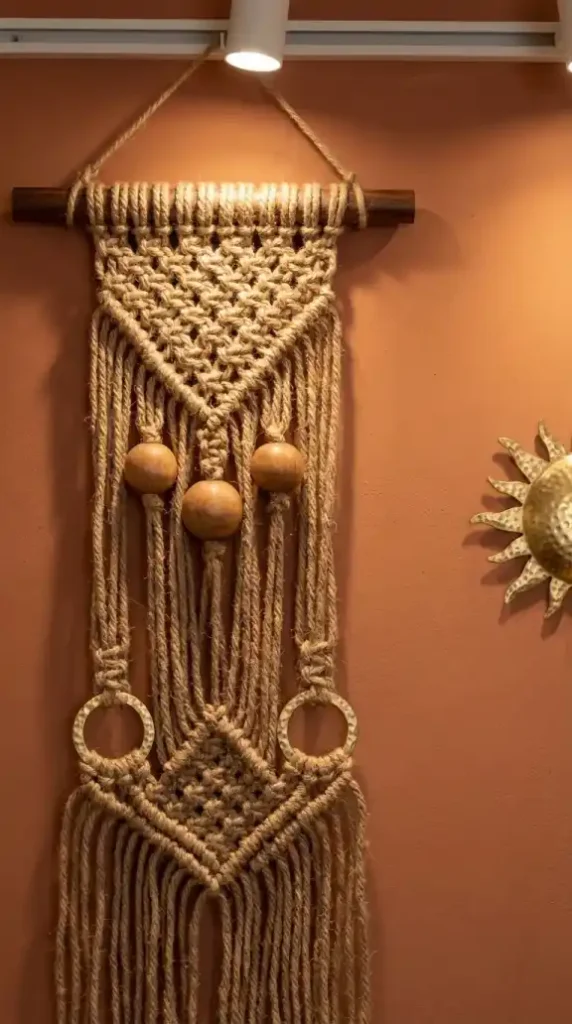
A jute or black cord macramé fiber art hanging — updated from standard boho macramé with dark-toned cords, wooden beads, and brass ring accents — brings the fiber art tradition to the Afro Bohemian gallery at the outer edge textural position.
Jute cord in its natural honey-brown tone sits within the Grounded palette category — its rough twisted fiber surface reading as cohesive with the Tonga basket weave and the Kuba cloth raffia surface elsewhere in the gallery.
Black cord macramé delivers the High Contrast component at the fiber art position — the dark cord creating the bold graphic quality against the warm plaster wall that the ebony wood relief delivers at the sculptural position.
Wooden beads and hammered brass rings incorporated into the knotwork extend the material vocabulary of the gallery into the fiber art medium — smooth wood beside rough cord, warm brass beside matte jute.
Position the macramé hanging at the gallery’s lower outer edge — the piece that completes the gallery composition at its widest point and lowest visual zone.
9. Place a Muted Gold Celestial Motif
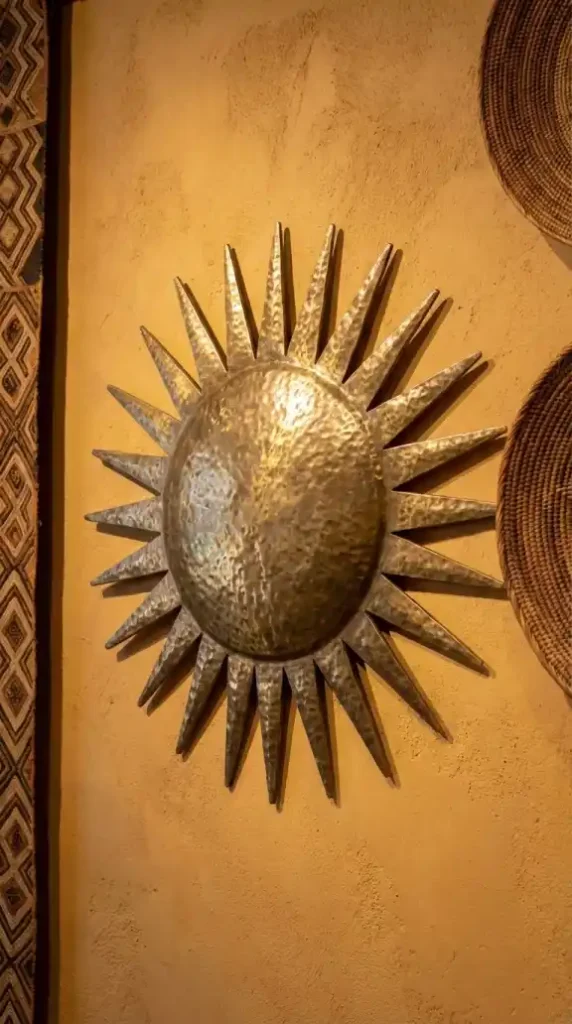
A muted gold or hammered brass celestial sun or crescent moon wall sculpture provides the gallery’s celestial motif layer at the detail accent scale.
Celestial symbols in warm gold and muted brass rather than bright white or silver — the sun rendered in oxidized hammered brass, the crescent moon in aged warm gold — sit firmly within the Vibrant and Grounded palette categories rather than the cool-toned palette register of conventional celestial wall decor.
The hammered brass surface catches warm 2700K track light in multiple small shifting highlight points — the same living metallic quality that makes hammered brass hardware and desk lamps perform in other rooms.
Position the celestial motif piece between two primary gallery elements — in the compositional gap between the Kuba cloth anchor and the basket cluster, or between the Afro Queen portrait and the line art silhouette.
Its smaller scale fills the gap without creating another primary focal element — it reads as the gallery’s compositional bridge rather than a competing anchor.
10. Mount a Cowrie Shell Cultural Artifact Shadow Box
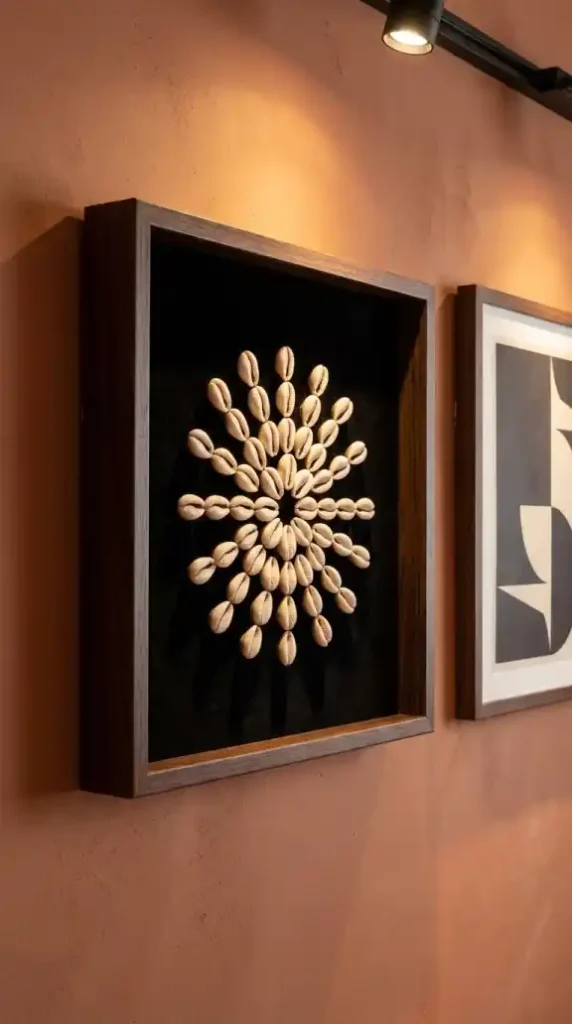
A cowrie shell shadow box is the gallery’s most culturally specific detail accent — the piece that rewards close inspection with centuries of symbolic weight.
Cowrie shells carry deep meaning across West and Central African cultures — associations with wealth, fertility, protection, and spiritual connection that make them among the most symbolically loaded objects in the Afro Bohemian cultural vocabulary.
Arranged in an organic radial pattern on black velvet backing inside a deep dark wood shadow box frame the cowrie shells read simultaneously as natural objects, cultural artifacts, and three-dimensional art pieces.
The black velvet backing delivers the High Contrast Neutral component at the detail scale — the cream-white shells reading as dramatically luminous against the deep black velvet.
The three-dimensional shells cast small shadows onto the velvet beneath them under warm track light — a subtle depth effect that no flat print can produce.
Position the cowrie shell shadow box at the gallery’s detail zone — at eye level for close viewing, beside the line art silhouette or below the Afro Queen portrait — where its cultural specificity can be read at the intimate distance it requires.
11. Add an Abstract Geometry Scarification Print
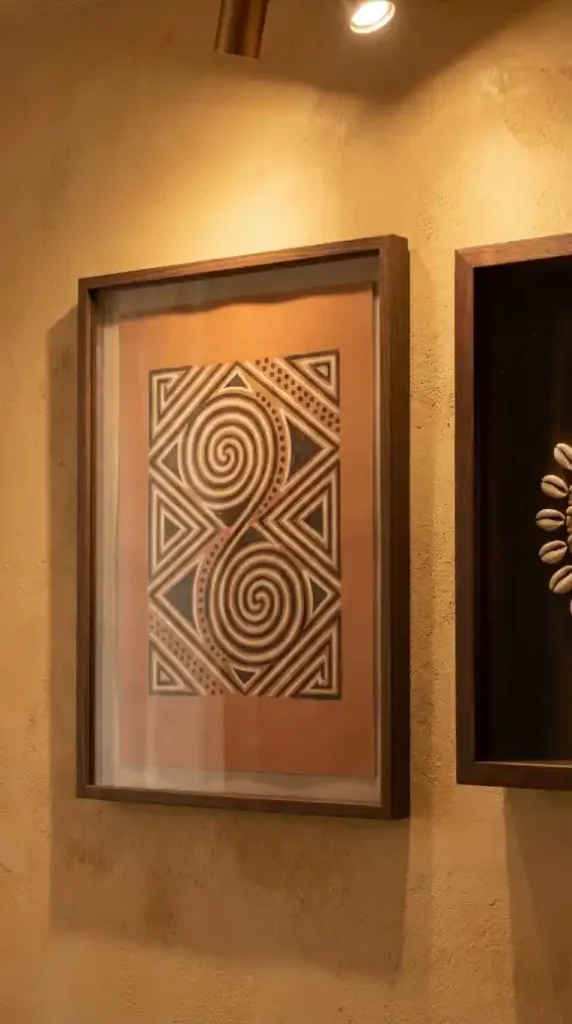
An abstract geometry print featuring spirals, triangles, and dot patterns referencing traditional scarification markings or tribal body art traditions brings the body marking vocabulary into the gallery at the detail print scale.
Rendered in charcoal and cream on a warm terracotta paper background these abstract geometry prints sit across both the High Contrast Neutral and Foundation Earth Tone palette categories — the charcoal and cream providing the contrast component, the terracotta background providing the grounding component.
The cultural reference — scarification patterns as a visual language with specific meaning within African body art traditions — adds the depth of cultural specificity at the gallery’s smallest scale.
Position it at the gallery’s detail zone beside the cowrie shell shadow box — the two detail-scale pieces with the highest cultural specificity forming a sub-composition at the gallery’s most intimate viewing position.
Arranging Your Afro Bohemian Gallery Wall: The Layout Logic
Before hanging anything answer these questions about the wall and the pieces you’ve collected:
- Is the largest piece — the Kuba cloth or mud cloth textile panel — at least 90cm wide? If not it will be overwhelmed by the surrounding three-dimensional elements and lose its anchor status. Scale up the primary textile panel before adding any adjacent pieces.
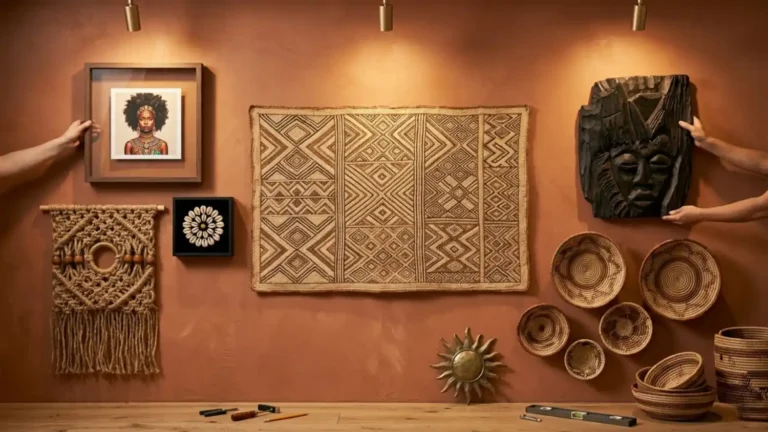
- Have you laid the full composition on the floor before marking the wall? Floor layout is the step most beginners skip and the one that most consistently produces wrong spacing and scale relationships on the wall. Every piece goes on the floor first.
- Is there at least one three-dimensional piece extending from the wall surface? If every gallery piece is flat-mounted behind glass the three-dimensional layer is absent. Add a Tonga basket cluster, a carved wood relief panel, or a macramé hanging before adding any more flat framed pieces.
- Is the figural layer — Afro Queen portrait, line art silhouette, cowrie shell shadow box — present in the composition? If every gallery piece is abstract pattern or decorative motif the identity and heritage layer is absent from the wall art system.
- Is the arrangement genuinely asymmetric? Stand at the entry point and close one eye. Does the composition feel balanced through material contrast and scale variation rather than through mirror symmetry? If it reads as symmetrical the arrangement needs to be disrupted at its most balanced point.
- Are all three palette categories represented — Grounded earth tones in the textile panels and carved wood, Vibrant accents in the portrait and Ankara print, High Contrast black and cream in the mud cloth and line art silhouette? The absent palette category is the next addition to the gallery regardless of what pieces are already present.
An Afro Bohemian gallery wall performs at its fullest when all four layers are operating simultaneously.
The symbolic textile anchor — Kuba cloth, mud cloth, Ankara — at architectural scale. The figural imagery — Afro Queen portrait, line art silhouette, cowrie shell shadow box — at the identity and heritage scale. The three-dimensional textural elements — Tonga baskets, carved ebony relief, jute macramé — extending the gallery into the room’s physical depth. The detail accents — celestial brass motif, abstract geometry scarification print — rewarding close inspection with cultural specificity at the smallest scale.
That four-layer composition across three palette categories and four distinct material registers is what makes an Afro Bohemian gallery wall the most visually compelling surface in the house — and the one that reads differently at every viewing distance from across the room to up close.
Dig deeper into the Afro Bohemian gallery wall:
- Afro Bohemian Wall Art: The Complete Guide — Understand the full four-layer system behind symbolic textiles, figural imagery, and three-dimensional pieces as a unified cultural and material framework.
- How to Style Afro Bohemian Wall Art in Any Room — Follow the complete ten-step sequence from lighting installation to the final detail accent in the exact order that makes every placement decision easier than the last.
- Afro Bohemian Wall Art Must-Haves for Beginners — Get the exact pieces and mounting sequence for building your first gallery wall — from the basket cluster anchor to the macro photography layer.