Afro Bohemian Kitchen Decor Must-Haves for Beginners
The kitchen is the hardest room in the house to start with.
No textiles on the walls. No layered rugs on the floor. No mud cloth throws over the furniture. Every other room in the house gets the full Afro Bohemian toolkit — the kitchen gets a constrained version and has to work harder with less.
But the constraint has a structure. And the structure has a sequence.
This list gives you both — the specific pieces that make an Afro Bohemian kitchen work, organized into the palette logic that holds them together across every surface.
Quick Takeaway:
- The 60-30-10 rule is your palette framework — 60% earthy neutrals, 30% organic textures, 10% high-contrast accent. Buy in that ratio and the kitchen holds together without effort.
- Textiles enter the kitchen at two positions only — the floor runner and the window treatment. Both should be hand-woven and pattern-forward.
- Greenery is structural in this aesthetic, not decorative — Snake Plants, trailing Pothos, and a Bird of Paradise each occupy a specific spatial zone and do specific visual work.
The Palette Framework: 60-30-10 Before You Buy Anything
Before buying a single piece, set the palette distribution.
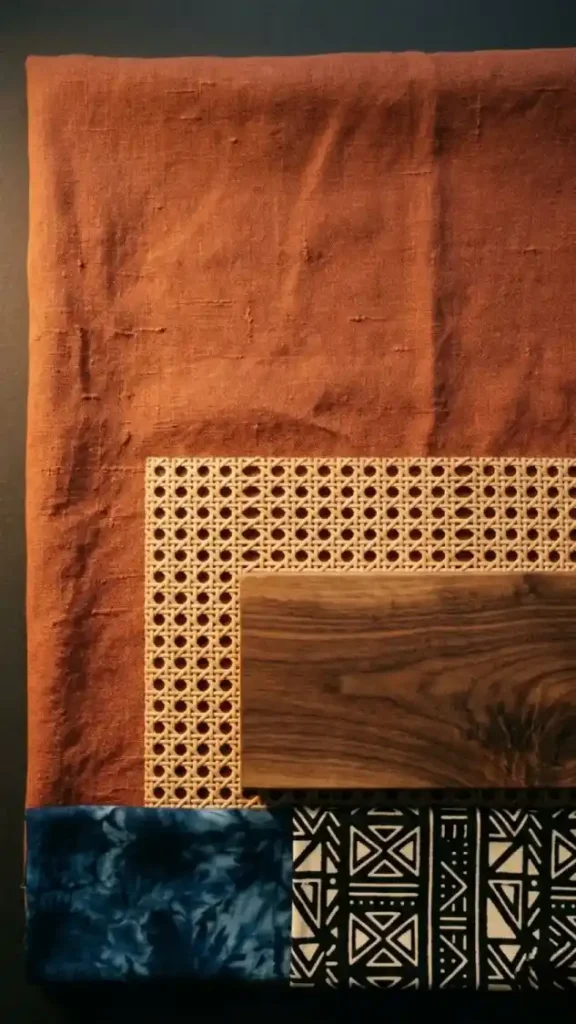
60% earthy neutrals — terracotta, warm sand, charcoal, and cream. These are your wall tone, your cabinet finish, your countertop, your floor surface. The largest surfaces in the kitchen.
30% organic textures — wood, rattan, jute, natural fiber, and greenery. These are your open shelving, your bar stools, your runner, your plants. The mid-layer surfaces and objects.
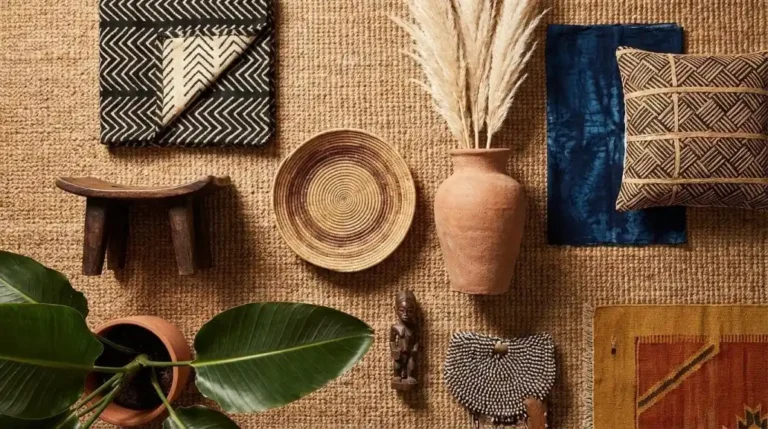
10% high-contrast accents — bold black-and-cream mud cloth pattern, deep indigo batik, hammered brass. These are your textiles, your hardware, your statement objects. The smallest surface area with the highest visual impact.
Every purchase on this list sits in one of those three categories.
Buy in that ratio and the kitchen assembles itself into coherence.
Buy outside it — too much pattern, too many metallics, not enough neutral surface — and no amount of individual piece quality will hold the room together.
First Purchase: A Mud Cloth Table Runner or Seat Cushions
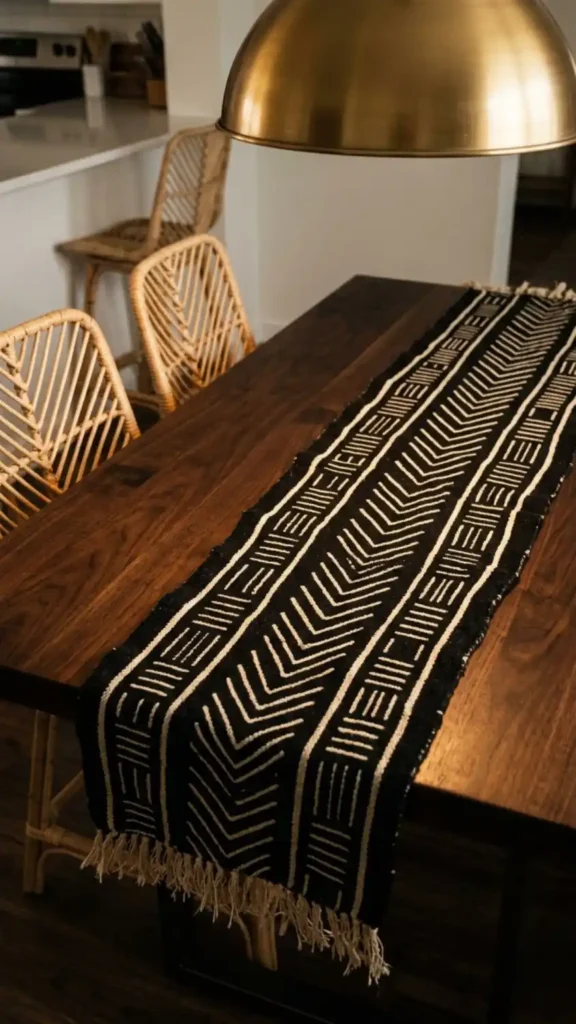
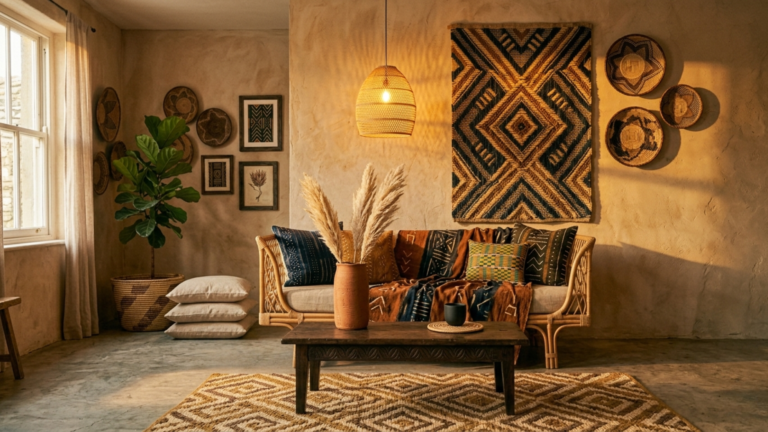
Mud cloth — Bògòlanfini from Mali — is the kitchen’s primary pattern textile.
In the kitchen it can’t go on the walls or the floor at the cooking zone. But it works at the dining surface and the seating position.
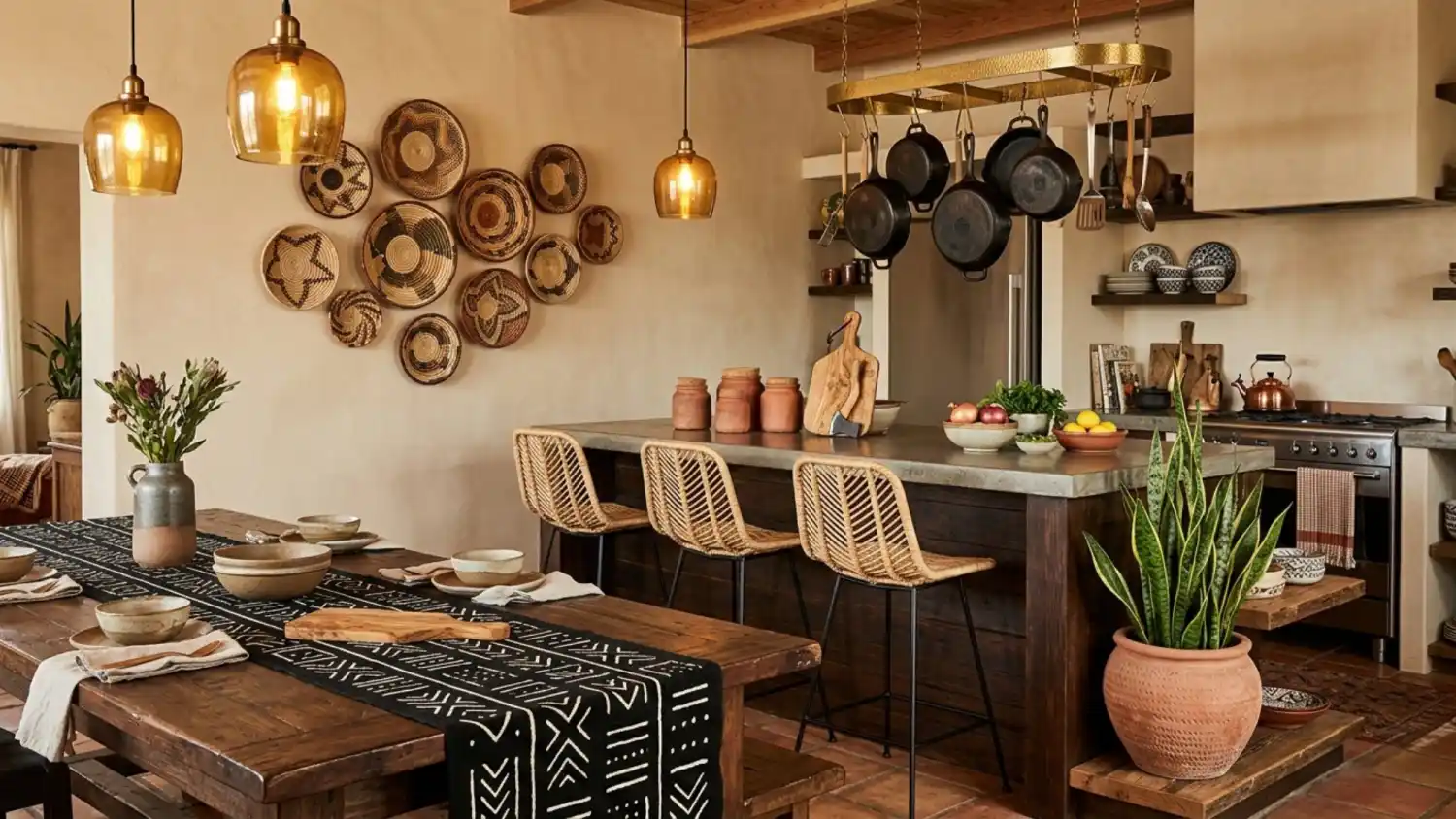
A mud cloth table runner in black, cream, and rust geometric pattern introduces the high-contrast accent layer — the 10% — at the dining surface. It’s the piece that signals the aesthetic immediately and sets the pattern standard everything else responds to.
Mud cloth seat cushions on bar stools extend the textile layer into the seating zone without creating a maintenance problem at the cooking area.
Buy the runner before the cushions if budget allows only one.
The table runner has more surface area and therefore more visual weight — it anchors the dining zone more powerfully and gives you a clearer pattern reference for every subsequent textile decision.
Second Purchase: A Tonga or Binga Basket Wall Cluster
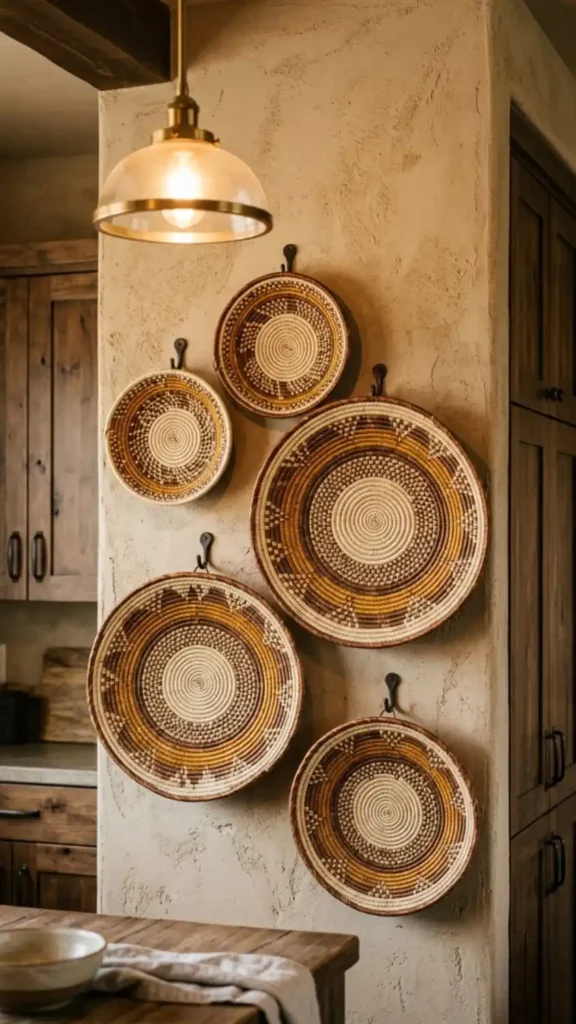
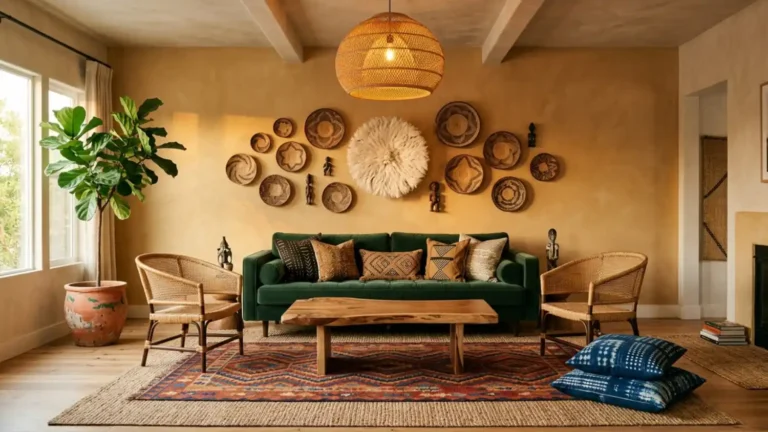
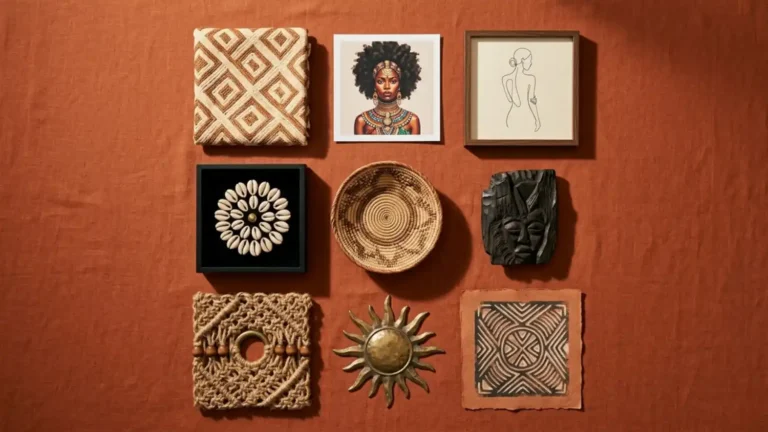
The basket wall cluster is the kitchen’s primary wall element — the piece that breaks up the linear geometry of cabinet rows with circular form and radial pattern.
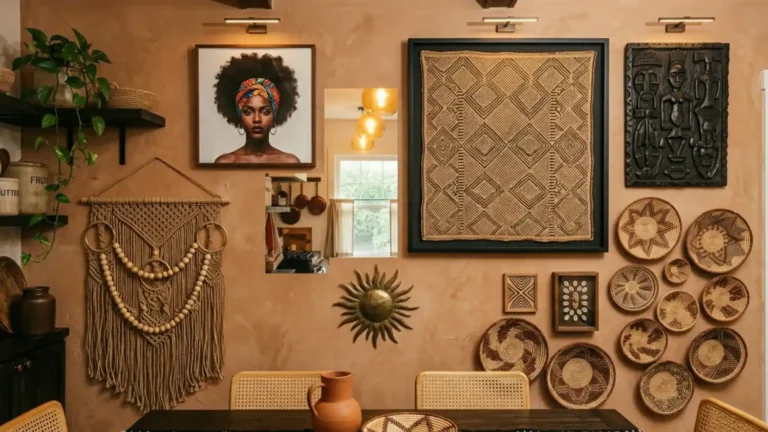
Tonga baskets from Zimbabwe carry geometric patterns in cream, ochre, and warm brown that sit directly within the earth palette. Binga baskets offer tighter, more intricate radial patterns at a smaller scale.
Buy five baskets in graduated sizes for a statement cluster, or three for a more restrained grouping.
Arrange them asymmetrically — not in a grid.
One large anchor basket, two or three mid-size, one small at the edge. The asymmetric arrangement creates visual movement. A grid arrangement creates order — and order is the wrong register for this aesthetic.
Position the cluster near the dining nook where it creates a focal point for the social zone of the kitchen rather than competing with the functional work zone.
Third Purchase: Rattan or Cane Bar Stools
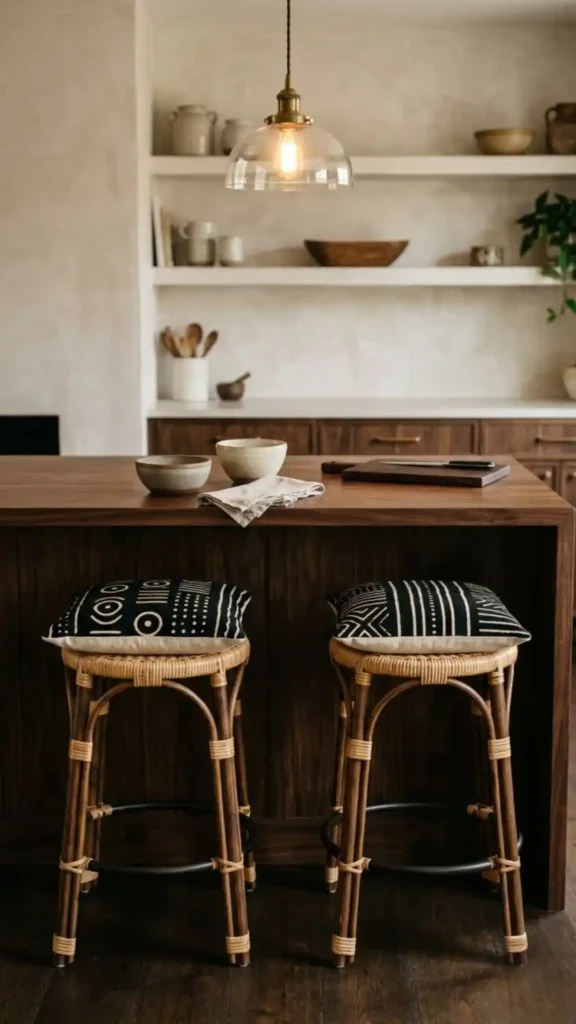
Rattan and cane bar stools do something solid-seat stools can’t — they keep the kitchen feeling airy while adding the natural fiber vocabulary at the seating level.
The see-through quality of cane weave means the stools don’t block the floor plane visually the way solid wood or upholstered stools do. This matters in a kitchen where the floor is already carrying a jute or sisal runner and the visual weight needs to stay light at the seating level.
Pair them with mud cloth seat cushions to connect the stool to the textile layer already established by the runner. Natural rattan finish — not painted, not lacquered — keeps the organic material identity intact.
A painted rattan stool loses the material honesty that makes it earn its place in the 30% organic texture layer.
Fourth Purchase: A Jute or Sisal Kitchen Runner
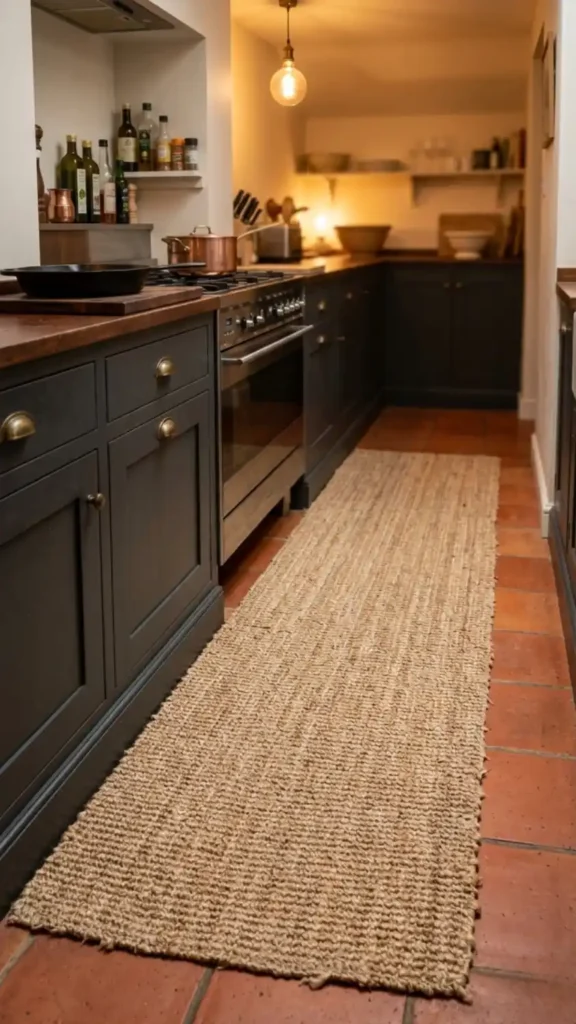
Jute and sisal runners are the correct floor textile for the kitchen cooking zone — not mud cloth, not a wool rug.
They handle kitchen foot traffic without the maintenance issues that woven wool or cotton creates near a cooking surface. The natural fiber weave reads as materially cohesive with the basket wall and the rattan stools without requiring the same level of care.
A jute runner in the galley area — running the length of the primary work counter — grounds the cooking zone with the organic texture layer while the mud cloth runner handles the dining zone.
Two distinct runners, two distinct material characters, two distinct zones.
The jute handles the functional zone practically. The mud cloth handles the social zone expressively. Each runner is correct for its position.
Fifth Purchase: Terracotta and Clay Kitchen Objects
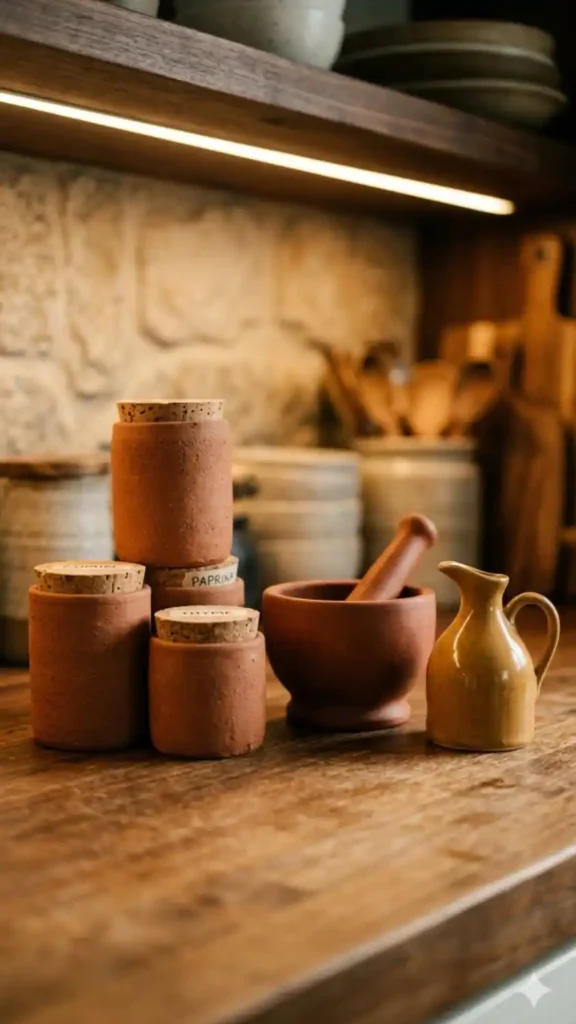
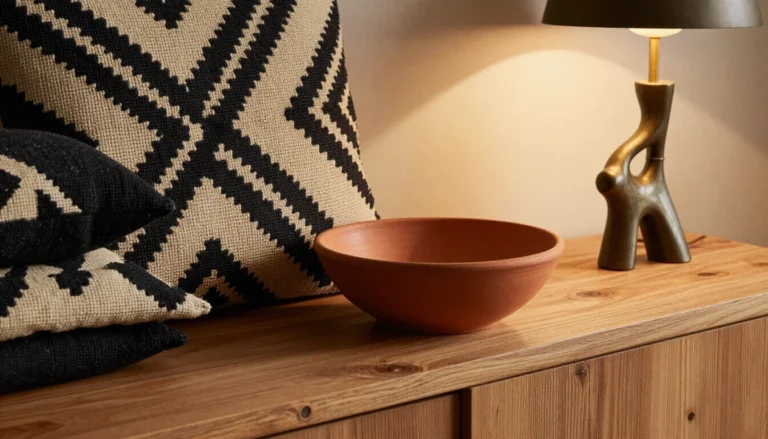
Terracotta and clay objects are the kitchen’s primary contribution to the 60% earthy neutral layer at the object scale.
Matte terracotta spice jars with cork lids at varying heights replace plastic or uniform glass containers with objects that carry material identity.
They’re functional and visually correct simultaneously — the highest standard for any kitchen object in this aesthetic.
A clay mortar and pestle in burnt sienna or ochre adds the rough surface texture that the smoother spice jars don’t provide.
The material contrast within a single counter vignette — rough clay mortar beside smooth terracotta spice jars beside a slightly glossed ceramic oil pourer — creates the three-surface-type composition that makes a grouping read as curated rather than collected.
Sixth Purchase: Olive Wood and Ebony Wood Kitchen Tools
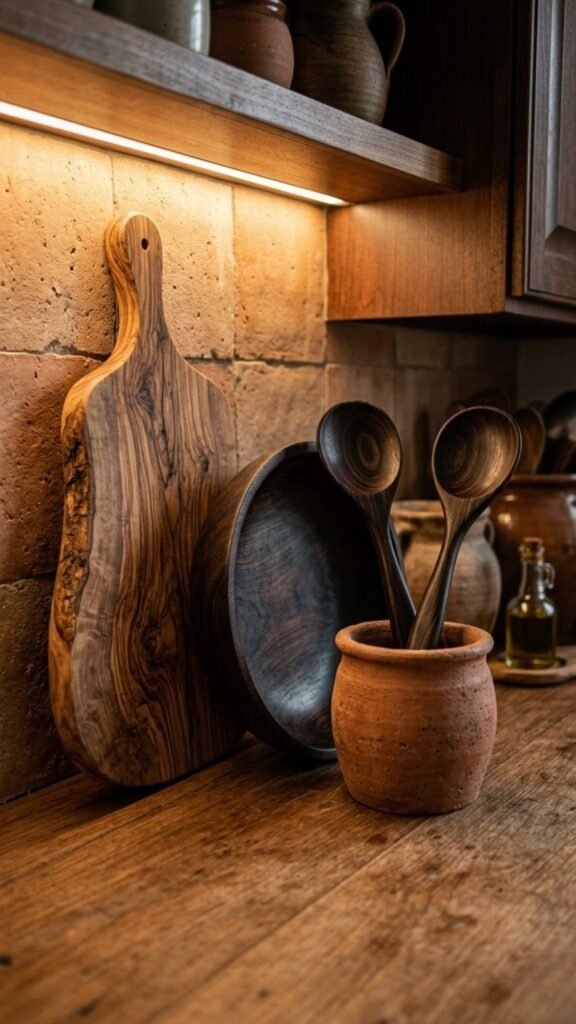
Dark-toned woods — olive wood and ebony — are the kitchen’s primary contribution to the organic texture layer at the tool and board scale.
An organic-edge olive wood cutting board leaned against the backsplash reads as both functional object and sculptural element — the irregular natural edge is what distinguishes it from a standard kitchen board.
An ebony or deep-toned dark wood salad bowl with visible grain variation adds the dark value anchor at the counter level that the palette needs.
Large dark wood serving spoons and ladles displayed in a terracotta vessel extend the functional object layer into the utensil position — every object visible, every object used.
Buy the cutting board first.
It has the largest surface area of the wood objects, makes the most visual impact at counter level, and establishes the dark wood standard that the bowl and utensils respond to.
Seventh Purchase: Hammered Brass or Copper Accents
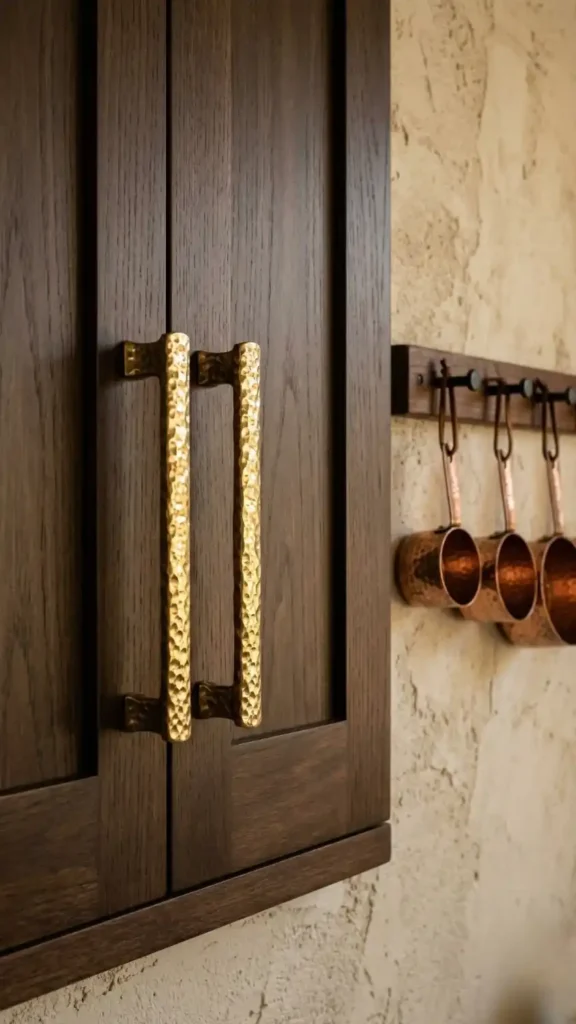
Hammered brass and copper sit in the 10% high-contrast accent layer — the metallic element that adds warmth and regal reference without tipping into decorative excess.
Hammered finish is the critical distinction. Smooth polished brass reads as contemporary hardware. Hammered brass reads as hand-worked metal — a craft object that references African metalwork traditions.
The hammered surface creates multiple small light-catch points that shift as the viewing angle changes — a living surface quality that smooth metal eliminates.
Cabinet hardware in hammered brass is the most accessible entry point.
A hanging copper pot rack — if the kitchen ceiling structure allows it — moves the hammered metallic into the overhead zone where it reflects warm pendant light downward onto the cooking surface.
Both work within the 10% accent allocation without tipping the metallic presence into dominance.
Eighth Purchase: A Calabash Gourd or Hand-Painted Ceramic Plates
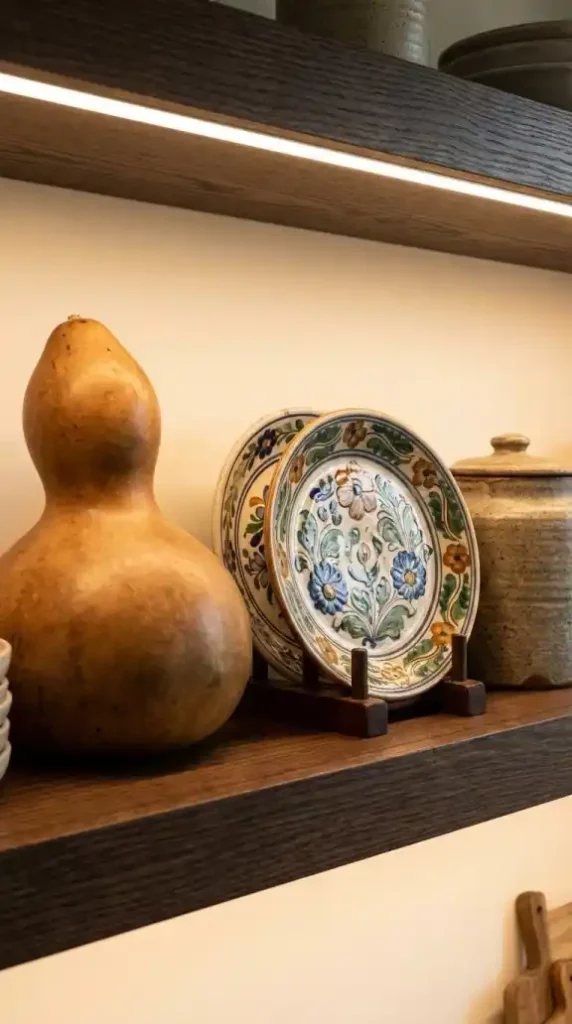
The heritage object layer — the items that carry cultural reference beyond their function — is what separates an Afro Bohemian kitchen from a well-styled earth-tone kitchen.
A dried calabash gourd displayed on an open shelf reads as a functional heritage object — gourds have been used as vessels, musical instruments, and containers across Sub-Saharan Africa for centuries. Displayed in a modern kitchen, it carries that history without requiring explanation.
Hand-painted ceramic plates displayed upright in a dark wood plate stand extend the heritage layer into the ceramic category — functional objects elevated to display status by the intentionality of their presentation.
These are the objects that make a visitor ask where they came from — and the answer is the point.
They sit at the intersection of function and cultural artifact, which is exactly where the Afro Bohemian aesthetic lives.
Ninth Purchase: Statement Greenery in the Right Positions
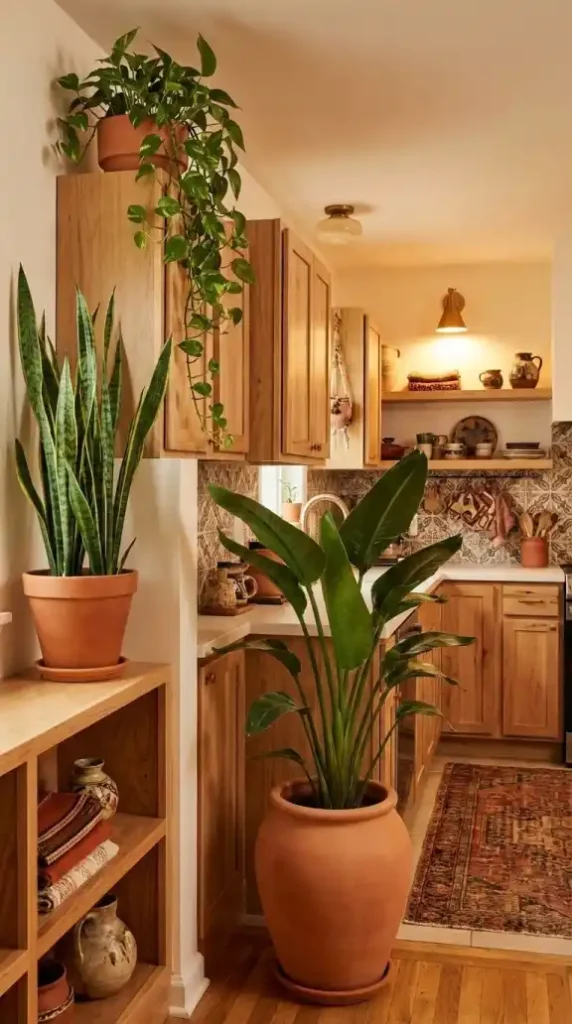
Greenery in the Afro Bohemian kitchen isn’t decoration — it’s structural.
Each plant occupies a specific spatial zone and does specific visual work that no object can replicate.
Snake Plant (Sansevieria) on the lower shelf or counter: strong vertical lines, low maintenance, native to West Africa. Its upright form creates height variation at the shelf level without consuming floor space.
Trailing Pothos or Heartleaf Philodendron at the highest shelf: cascading vines that fill the dead zone above the upper cabinets and draw the eye upward. The trailing habit does the vertical space work passively — it grows into the position over time rather than requiring styling.
Bird of Paradise at the kitchen entry corner: if floor space allows, its broad tropical leaf silhouette creates a dramatic threshold element that signals the aesthetic before the rest of the kitchen is even fully visible.
Buy the Snake Plant first — it’s the most kitchen-compatible, the most materially connected to the West African design tradition, and the most forgiving in variable light conditions.
Tenth Purchase: Kuba Cloth or Indigo Batik Window Treatment
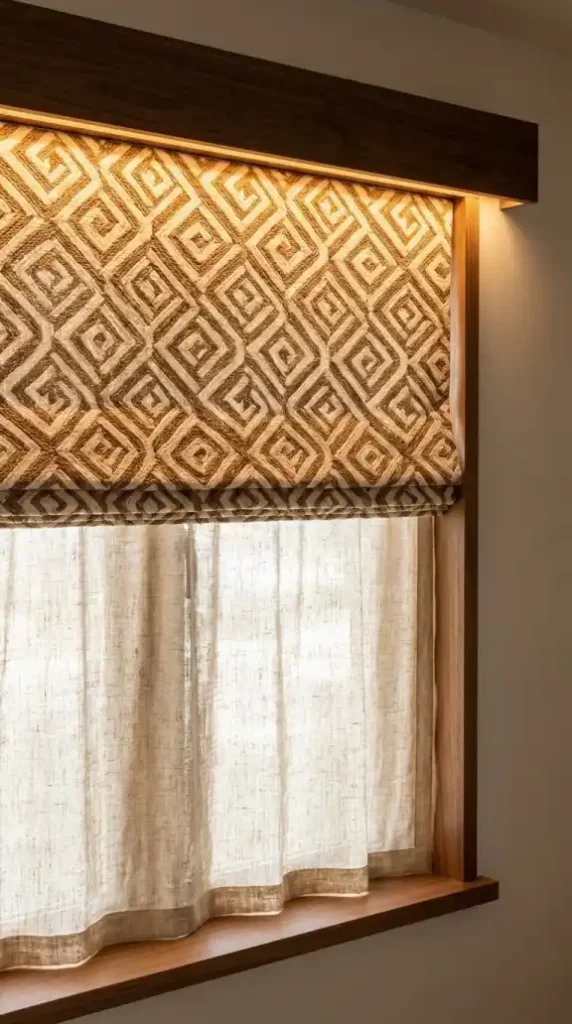
The window treatment is the kitchen’s one remaining textile position — and it should carry pattern.
Kuba cloth-inspired window panels — intricate raffia-derived geometric patterns in cream and warm brown — introduce the maximalist geometric touch at the window line without creating a fabric maintenance problem at the counter or floor.
Indigo batik panels are the alternative where the kitchen needs a cooler accent to balance the warmer earth tones — the deep hand-dyed blue pulls the palette toward the 10% high-contrast accent while staying within the hand-dyed textile tradition.
Raw linen cafe curtains in the lower window position combine with a Kuba or indigo panel in the upper position for a layered window treatment that handles both light filtering and pattern contribution simultaneously.
Buy the raw linen cafe curtain first — it solves the functional light-filtering requirement and provides the neutral base that the patterned upper panel reads against.
The Beginner Buying Sequence at a Glance
Before making any purchase, confirm the palette distribution is correct:
- Is 60% of the kitchen’s surface area — walls, cabinets, floor, countertop — within the earthy neutral range of terracotta, sand, charcoal, and cream? If not, the surface material decisions need to come before any object purchases.
- Does the current kitchen have at least one open shelving section? If all storage is behind closed cabinet doors, the organic texture layer has nowhere to land. One section of open dark wood shelving installed before any object purchases is the most impactful single structural change available.
- What is the current hardware finish? Replacing chrome or brushed nickel with hammered brass or oil-rubbed bronze is the single intervention that most changes the kitchen’s tonal reading relative to its cost and effort.
- Is there a dining surface or island that can hold a mud cloth runner? If yes, that’s the first textile purchase — it establishes the 10% high-contrast accent layer immediately and gives every subsequent decision a pattern reference to work from.
- Where is the best natural light position for a Snake Plant? Identify it before buying the plant — position determines the plant’s health and therefore its structural contribution to the kitchen long-term.
Keep going with the Afro Bohemian Kitchen series:
- Afro Bohemian Kitchen: How to Bring the Aesthetic Into a Functional Space — Learn why the kitchen demands a different approach than every other room
- 11 Afro Bohemian Kitchen Ideas for a Warm and Functional Space — Explore 11 practical ideas broken down by surface, object, and light
- How to Style an Afro Bohemian Kitchen — Go through the complete eight-level styling sequence once your foundation is in place