Afro Bohemian Decor for Beginners: What to Buy First
Most beginners approach Afro Bohemian decor as a shopping list problem.
They find a reference image they love, identify the objects in it, and attempt to purchase their way to the same result. The room they build looks close but doesn’t quite hold together — and the reason is almost always sequence rather than piece selection.
The Afro Bohemian decor system isn’t assembled. It’s built — in a specific order where each piece creates the context that makes the next piece correct.
This list gives beginners both. The specific pieces and the sequence. The purchase logic and the reason behind it. The palette framework and the practical test for knowing when each layer is working before moving to the next.
Quick Takeaway:
- The mud cloth throw is the first purchase in every room — it sets the geometric scale, colorway, and material standard that every subsequent decision responds to.
- The High-Low pairing — one modern functional silhouette beside one raw ancestral artifact — must be established at the furniture scale before any textile or object layer is introduced.
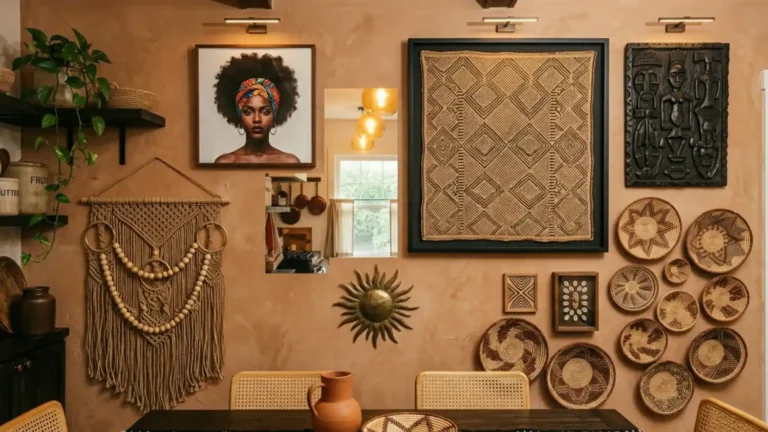
- The Tonga basket gallery is the wall’s first purchase — it sets the center axis and compositional scale that the carved mask and macro photography respond to, not the other way around.
The Palette Framework: Foundation, Contrast, and Accent Before Any Purchase
Before buying anything run the palette framework against the room you’re starting in.
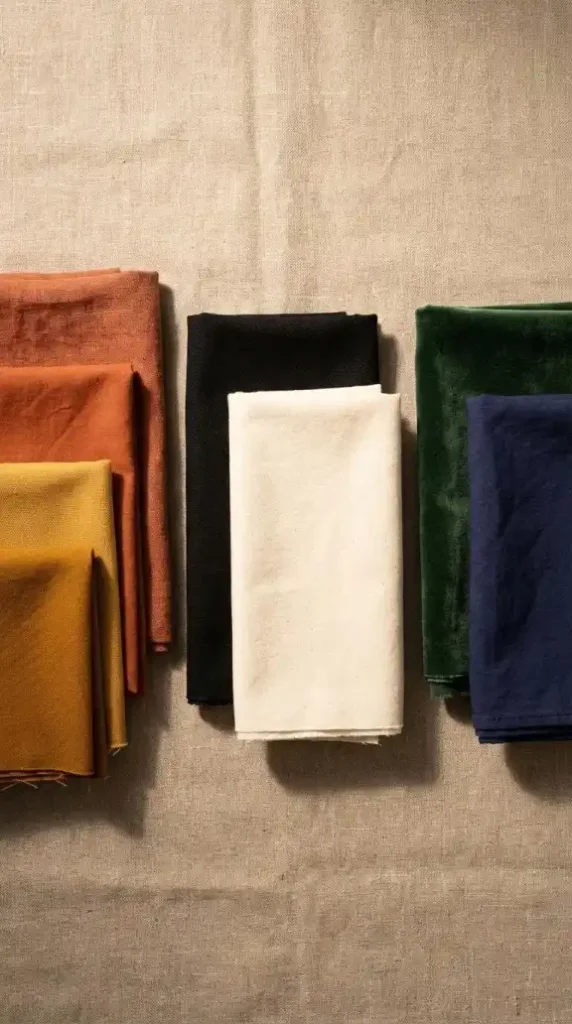
Foundation Earth Tones — terracotta, burnt orange, mustard yellow, deep ochre — are the dominant. These live in the wall color, the primary rug tone, the dominant upholstery, and the base textile layer. The largest surface areas. The warmth and grounding that hold the maximalist layers above them.
High Contrast Neutrals — stark black and crisp cream — give the geometric textile patterns their visual legibility. The mud cloth’s geometric pattern reads as bold and resolved because the black and cream contrast ratio is high enough for the eye to process the geometry. Without the contrast neutrals the patterns flatten.
Lush Accents — forest green and deep indigo — are the 10% that adds vibrancy and prevents the earth palette from reading as flat. Used at the cushion, curtain, and accent object level — never at the dominant wall or rug level.
Every purchase on this list sits in one of these three categories.
Buy in the right ratio — Foundation Earth Tone dominant, High Contrast Neutral structural, Lush Accent punctuating — and the room assembles into coherence without conscious effort.
First Purchase: A Mud Cloth Throw
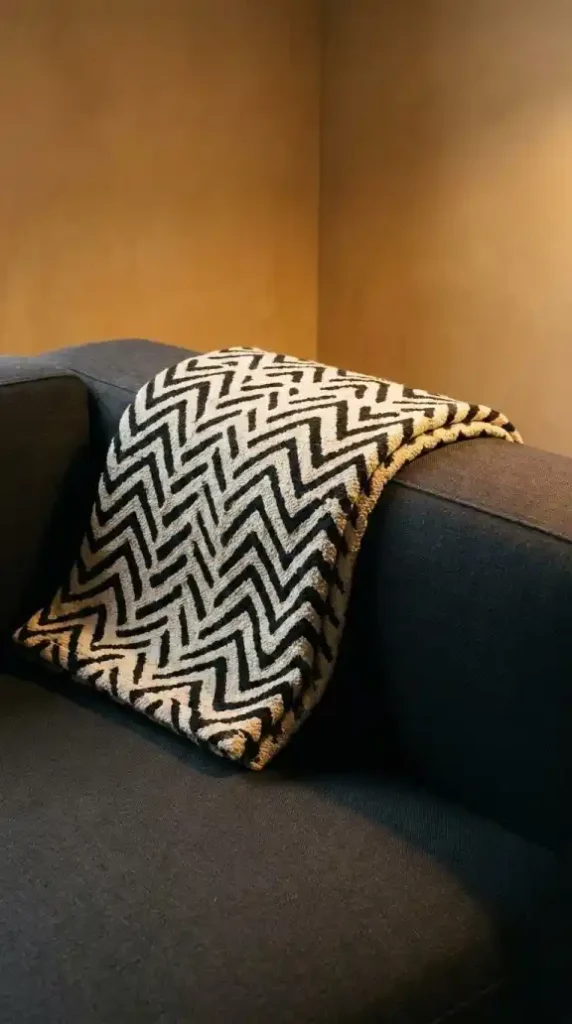
The mud cloth throw is the first purchase for every room in the Afro Bohemian decor system — not just the living room.
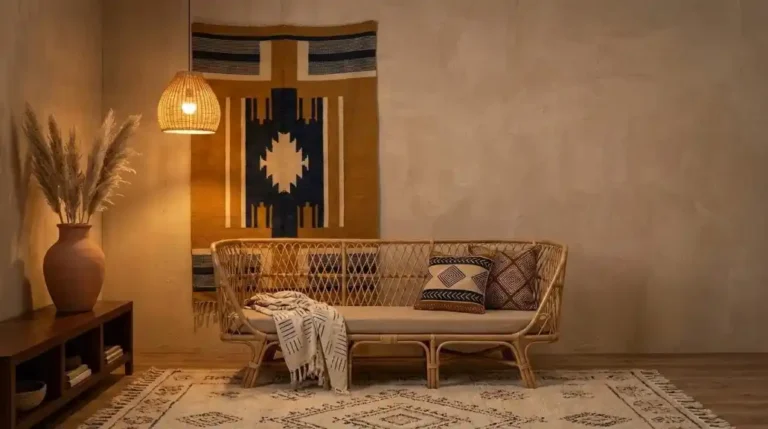
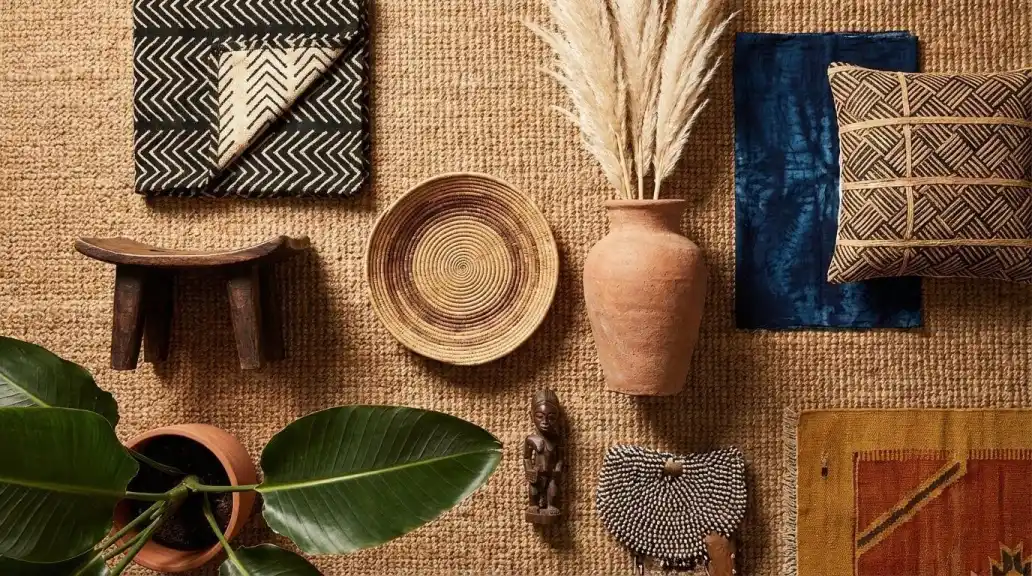
Malian Bogolan carries the High Contrast Neutral palette component and the geometric pattern anchor in a single object. Its black and cream colorway sets the pattern scale reference — the geometric repeat that every subsequent textile responds to at a distinctly different scale.
Buy a throw before cushion covers if budget allows only one mud cloth piece.
A throw has more surface area than cushions — it carries more visual weight, makes a stronger palette statement, and gives you a clearer material reference for every subsequent purchase.
Authentic hand-woven Bogolan from Mali is the ideal. If budget requires an alternative, hand-loomed cotton with genuine geometric pattern in warm black and cream is an acceptable entry point — as long as the surface has raised weave texture rather than a printed flat finish.
A printed flat fabric with a geometric pattern is not a mud cloth substitute.
The texture is structural — not decorative. The raised weave catches 2700K warm light and creates surface depth that flat fabric eliminates. Without the texture the material honesty the aesthetic depends on is absent from the room’s most prominent textile piece.
Second Purchase: 2700K Warm Bulbs and a Rattan Pendant
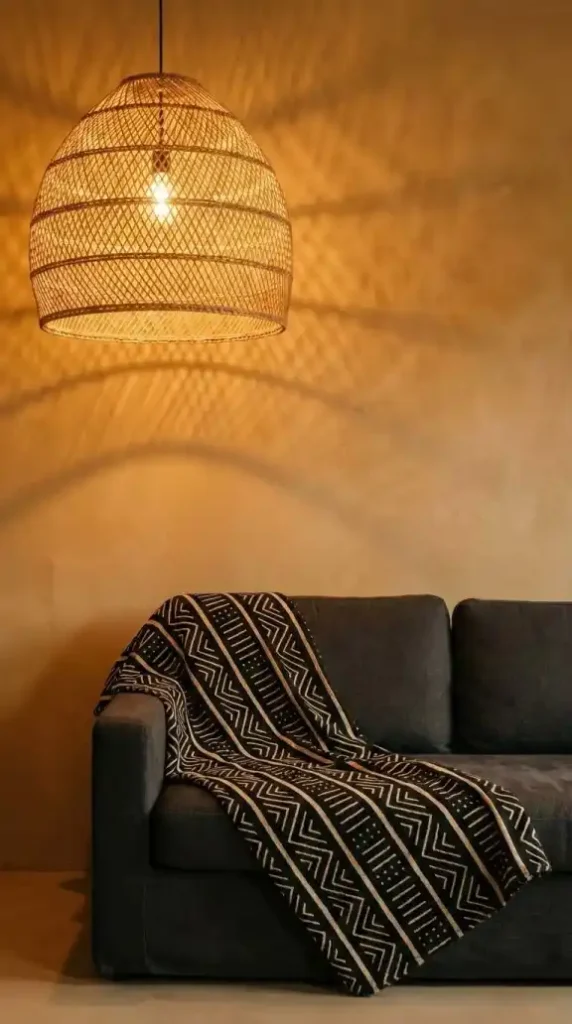
The lighting purchase comes second — before the hand-carved stool, before the basket wall, before any rug or secondary textile.
Every styling decision made under the wrong light temperature is a decision made under false conditions.
Replace every bulb in the room with 2700K warm LED before evaluating the mud cloth you just placed, before choosing a wall color, before deciding whether existing furniture works within the palette.
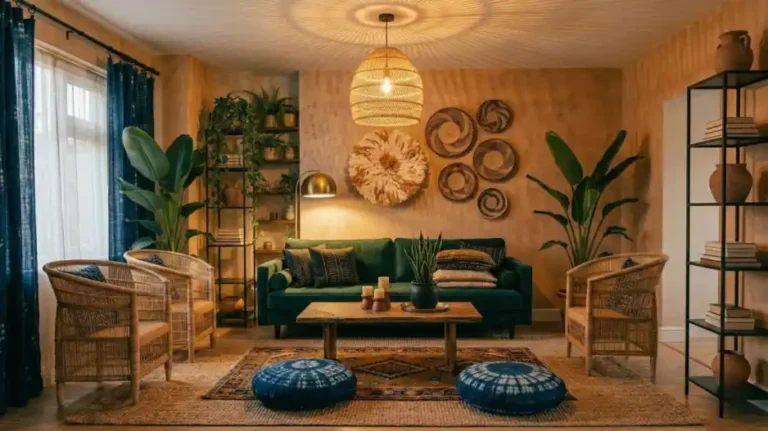
The rattan or raffia pendant is the room’s primary fixture and its ceiling-level textural element simultaneously.
Buy it oversized — 60cm diameter minimum for a standard room, 70–80cm for a primary living space.
An oversized rattan pendant reads as an architectural decision. A correctly sized or undersized rattan pendant reads as an accessory. The difference between the two is purely a scale decision — and scale is the one thing that can’t be compensated for by styling.
After dark the open weave casts geometric shadow projections across the ceiling and upper walls — adding a visual layer to the room that exists only in the evening and deepens the heritage gallery atmosphere without requiring additional objects.
Third Purchase: A Hand-Carved Ashanti or Senufo Stool
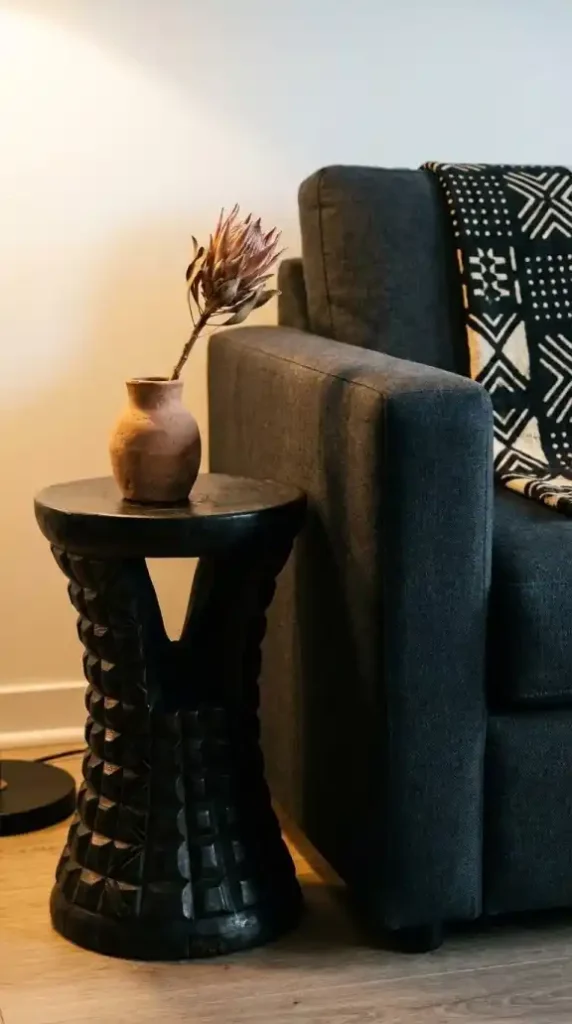
The hand-carved Ashanti or Senufo stool is the High-Low Mix’s first furniture expression — and it comes third because it needs the mud cloth anchor and the correct lighting to evaluate its pairing correctly.
Position it beside the contemporary sofa or bed frame as a side table.
The Ashanti stool’s geometric carved base is a ceremonial object from the Akan people of Ghana — its form carries cultural specificity that reads from across the room even to viewers who can’t name its origin.
That cultural specificity is what distinguishes the Afro Bohemian decor system from generic bohemian.
A generic bohemian room might have a wooden side table. An Afro Bohemian room has an Ashanti stool — an object with centuries of cultural meaning being used in a contemporary functional role. The repurposing of the ceremonial object at the daily-use scale is the most intimate expression of the High-Low principle.
Buy dark-stained or naturally dark wood — ebony, mahogany, or dark-oiled teak.
The dark tone provides the value anchor at the furniture scale that the palette needs to prevent earth tones from reading as undifferentiated warmth. A light-toned wood stool references a Scandinavian or contemporary register that sits outside the material vocabulary entirely.
Fourth Purchase: A Large Jute or Sisal Base Rug
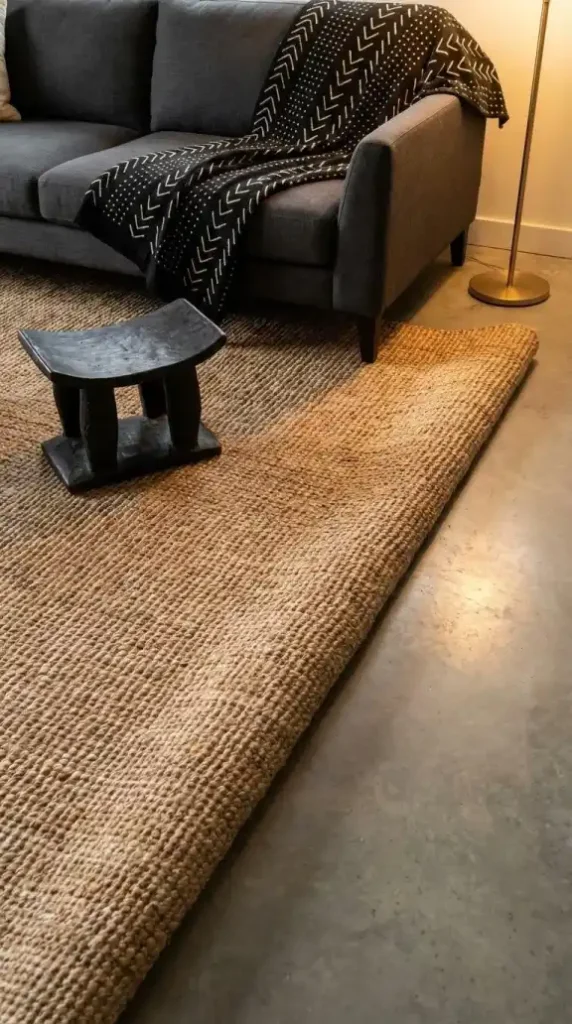
The jute or sisal base rug is the floor layer’s foundation — and it must be sized correctly before the kilim accent layer is chosen.
Buy the jute base before the kilim.
The jute base determines the floor’s neutral material foundation. The kilim is chosen in response to the jute’s honey-warm fiber tone and the room’s established palette — not selected independently.
Extend the jute base under the front legs of all primary seating — sofa, chairs, reading nook.
A rug that stops at the furniture perimeter creates visual disconnection between the floor layer and the furniture layer. A rug extending beneath the front legs creates a unified ground plane that the furniture sits within rather than on top of.
Natural honey-toned jute under 2700K warm light reads as grounding and warm — cohesive with the mud cloth’s cream tones and the ochre wall behind.
Buy the largest jute rug the floor plan allows. You can always add a smaller kilim accent on top. You cannot compensate for a jute base too small for the room’s furniture arrangement.
Fifth Purchase: A Hand-Knotted Kilim Accent Rug
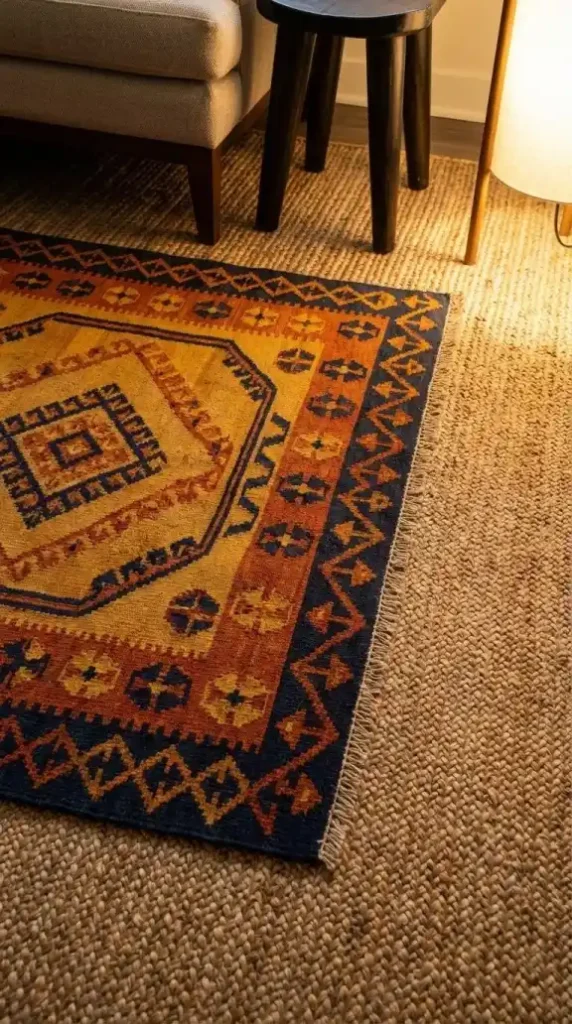
The kilim accent rug is placed after the jute base is confirmed — chosen in response to the jute’s neutral honey tone and the mud cloth’s black and cream colorway already established at the sofa.
A hand-knotted kilim in ochre, burnt orange, and deep indigo introduces all three palette categories at the floor level simultaneously — Foundation Earth Tones in the ochre and burnt orange, Lush Accent in the deep indigo.
The kilim’s geometric pattern at the floor level should be at a distinctly different scale from the mud cloth’s geometric repeat at the sofa level.
If the mud cloth has a large-scale chevron repeat the kilim should carry a smaller-scale diamond or linear repeat. If the mud cloth has a medium-scale geometric the kilim should carry either a very large or very small scale. The scale differentiation between the two prevents pattern competition at two different viewing distances simultaneously.
Size the kilim to cover approximately one third of the jute base’s visible surface area.
Large enough to read as a design layer from the room’s entry point. Small enough that the jute base remains the dominant floor material and the kilim reads as the accent layer it’s meant to be.
Sixth Purchase: A Tonga Basket Wall Cluster
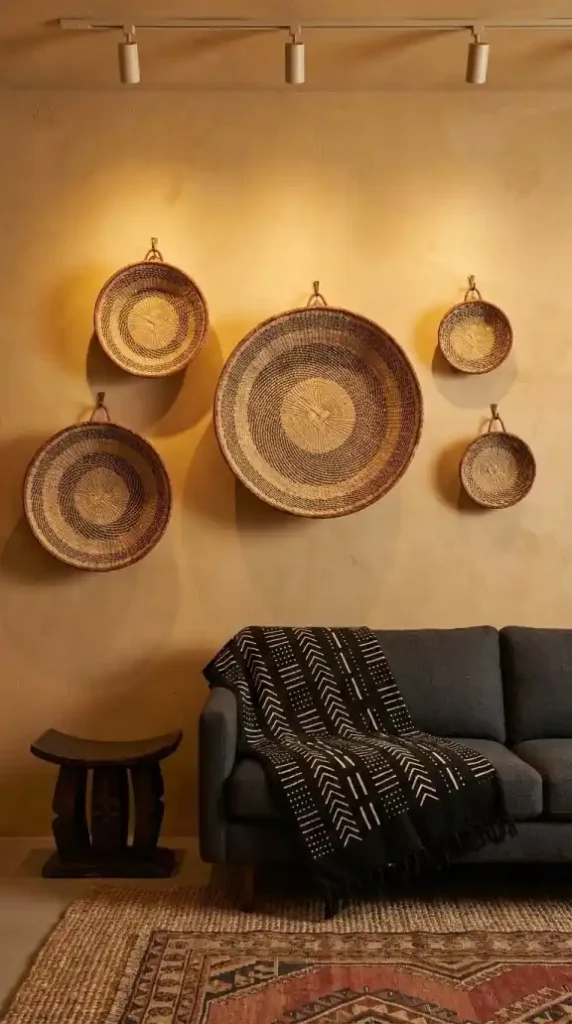
The Tonga basket wall cluster is the gallery wall’s first purchase — mounted before the carved mask, before the macro photography, and before the Yoruba beaded piece.
Five baskets in graduated sizes — not seven, not three. Five is the minimum number that creates the asymmetric cluster movement that makes the gallery read as a composed focal point rather than a decorative arrangement.
Arrange them asymmetrically. One large anchor basket. Two mid-size at varying heights. Two smaller at the outer positions.
The asymmetric arrangement creates visual movement across the wall. A grid arrangement creates order — and order is the wrong compositional register for the Afro Bohemian aesthetic at the wall gallery level.
Mount each basket on a small bronze hook — not chrome, not silver. Bronze sits within the warm metallic vocabulary of the room’s hammered brass and dark wood palette.
Live with the five-basket cluster on the wall for one week before buying any adjacent gallery element.
The week gives the eye time to calibrate the cluster’s scale and position against the room’s spatial context. It also reveals which adjacent position the gallery needs next — whether the mask should go to the left or right of the basket cluster, whether the macro photography should sit above or below the cluster’s center height. These decisions are impossible to make correctly before the anchor element has been lived with long enough to understand its visual weight in the actual space.
Seventh Purchase: A Terracotta Floor Vase With Dried Botanicals
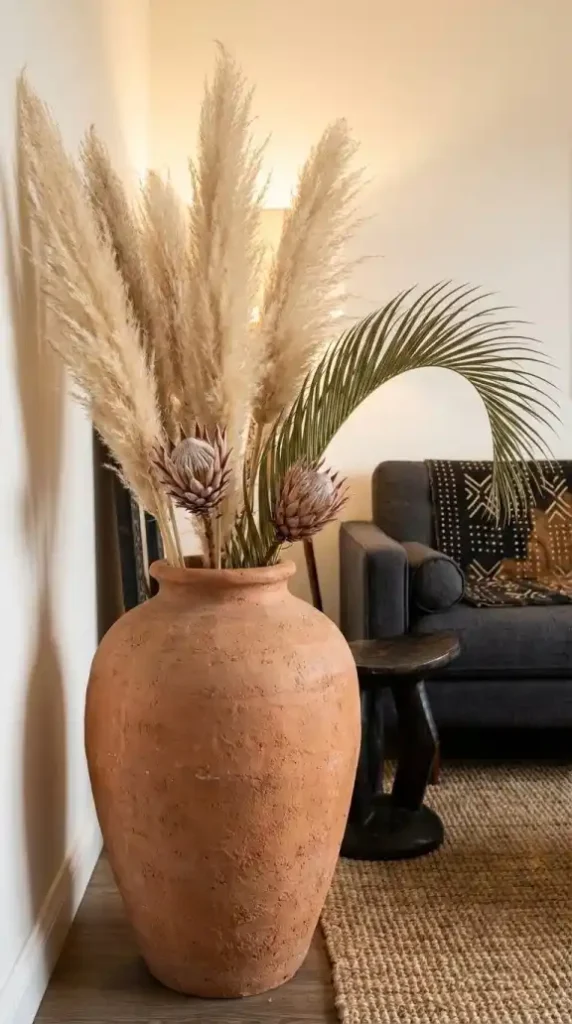
The terracotta floor vase with dried botanicals is the earth element of the botanical layer — and it’s placed before the living plants because its floor position needs to be confirmed before the living plant corner positions are determined around it.
A large heavy terracotta floor vase — genuinely heavy, with visible hand-throw marks and slight surface irregularity — holding dried pampas grass, dried protea seed heads, and a preserved palm frond.
The weight and mass of the floor vase creates an architectural presence at the floor level that a lightweight vessel can’t produce.
The dried botanical content provides three distinct structural forms at three distinct heights: the soft pale pampas plumes at the top, the rough textured protea seed cases at mid height, the dramatic curved arc of the dried palm frond at the side.
Together they create a dried botanical composition that reads as sculptural rather than decorative — an arrangement with architectural form rather than flower-arrangement softness.
Position the floor vase at the room’s secondary corner — not the corner reserved for the living Bird of Paradise, but the adjacent corner or beside the console where the dried botanical element anchors the floor level without competing with the living plant’s spatial zone.
Eighth Purchase: Kuba Cloth and Indigo Batik Cushion Set
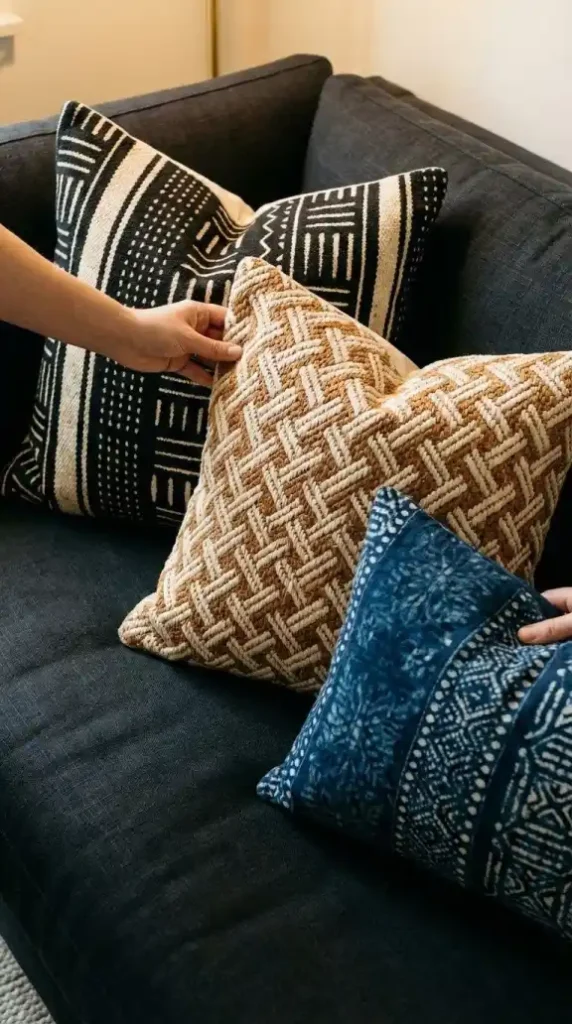
The secondary textile layer — Kuba cloth and indigo batik cushion covers — is purchased after the mud cloth anchor, the floor rugs, and the basket wall cluster are all in place.
Buying cushions before the basket wall exists means choosing cushion colors without knowing what palette the wall gallery will establish. Buying cushions before the kilim is in place means choosing cushion pattern scales without knowing what pattern scale the floor is already carrying.
The Kuba cloth cushion goes at the sofa center — its dense raffia-inspired interlocking geometric pattern at a different scale from the mud cloth’s cleaner chevron provides the maximalist pattern density layer without competing at the same geometric register.
The deep indigo batik cushion goes at the front or outer sofa position — the hand-dyed wax-resist indigo providing the Lush Accent cooling contrast that balances the warm earth palette dominant throughout the room.
A modern Kente-inspired cushion in muted gold and terracotta geometric repeat completes the four-textile-tradition cushion set at the accent position.
Four traditions. Four distinct pattern scales. One cohesive sofa textile composition — built outward from the mud cloth anchor rather than assembled simultaneously from scratch.
Ninth Purchase: A Carved Mask and Macro Photography Print
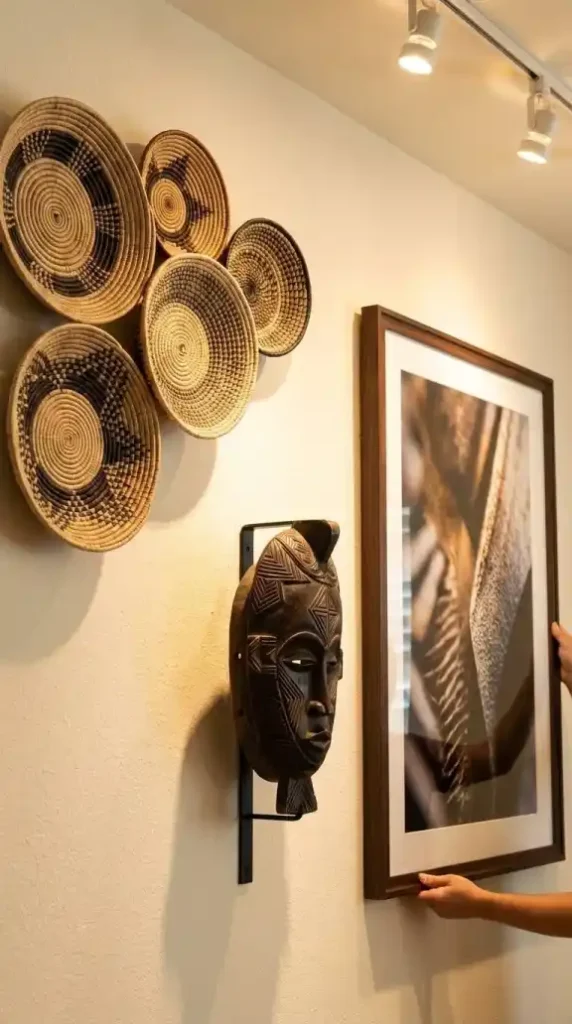
The carved mask and macro photography print are bought together as the gallery wall’s second and third layer — chosen in response to the Tonga basket cluster already mounted rather than selected independently.
The carved mask: mount it on a museum bracket at the gallery’s center axis — positioned so the basket cluster reads to one side and the photography print to the other. The mask’s three-dimensional carved surface at the gallery center creates depth that no flat-mounted piece produces.
Choose a mask with significant carved surface detail — geometric facial abstraction, relief carving across the surface — that catches warm track light in deep highlight and shadow from across the room.
The macro photography print: a 60x90cm grainy film photograph of an African landscape, wildlife close-up, or portraiture silhouette in a dark wood frame. The photograph’s smooth glass-fronted surface provides the one flat reflective element in the otherwise entirely textural gallery composition.
Size matters for both pieces.
The mask should be large enough to read as a primary gallery element from the room’s entry point — at least 30cm in height. The photography print should be large enough to function as a gallery anchor in its own right — 60x90cm minimum. Both at these scales earn their wall positions. Both at smaller scales read as accessories rather than gallery elements.
Tenth Purchase: Statement Greenery at Two Starter Positions
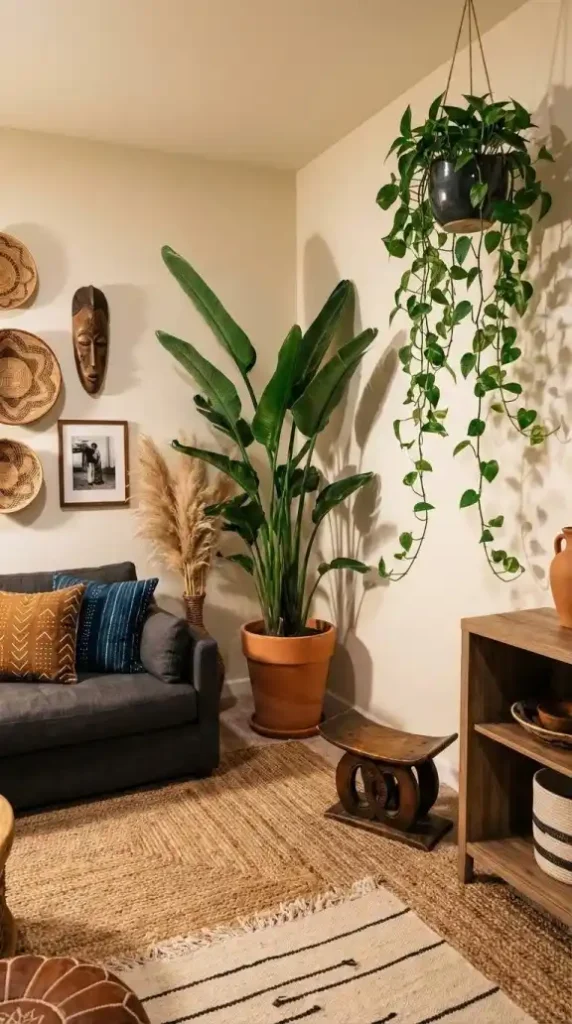
Statement greenery is the final structural layer — placed last because each plant’s position is determined by the spatial gaps the assembled room reveals.
Two starter positions cover the most critical spatial zones.
The large corner zone: a Bird of Paradise or Fiddle Leaf Fig in a terracotta floor pot at the room’s most open corner with access to indirect natural light. The broad tropical leaf silhouette fills the floor-to-ceiling zone that no furniture or object can address. At this corner position the living plant is the room’s most architecturally significant organic element — the foreground presence that the working eye rests on and that makes the room feel inhabited by nature rather than decorated with natural objects.
The high shelf or upper zone: a trailing Pothos in a dark ceramic hanging planter above the highest shelf or at the uppermost wall position. The cascading vines fill the dead zone where wall meets ceiling — the architectural gap that accumulates visual awkwardness without organic growth to address it. Pothos is the most reliable starter plant for this position — it thrives in variable light conditions and its trailing growth habit develops quickly enough to fill the upper wall zone within a few months of placement.
Add the Snake Plant at the close-range console or bedside position as the third greenery purchase once the two starter positions are established and confirmed as healthy.
All three repotted before entering the room. Terracotta for the floor corner plant. Dark glazed ceramic for the trailing upper plant. Terracotta or woven basket for the close-range position.
No plastic nursery pots visible at any position in the assembled room.
The One Piece to Source Rather Than Buy
The repurposed ancestral object — the hand-carved grain mortar used as a container, the traditional gourd vessel used as a decorative object, the ceremonial kola nut bowl used as a key dish — is the one piece on this list that should be sourced rather than purchased from a decor retailer.
African craft markets, diaspora cultural organizations, specialist importers of African traditional crafts, and estate sales or antique dealers with genuine African artifact collections are the sources that produce objects with authentic functional origin.
A genuinely used grain mortar — with the hollowed center worn smooth by generations of use, the exterior carved with geometric patterns that carry specific cultural meaning, the dark patina of aged wood — reads completely differently in a room from a decorative mortar manufactured to look aged.
The eye can’t always articulate the difference. But the room registers it.
Objects with genuine functional origin carry a material honesty that manufactured decorative pieces can approximate but not replicate. The worn surface, the slight asymmetry, the evidence of actual use — these are the qualities that make the High-Low Mix’s Low register read as ancestral rather than as a style reference.
Source one. Take the time to find it. It will be the piece that makes every other correctly chosen object in the room read more authentically than it would without it.
The Beginner Buying Sequence at a Glance
Before making any purchase answer these questions:
- What is the current room lighting temperature? Replace every bulb with 2700K warm LED before evaluating the room’s wall color, existing furniture tone, or any textile under its actual conditions. Every decision made under cool-white light is made under false conditions.
- What is the room’s primary furniture piece — sofa, bed frame, or desk — and does it function as the High element of the High-Low pairing? If the primary furniture piece is highly decorative or carries strong pattern it may be occupying both the High and Low registers simultaneously — which eliminates the productive tension the High-Low Mix depends on.
- What is the largest undecorated wall surface in the room? Measure it before buying the Tonga basket cluster. The basket cluster needs at minimum 120cm of wall width to arrange five baskets in a graduated asymmetric composition without crowding.
- Is there a corner with indirect natural light access for a Bird of Paradise or Fiddle Leaf Fig? Identify it before buying the plant. Light availability determines the plant’s long-term health and therefore its structural contribution to the room’s botanical layer.
- Is there a floor position at a secondary corner or beside the console where a large terracotta floor vase with dried botanicals can sit without competing with the living plant’s corner zone? The two botanical registers need distinct spatial positions to read as complementary rather than redundant.
- What is the current palette distribution in the room? Estimate what percentage of visible surface area falls in each of the three palette categories — Foundation Earth Tones, High Contrast Neutrals, and Lush Accents. The category furthest from its correct allocation tells you where the next purchase should be directed.
Ten pieces. One sequence. The full beginner Afro Bohemian decor system.
The mud cloth throw sets the pattern anchor and palette reference. The 2700K pendant and bulbs reveal it correctly after dark. The hand-carved Ashanti stool establishes the High-Low pairing at the furniture scale. The jute base rug grounds the floor plane. The kilim accent adds Heritage Accent color and pattern depth at the seating center. The Tonga basket cluster anchors the gallery wall’s center composition. The terracotta floor vase with dried botanicals delivers the earth element of the botanical layer. The Kuba cloth and indigo batik cushions complete the sofa’s four-textile-tradition hierarchy. The carved mask and macro photography print complete the gallery wall’s four-layer composition. The Bird of Paradise and trailing Pothos fill the two primary spatial zones with living jungle presence.
Each piece earns its place by doing something no other piece on the list is already doing.
And the one sourced piece — the repurposed ancestral object with genuine functional origin — earns its place by doing something no purchased piece can replicate.
That’s the full Afro Bohemian decor starter system. Built in sequence. Grounded in the High-Low logic. Anchored in cultural specificity rather than surface-level reference.
Build on This:
- Afro Bohemian Decor: The Complete Style Guide — Understand the full High-Low Mix logic and the four textile traditions that explain why every pairing decision in an Afro Bohemian room works as a unified cultural and material system.
- 11 Afro Bohemian Decor Ideas for a Warm and Layered Home — See the High-Low principle, the mud cloth anchor, and the dual botanical register applied across 11 specific decor moves, each one building the conditions for the next.
- How to Style Afro Bohemian Decor in Any Room — Follow the full ten-step styling sequence — from lighting setup to sensory finishing layer — in the exact order that makes the system work at any room scale.