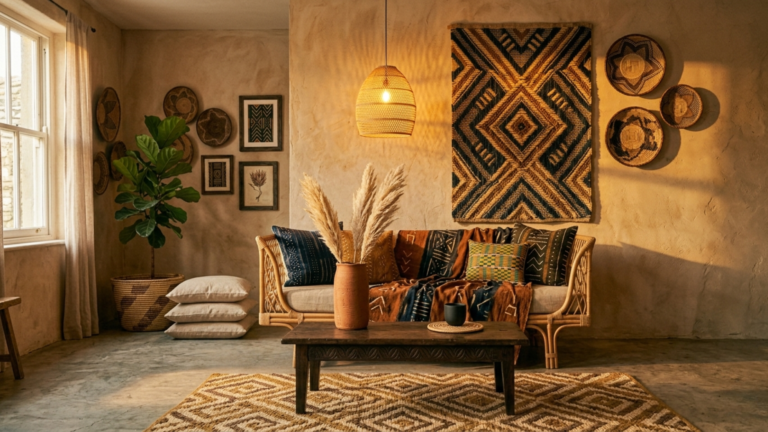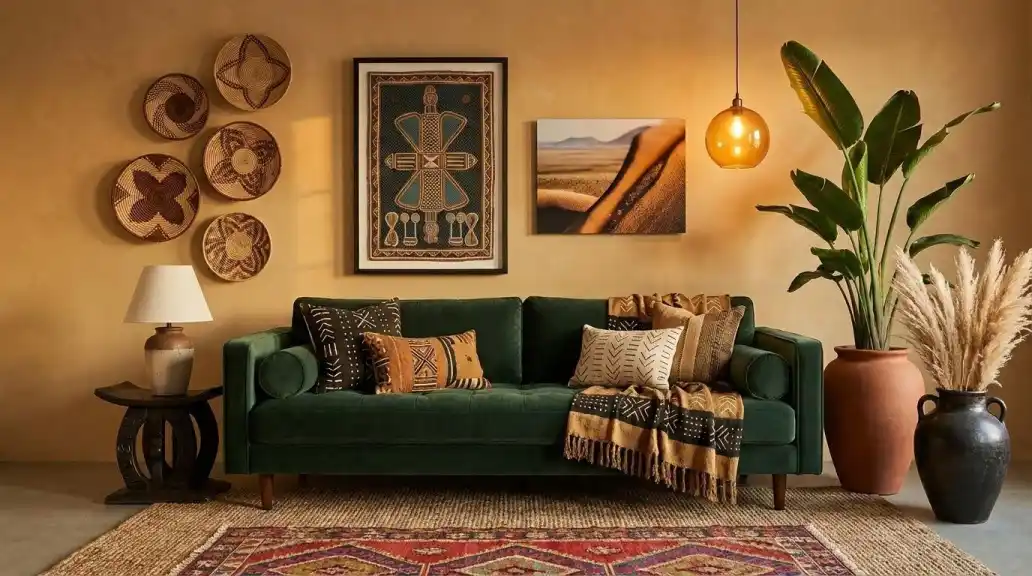
Afro Bohemian Decor: The Complete Style Guide
Afro Bohemian decor is built on a productive contradiction.
It’s earthy and maximalist simultaneously. Grounded in natural materials and bold in pattern commitment. Culturally specific in its references and universally appealing in its warmth.
Most interior aesthetics resolve toward one end of the spectrum — either restrained and neutral or expressive and layered. Afro Bohemian decor refuses that resolution. It holds both the earthy minimalism of organic materials and the high-energy maximalism of African pattern tradition in the same room — and the tension between them is exactly what gives the style its distinctive visual power.
The system that makes this work is the High-Low Mix: pairing clean-lined modern silhouettes with raw ancestral artifacts, functional contemporary furniture with hand-carved ceremonial objects, machine-made surfaces with handmade textiles. The contrast between the two registers is what prevents the room from reading as either a contemporary interior with ethnic accessories or a cultural exhibition with furniture placed inside it.
This guide covers the full Afro Bohemian decor system — textiles, materials, color, wall art, greenery, and the High-Low logic that holds everything together.
Quick Takeaway:
- The High-Low Mix is the governing principle — pair a modern functional silhouette with a raw ancestral artifact at every scale from furniture to object to wall piece.
- Textiles are the soul of the aesthetic — mud cloth, Kuba cloth, indigo batik, and Kente-inspired prints each occupy a distinct position in the room’s layering hierarchy.
- Dried botanicals and tropical plants operate as two distinct material registers — dried pampas and protea in heavy ceramic vases for the earth element, living Bird of Paradise and Fiddle Leaf Figs for the jungle layer.
The High-Low Mix: The Principle That Makes Everything Work
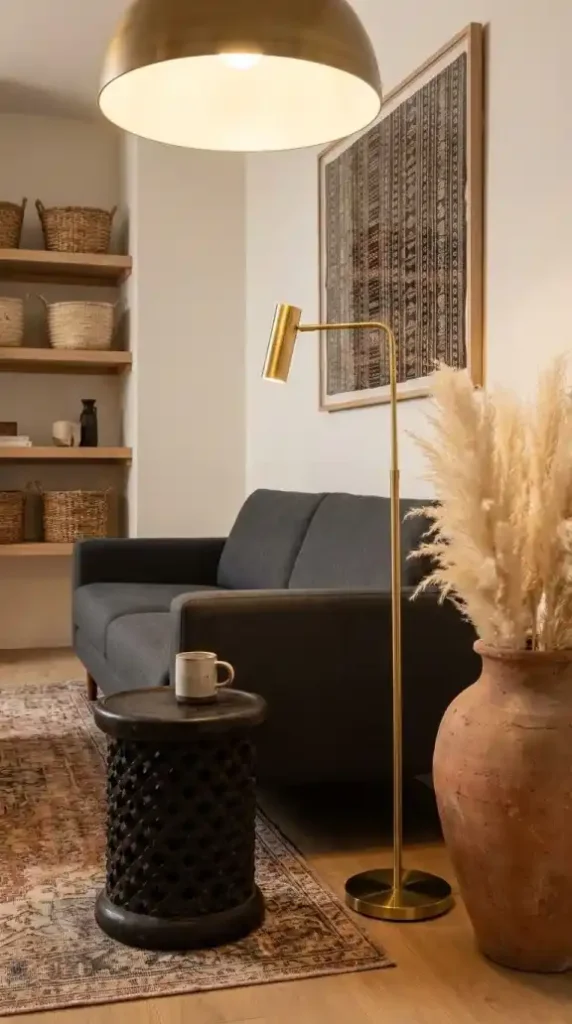
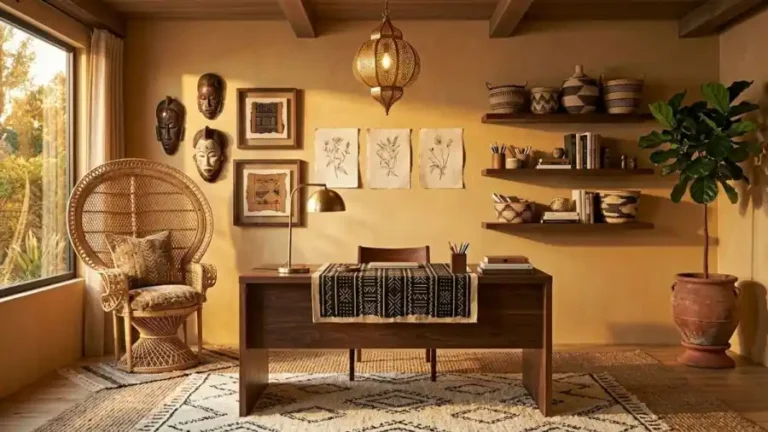
The High-Low Mix is not a styling technique — it’s the structural principle that determines what goes next to what in every zone of an Afro Bohemian room.
High: clean-lined contemporary furniture, modern functional silhouettes, machine-finished surfaces. The mid-century sofa. The minimalist brass lamp. The contemporary geometric rug. The thin-framed arched mirror.
Low: raw ancestral artifacts, hand-carved ceremonial objects, handmade craft pieces with visible process. The Ashanti stool used as a side table. The hand-thrown terracotta floor vase. The hand-carved grain mortar repurposed as a decorative object. The woven Tonga basket hung as wall art.
Placing these two registers in direct conversation at every scale — furniture scale, object scale, wall art scale — is what creates the “lived-in curated soul” that distinguishes Afro Bohemian decor from either a contemporary interior or a heritage collection.
A room with only High elements reads as modern and impersonal. A room with only Low elements reads as a cultural museum. The tension between the two produces a room that reads as neither — but as something more interesting than both.
Textiles: The Soul Layer of Every Room
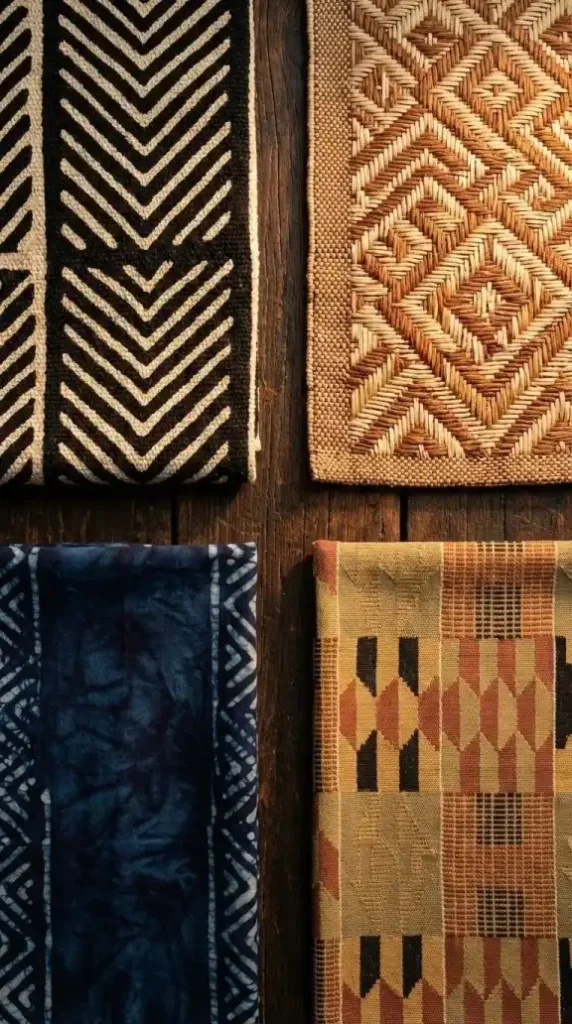
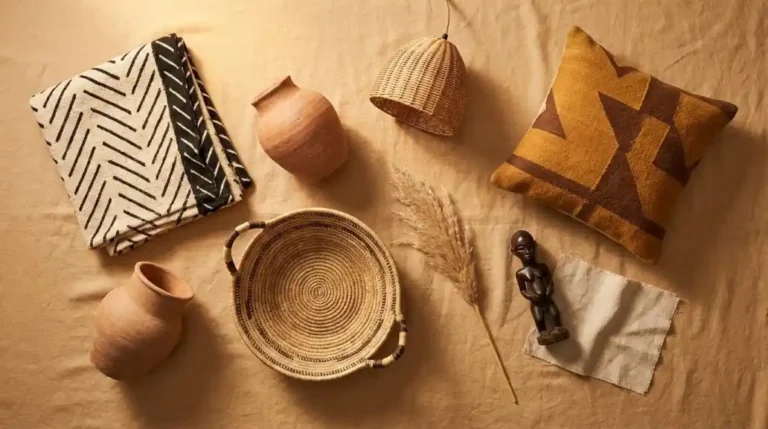
Four textile traditions anchor the Afro Bohemian decor vocabulary — and each one occupies a distinct position in the room’s layering hierarchy rather than appearing interchangeably.
Malian mud cloth — Bogolan — carries the High Contrast palette component at the most visible textile position in any room. Its bold geometric patterns in black, white, and ochre are the pattern anchor that every other textile responds to. Position it at the largest textile surface — the sofa throw, the bed foot layer, the shower curtain — before any other pattern textile is introduced.
Kuba cloth from the Congo operates at the secondary textile level — wall hangings, structured cushion covers, framed panels. Its rhythmic patch-like embroidery and earthy tones add maximalist pattern density at a different geometric scale than the mud cloth’s cleaner geometry.
Indigo batik provides the cool contrast that prevents the warm earth palette from reading as monochromatic. Positioned as curtain panels, oversized floor cushions, or table runners, the deep hand-dyed indigo introduces the Life tone cooling accent that balances the terracotta and ochre dominant.
Kente-inspired prints in modern interpretations — muted gold, terracotta, and warm brown rather than the original high-chroma colorway — add the vibrant geometric vocabulary of West African strip weaving at the accent cushion and runner level. The muted Kente interpretation sits within the earth palette without the color contrast of traditional Kente overwhelming the room’s cohesive warmth.
Natural Materials: Organic Luxury at Every Scale
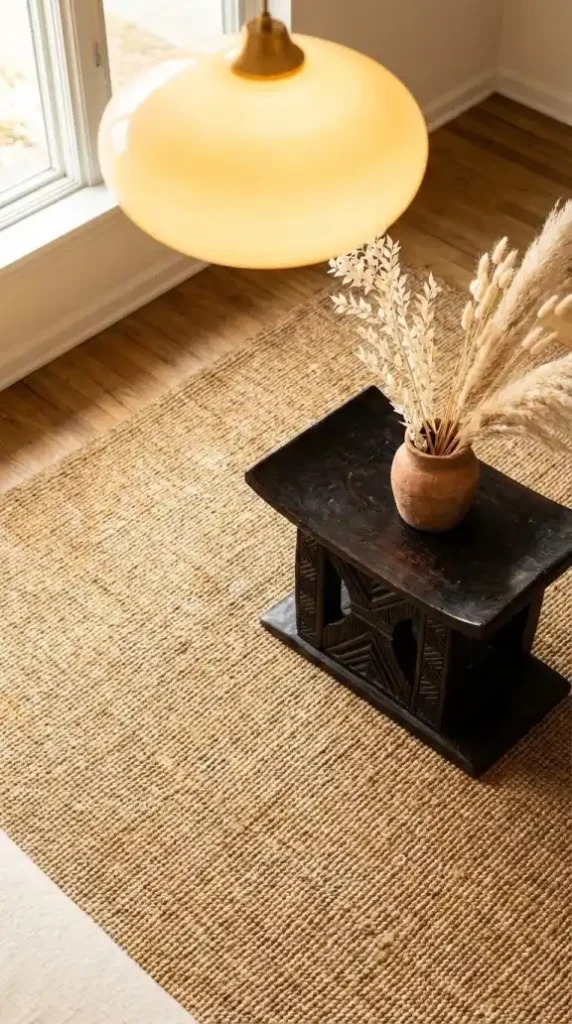
Natural materials in Afro Bohemian decor operate across three distinct scales — and all three need to be present simultaneously for the material vocabulary to read as complete.
At the macro scale: woven fiber surfaces — jute rugs, sisal runners, seagrass floor coverings, raffia wall hangings. The organic material ground plane that the room’s higher-detail elements read against.
At the mid scale: carved wood furniture and objects — hand-carved Senufo or Ashanti stools used as side tables, dark ebony or mahogany serving bowls, live-edge wood shelving with visible grain variation. These mid-scale wood pieces carry the ancestral craft reference at the furniture level. The Ashanti stool’s geometric carved base is not incidental decoration — it’s a visual language with cultural specificity that reads from across the room.
At the close-range object scale: clay and terracotta — matte-finished pottery, large floor vases, hand-sculpted ceramics. The earth pigment material at the touch distance. The hand-thrown irregularity of a terracotta vessel — the slight lip variation, the tool marks on the surface — is the material detail that the working hand encounters and the close-range eye reads as authentic rather than manufactured.
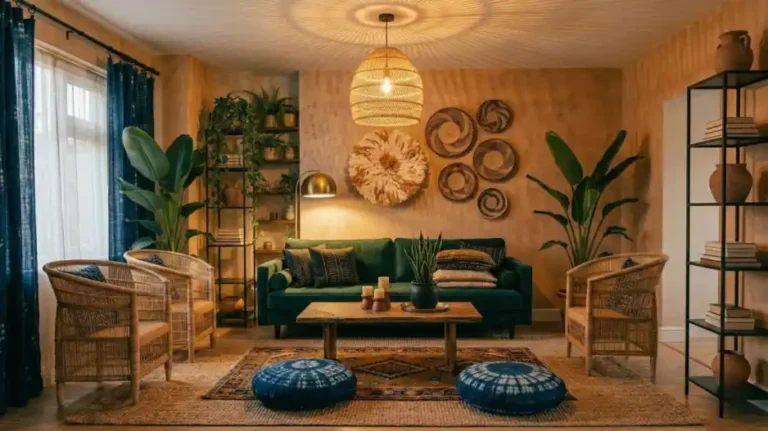
Velvet enters the natural material vocabulary as the maximalist contrast to the rough organic surfaces. A velvet cushion in forest green or deep indigo placed against a rough jute cushion creates the same material opposition as the High-Low Mix at the textile layer — the plush pile reading more luxurious next to rough fiber, the rough fiber reading more tactile next to smooth velvet.
The Color Palette: Earth Foundation With Jewel Tone Accent
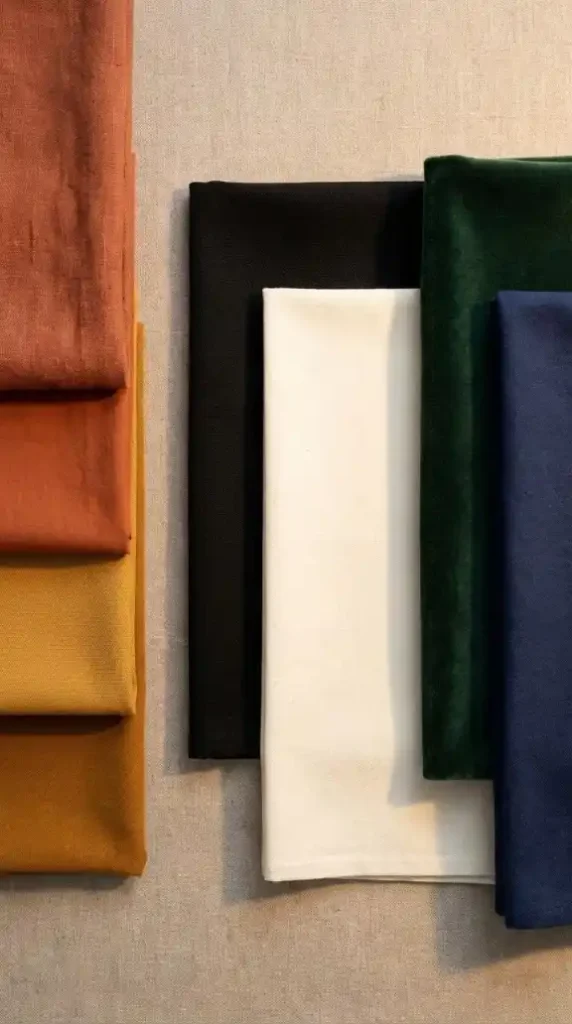
The Afro Bohemian palette is built in three layers — and understanding the functional role of each layer prevents the maximalist approach from collapsing into visual chaos.
Foundation Earth Tones — terracotta, burnt orange, mustard yellow, deep ochre — are the dominant. The wall color, the primary rug tone, the dominant upholstery, the base textile layer. The warmth and grounding that hold the maximalist layers above them.
High Contrast Neutrals — stark black and crisp cream — give the geometric textile patterns their visual legibility. Mud cloth reads as geometric because the black and cream contrast ratio is high enough for the eye to resolve the pattern. Without the contrast neutrals present, geometric patterns flatten into undifferentiated texture.
Lush Accents — forest green and deep indigo — prevent the earth palette from reading as flat or monochromatic. Used sparingly at the cushion, curtain, and accent object level — the 10% that adds vibrancy to the 60% earth foundation. Forest green references plant-dye textile traditions. Deep indigo references the batik dyeing heritage of West Africa.
All three layers must be present. A room with only Foundation Earth Tones reads as warm but flat. A room with only High Contrast reads as graphic but cold. The Lush Accents are what make the palette feel alive rather than assembled.
Wall Art and Decor: The Heritage Gallery System
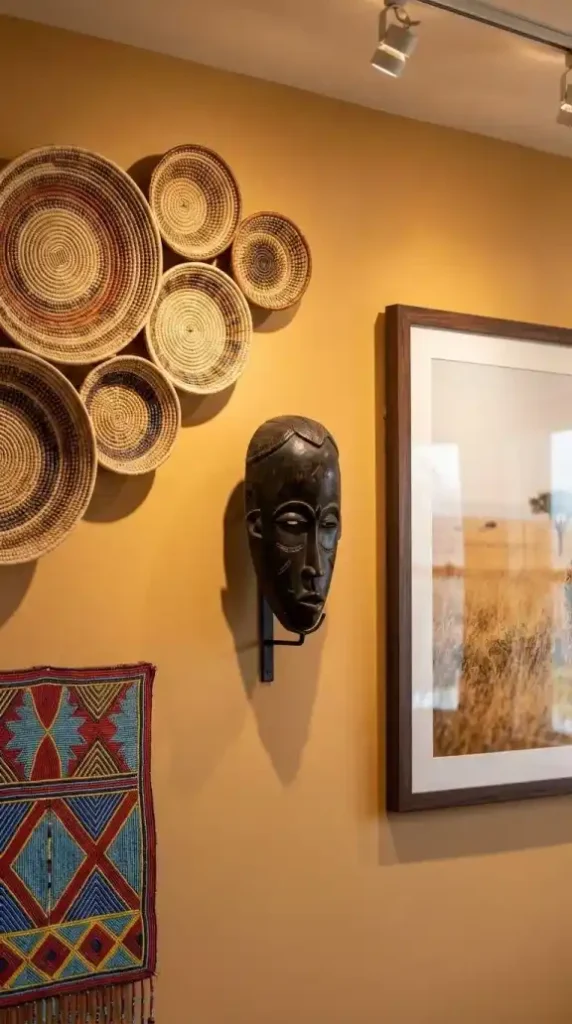
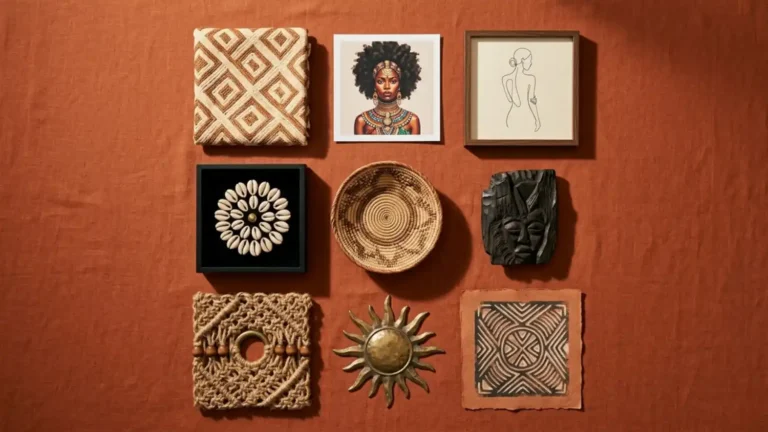
The wall in an Afro Bohemian room functions as a heritage gallery — a curated display of cultural artifacts, textile fragments, photographic art, and woven objects operating across four distinct scales simultaneously.
The Tonga or Binga basket gallery is the wall’s primary textural element. Groups of woven baskets — seven or more in graduated sizes arranged asymmetrically — create a focal point that no flat art piece can replicate. The radial geometric patterns of Tonga baskets reference the same design tradition as the mud cloth on the sofa below, at a different material and scale register.
Hand-carved masks — Bamileke, Fang, or Bamileke brass — are mounted on museum-style brackets as sculptural wall elements rather than flat art pieces. Their three-dimensional surface detail catches warm track light in deep highlight and shadow that framed art eliminates. Used sparingly — one mask per gallery composition — they carry the ancestral ceremonial reference at the highest cultural weight.
Macro photography — large-scale prints of African landscapes, wildlife, or portraiture — adds the contemporary visual language layer. A 60x90cm grainy film photograph of an African landscape or silhouette portrait in a dark wood frame reads as sophisticated and culturally specific simultaneously — the contemporary medium in direct conversation with the traditional craft objects beside it.
Yoruba beaded art — intricate beaded chairs repurposed as wall hangings, beaded panels, or large-format beaded textile pieces — introduces texture and color at a register that no other wall element provides. The dense bead surface catches light differently from every angle — a living surface quality that flat prints and even woven baskets don’t replicate.
Greenery: Two Distinct Plant Registers
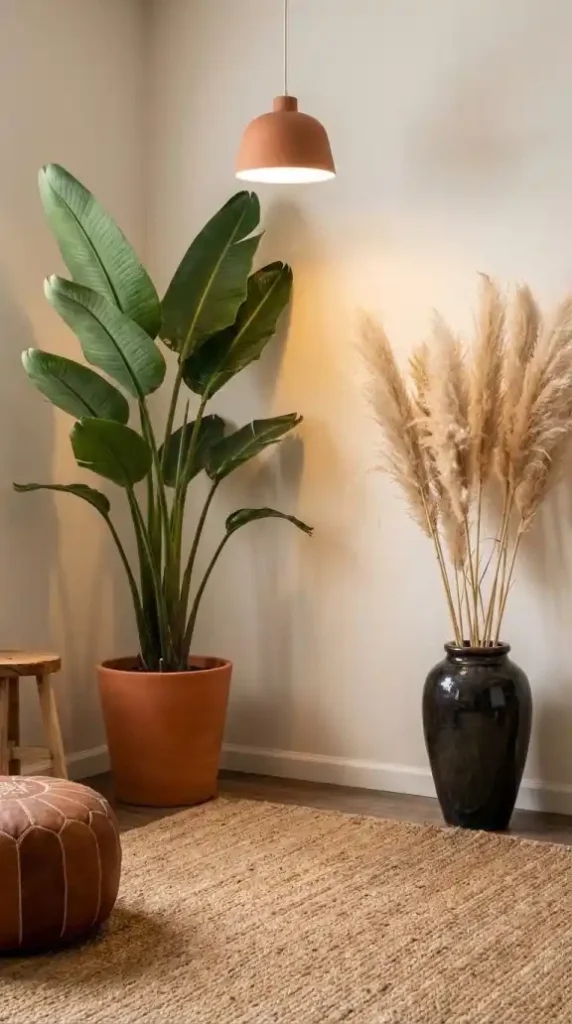
Afro Bohemian decor uses greenery across two distinct registers — and both need to be present for the botanical layer to read as complete.
The living jungle layer: large-leafed tropical plants that thrive indoors and provide vertical botanical drama. Bird of Paradise with its broad tropical leaf silhouette. Fiddle Leaf Fig with its structured upright form. Snake Plant with its strong architectural vertical lines and West African origin. These living plants provide the humidity, the organic movement, and the floor-to-ceiling vertical presence that the jungle layer requires.
The dried earth layer: pampas grass, dried palm fronds, and protea flowers arranged in heavy ceramic vases. These dried botanical elements have a textural presence that living plants at their scale can’t match — the pale plumes of pampas grass, the structural seed cases of dried protea, the arching form of preserved palm fronds all read as natural sculptural objects rather than plant-care requirements. In a heavy dark glazed ceramic or large terracotta floor vase, dried pampas reads as architectural.
The two registers provide different material characters at the botanical layer. The living plants provide color, humidity, and organic growth. The dried botanicals provide muted tone, structural form, and the permanent installation quality that living plants can’t guarantee.
Position them at distinct spatial zones — living plants at the room’s corner floor positions and high shelf zones, dried botanicals at the console and floor vase positions where their architectural form can be read at close range.
The Decor System Applied Room by Room
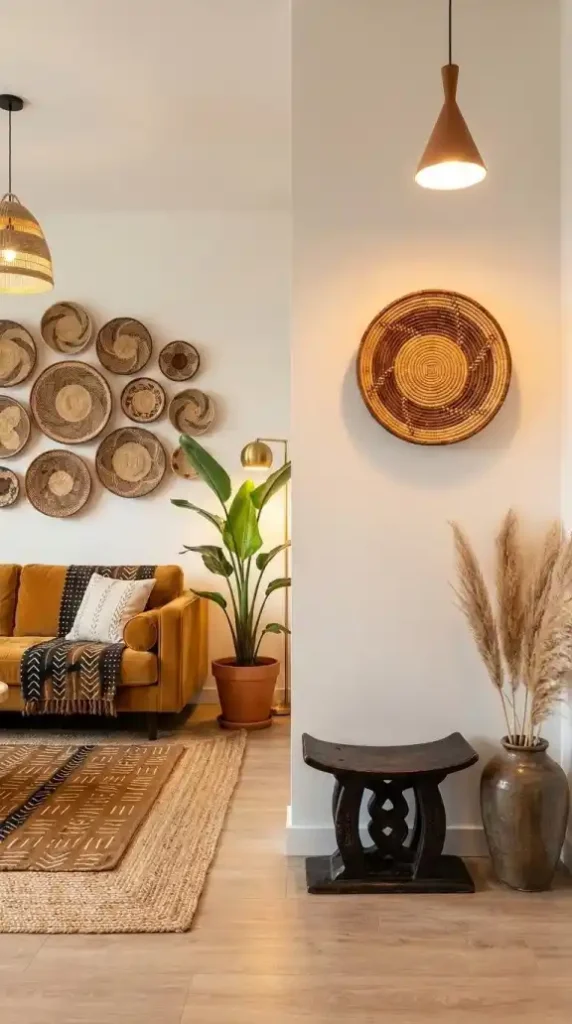
The Afro Bohemian decor system is scalable — it applies at the full living room scale with equal coherence to a transitional corridor or a single styled corner.
In large rooms the full system operates: velvet sofa anchoring the seating zone, layered jute and kilim rug at the floor, basket gallery and mask composition at the primary wall, Bird of Paradise at the far corner, dried pampas at the console position, Kuba cloth wall panel above the sofa, macro photography at the gallery wall’s secondary position.
In smaller rooms or individual zones the system scales down proportionally: a single large Tonga basket hung on the wall, one hand-carved Ashanti stool as a side surface, one dried pampas floor vase in a heavy ceramic, one mud cloth runner on a surface. The same High-Low logic, the same material vocabulary, the same palette — applied at the scale the space allows.
The consistency of the material logic across scales is what makes the aesthetic legible throughout the house — the same design language in the living room, the bedroom, the hallway, and the bathroom, calibrated to each room’s spatial constraints rather than forced into a uniform density.
What Makes Afro Bohemian Decor Different From Generic Boho
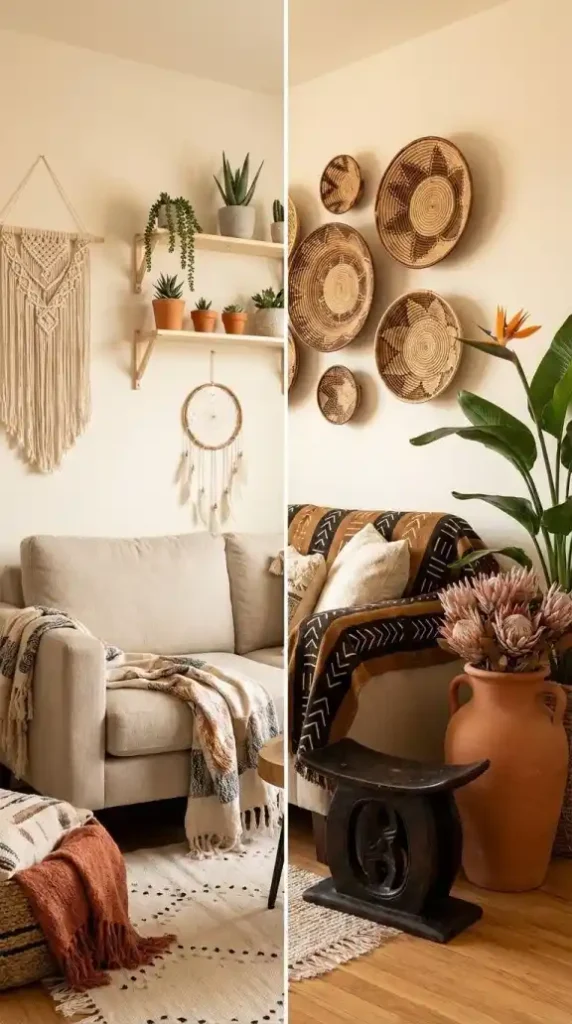
Generic bohemian decor borrows broadly and shallowly from loosely defined global sources.
It has the macramé, the layered rugs, the plants, the vintage finds. But the references are culturally nonspecific — the aesthetic reads as eclectic rather than grounded, as accumulated rather than curated.
Afro Bohemian decor is grounded in cultural specificity.
The mud cloth isn’t a geometric-pattern textile — it’s Bogolan from Mali, with a centuries-old tradition of fermented mud dyeing and pattern systems that carry social and ceremonial meaning. The Ashanti stool isn’t a carved wooden side table — it’s a ceremonial object from the Akan people of Ghana whose form references a specific cultural and spiritual tradition. The Tonga basket isn’t a woven wall piece — it’s a craft tradition from the Tonga people of Zimbabwe with radial geometric patterns developed over generations.
When these objects are chosen with knowledge of their origin rather than purely for their visual appeal, the room doesn’t just look different from generic boho — it reads differently. The cultural depth is materially present in the objects themselves, not applied as a surface interpretation.
That specificity of cultural reference is what gives Afro Bohemian decor its staying power while other aesthetic cycles come and go.
Auditing Your Space for Afro Bohemian Decor Coherence
Walk through any room you’re applying the aesthetic to and answer these questions:
- Is the High-Low Mix operating at every scale — furniture, object, and wall art — or is the room running at one register only? Identify the scale where the contrast is missing and introduce the opposing register there first.
- Can you identify which of the four textile traditions — mud cloth, Kuba cloth, indigo batik, Kente-inspired print — is present in the room? Which is missing? The missing textile tradition is the next textile purchase — not another piece from a tradition already represented.
- Is there at least one hand-carved wood object — an Ashanti stool, a Senufo stool, a carved mask, a dark wood serving bowl — at the furniture or object scale? If every wood surface in the room is machine-finished the ancestral craft register is absent from the material vocabulary.
- Are both greenery registers present — living tropical plants and dried botanical arrangements in heavy ceramic vases? If only one register is present the botanical layer reads as incomplete.
- Is the wall functioning as a heritage gallery — basket cluster, carved mask, macro photography, beaded piece — at four distinct scales? Or is it carrying only flat framed art? Identify which gallery layer is missing and address it before adding more pieces in the layers already represented.
- Does the room read as culturally grounded or culturally generic? The test is simple: could the same objects exist in a standard bohemian room without their cultural origin being apparent? If yes the cultural specificity of the Afro Bohemian system needs to be strengthened through more intentional object selection.
Afro Bohemian decor works because it resolves the tension between earthy minimalism and high-energy maximalism not by choosing between them but by applying each where it belongs.
The earth tones and natural materials provide the grounding. The bold African patterns and jewel tone accents provide the energy. The hand-carved ancestral artifacts provide the cultural depth. The contemporary modern silhouettes provide the functional clarity.
And the High-Low Mix — the productive tension between all of these registers operating simultaneously in the same space — produces a room that reads as neither decorated nor curated.
It reads as inhabited. By someone who knows exactly where every object comes from and exactly why it belongs.
While You’re Here:
- 11 Afro Bohemian Decor Ideas for a Warm and Layered Home — See the High-Low principle, the mud cloth anchor, and the dual botanical register applied across 11 specific decor moves, each one building the conditions for the next.
- How to Style Afro Bohemian Decor in Any Room — Follow the full ten-step styling sequence — from lighting setup to sensory finishing layer — in the exact order that makes the system work at any room scale.
- Afro Bohemian Decor for Beginners: What to Buy First — If the High-Low logic and four-layer wall gallery feel abstract, start here with the ten anchor pieces and the exact buying sequence that makes both principles concrete from the first purchase.