Afro Bohemian Office: The Complete Style Guide
The office is the room where the Afro Bohemian aesthetic faces its most demanding constraint — it has to be beautiful and functional simultaneously.
Every other room in the house is built for rest, social engagement, or personal expression. The office is built for output. Which means the layered maximalism that makes the living room and bedroom perform so powerfully has to be applied with a different logic — one that concentrates visual complexity at the walls and floor while keeping the immediate work surface clear enough to support sustained cognitive engagement.
This isn’t a compromise of the aesthetic. It’s the most intelligent application of it.
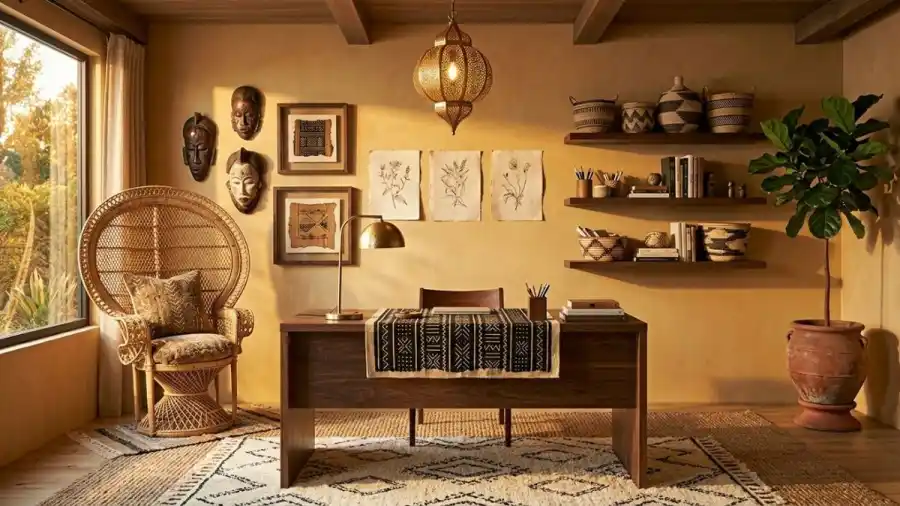
The Afro Bohemian office channels the full visual language — mud cloth, carved wood, Bolga baskets, gallery walls, warm lighting, abundant greenery — into the zones of the room that the working eye doesn’t need to process constantly. The desk surface stays minimalist and tactile. The walls carry the heritage gallery. The floor carries the layered rugs. The corner carries the reading nook. The light carries the golden hour glow.
Soulful maximalism in the right places. Productive clarity where it matters.
Quick Takeaway:
- Concentrate the maximalist pattern and texture at the walls and floor — keep the immediate desk surface relatively minimal and tactile to avoid visual fatigue during long working hours.
- The tech-organic balance is resolved through hidden cable management in woven baskets, warm Moroccan lantern or raffia pendant lighting, and brass desk accents that bridge the contemporary and the handmade.
- The reading nook — a rattan peacock chair or Malawi cane chair with a mud cloth cushion — is the room’s secondary zone that separates creative thinking from task-focused work.
The Core Design Principle: Maximalism at the Walls, Minimalism at the Desk
The Afro Bohemian office works when it understands the difference between the zones a working eye processes continuously and the zones it rests on peripherally.
The desk surface is a continuous processing zone — the surface the working eye returns to every few seconds throughout the day. Visual complexity at this zone creates cognitive fatigue. A busy patterned desk surface, a cluttered arrangement of decorative objects, a visually demanding textile directly in the sightline — all of these reduce the room’s functional effectiveness as a workspace regardless of how aesthetically correct they are.
The walls, floor, and corner zones are peripheral rest zones — the surfaces the working eye visits intermittently rather than continuously. Visual richness at these zones provides the sensory depth and cultural warmth of the aesthetic without compromising the cognitive clarity the desk demands.
The practical application is straightforward: concentrate the mud cloth, the gallery wall, the Bolga baskets, the layered rugs, and the statement plants at the walls, shelves, floor, and corner. Keep the desk surface to three tactile objects maximum — a brass lamp, a terracotta stationery holder, and a mud cloth desk runner that adds texture without pattern complexity at close range.
This principle is what separates a functional Afro Bohemian office from a beautifully styled room that’s exhausting to work in.
The Desk: Reclaimed Wood as the Functional Foundation
The reclaimed wood desk is the office’s primary furniture piece — and it carries the same grounding material logic as the live-edge coffee table in the living room and the teak vanity in the bathroom.
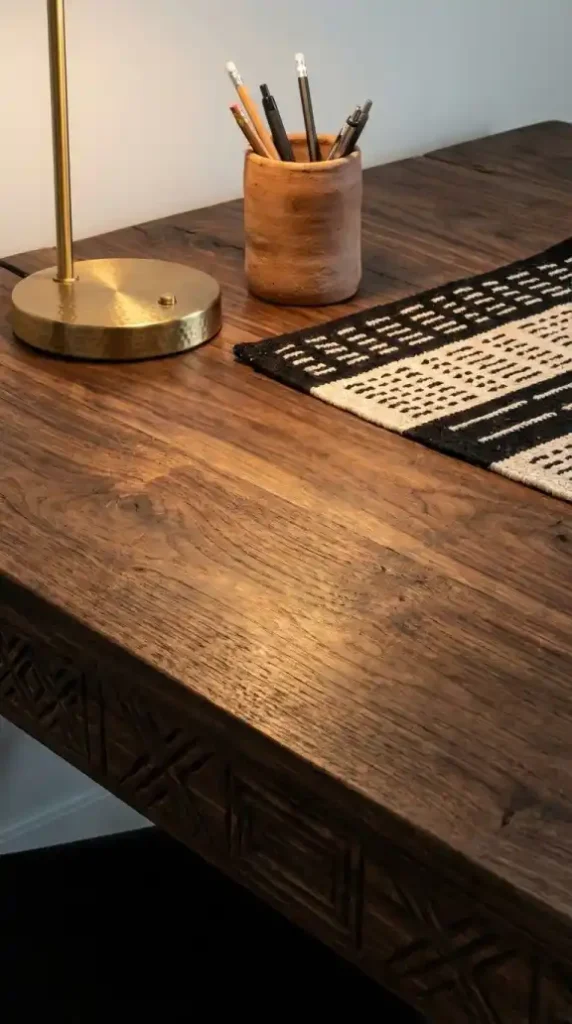
Dark walnut or ebony-stained reclaimed wood with visible grain variation and hand-carved geometric motif detail on the desk face delivers the handmade heritage object quality that mass-produced office furniture eliminates.
The carved motif detail on the desk face — visible from the seated position — provides the cultural reference at close range without occupying any desk surface area. It’s the detail that the working eye passes over rather than processing, registering the aesthetic’s depth without demanding cognitive attention.
The desk surface itself is kept to three objects maximum.
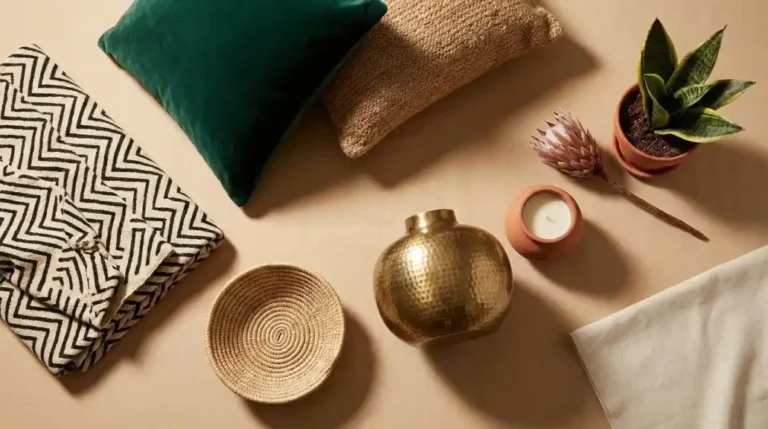
A minimalist brass desk lamp — the only contemporary-adjacent piece on the desk surface — provides the warm task light that makes the work surface functional. Its brass finish bridges the contemporary tech-organic balance at the most intimate desk position.
A small terracotta vessel holding pens, pencils, and stationery. Functional. Materially correct. Contributing to the earth pigment palette at the desk’s most practical object position.
A short mud cloth desk runner — not a full desk covering — adds the natural fiber texture layer at close range without introducing the pattern complexity that a full mud cloth surface would create at sustained viewing distance.
The Chair: Functional Desk Chair and Reading Nook Seating
The Afro Bohemian office runs on two seating positions — the functional desk chair and the reading nook chair — and both carry distinct material identities.
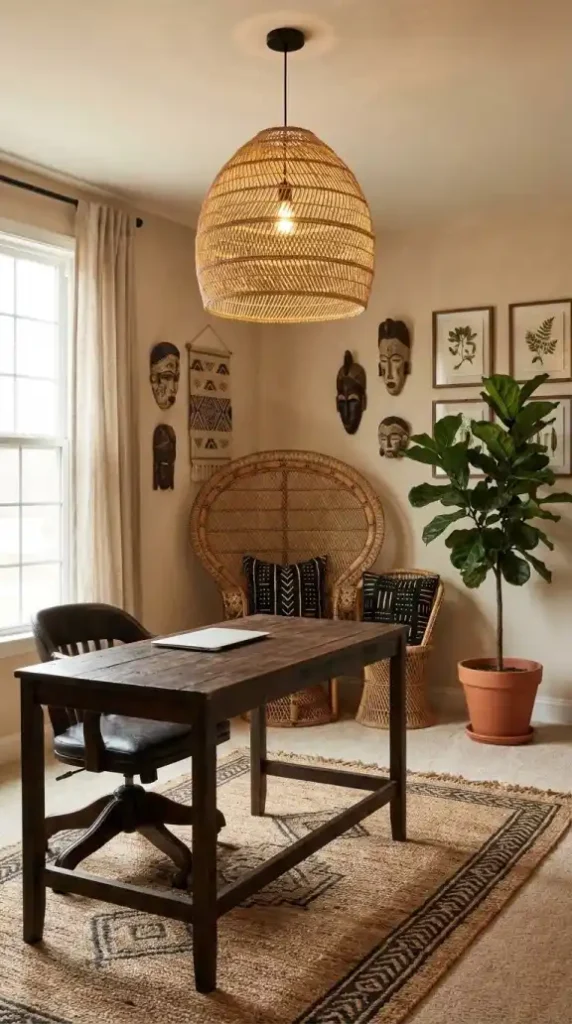
The desk chair is the functional seating piece — and in this aesthetic it sits at the intersection of the contemporary and the handmade. A deeply saturated velvet desk chair in forest green or rust carries the velvet maximalist touch at the primary work position. A dark leather chair with aged patina provides the lived-in material quality at a more restrained register. Either works. Both should be low-arm or armless to sit correctly under the desk surface.
The reading nook is the room’s secondary zone — the place for creative thinking, reading, and the less task-focused work that benefits from a different physical and visual position.
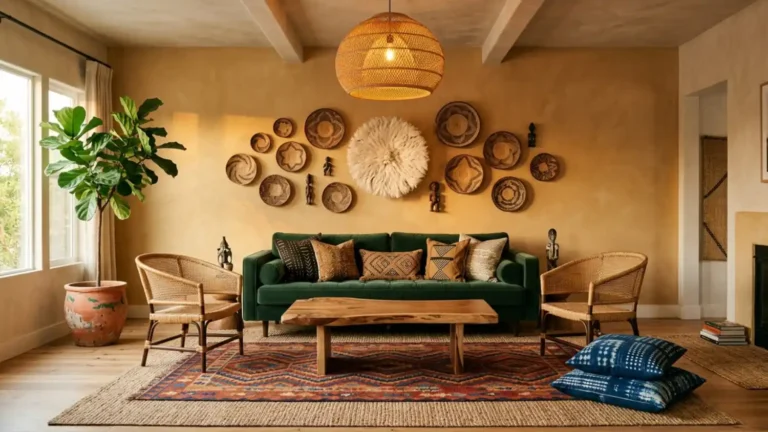
A rattan peacock chair or Malawi cane chair with a mud cloth or Kuba cloth cushion defines the reading nook as a distinct space within the office. The open weave structure of the rattan keeps the corner zone visually light. The mud cloth cushion connects the reading nook to the desk’s textile vocabulary.
The two seating positions together create the Afro Bohemian office’s most important functional distinction: a place to execute and a place to think. That distinction, embedded in the room’s spatial logic, makes the office more productive and more personally meaningful simultaneously.
The Gallery Wall: Office as Curated Cultural Space
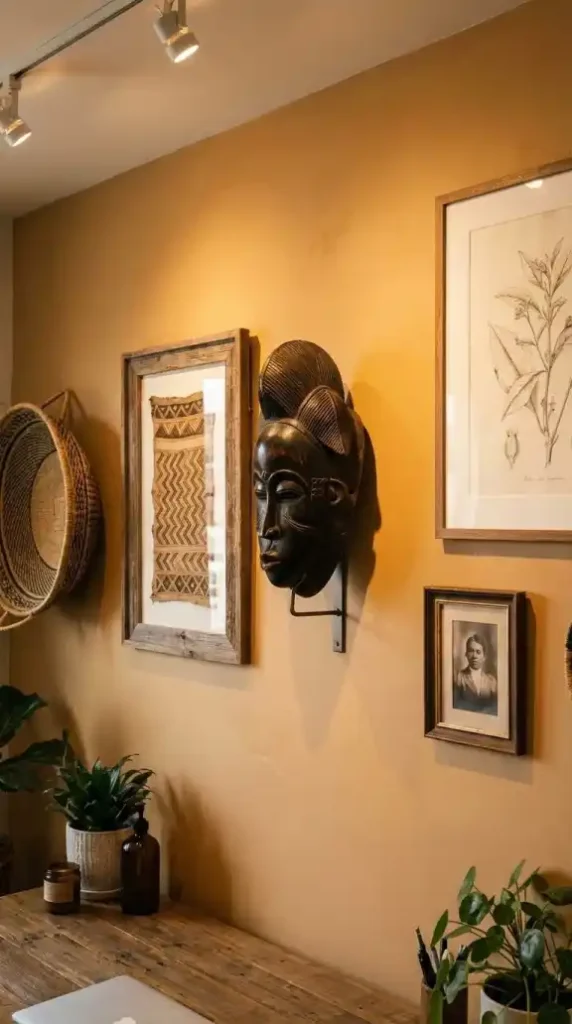
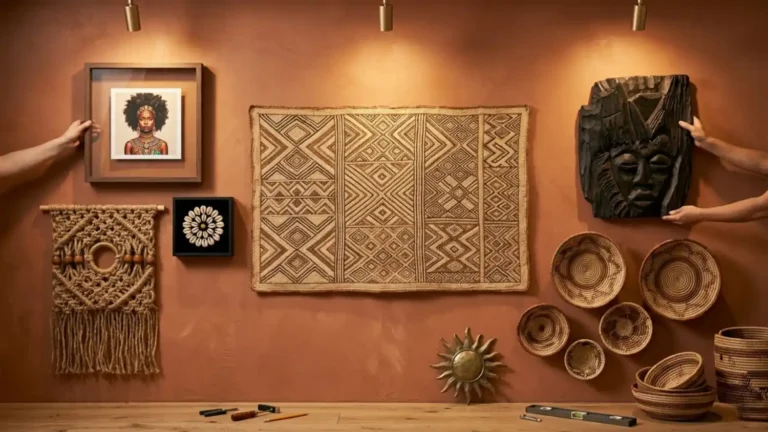
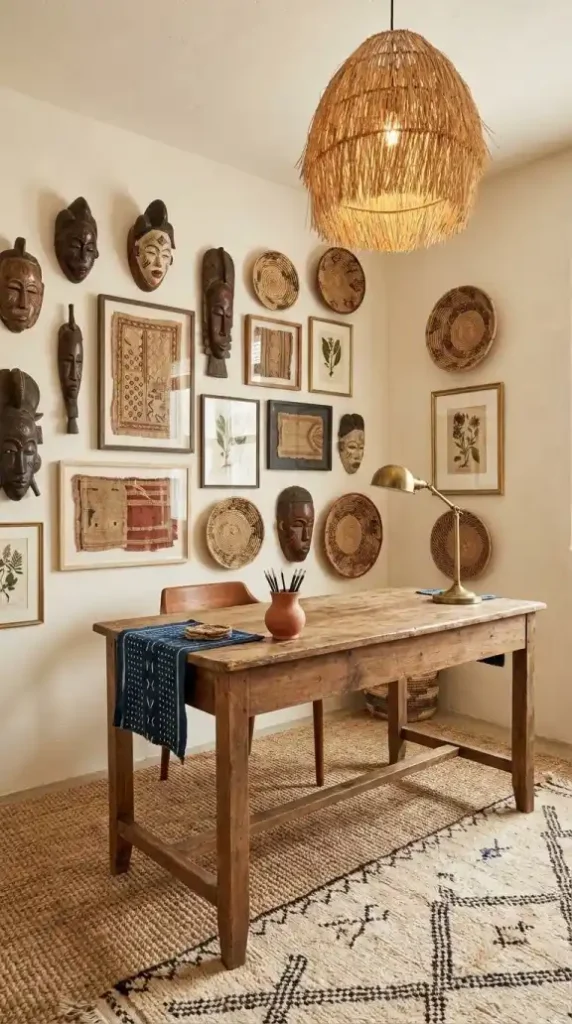
The office gallery wall functions as a curated cultural space — a heritage display that provides visual richness at the peripheral zone where the working eye rests rather than processes.
The gallery composition operates across four distinct object categories at four distinct scales — creating depth across viewing distances that makes the wall feel expansive rather than flat.
African masks and statues at the primary focal point position. A carved wooden or brass mask mounted on a museum bracket at the gallery’s center axis — the piece with the most cultural weight and the most three-dimensional surface detail. Its carved relief catches warm track light in deep highlight and shadow that flat framed pieces can’t replicate.
Framed Kuba cloth or mud cloth textile fragments at the secondary position — stretched and framed like art, their geometric pattern and raised weave surface adding texture at the mid-scale gallery layer.
Botanical sketches and vintage photography at the tertiary position — framed prints that add contemporary visual language in direct conversation with the traditional craft objects. The botanical sketches reference the greenery in the room’s corner zones. The vintage photography adds the grainy film depth that makes the gallery feel inhabited by history.
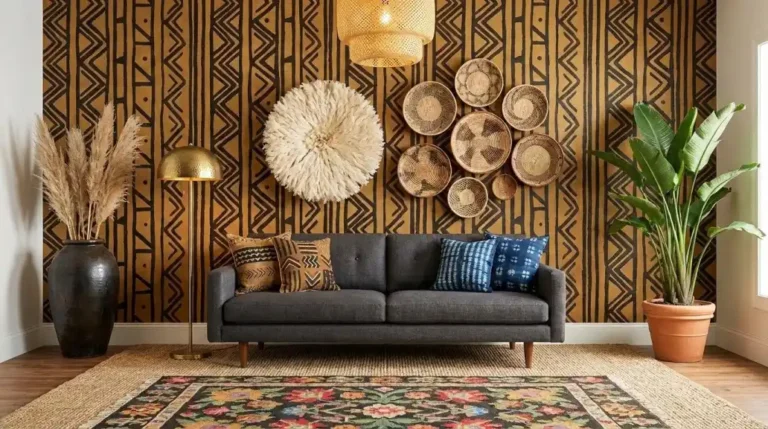
Bolga or Zulu baskets hung as wall elements at the gallery’s outer positions — the circular woven forms that break the rectangular geometry of framed pieces with the same organic logic that baskets break cabinet linearity in the kitchen.
Floating Shelves: Where Function and Display Converge
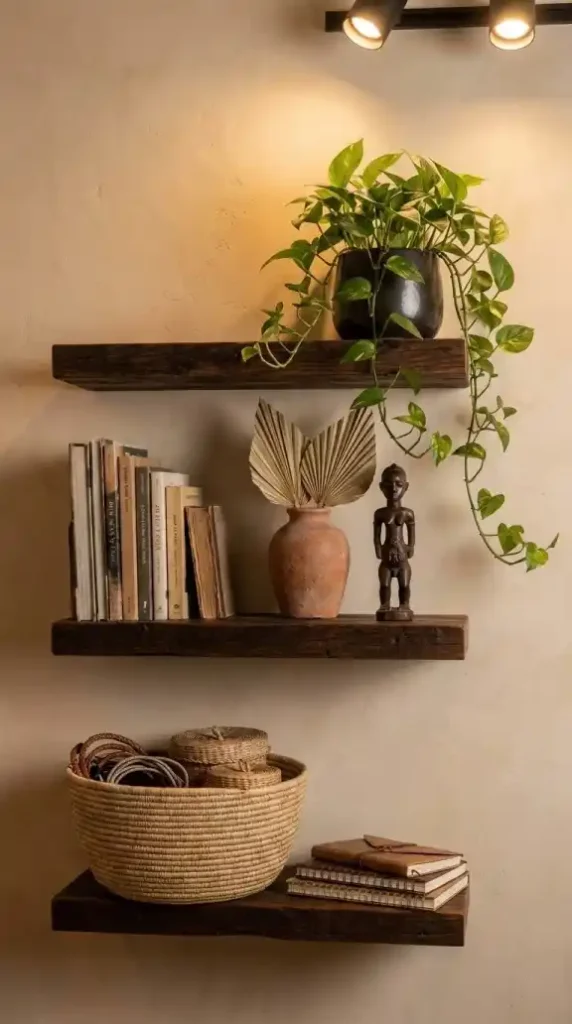
Dark reclaimed wood floating shelves are the office’s primary functional display surface — the zone where Bolga basket storage, book organization, terracotta objects, and greenery operate simultaneously as both practical storage and aesthetic layer.
The shelf styling follows the same three-surface-type rule as every other vignette in the Afro Bohemian system: one rough surface, one smooth surface, one open or structural surface per visible shelf section.
The Bolga and Zulu baskets serve their most important functional role here — they hold cable management supplies, spare office stationery, phone chargers, and small tech accessories behind a woven exterior that reads as a design object from across the room.
This is the tech-organic balance at its most practical application: the modern office’s cable and tech clutter contained within a traditional West African craft object, invisible from the desk position and invisible to video call backgrounds.
Books stacked vertically and horizontally in earth-tone spines add the horizontal surface variation that purely upright shelving eliminates. A terracotta vessel with dried botanicals and a small African carved figurine complete the shelf vignette at the mid and small scale — odd number, varying height, deliberate negative space.
A trailing Pothos at the top shelf cascades downward over the shelf edge — filling the space above the shelving with organic movement and softening the architectural line between the shelf top and the ceiling.
The Layered Rug: Floor Composition for a Functional Space
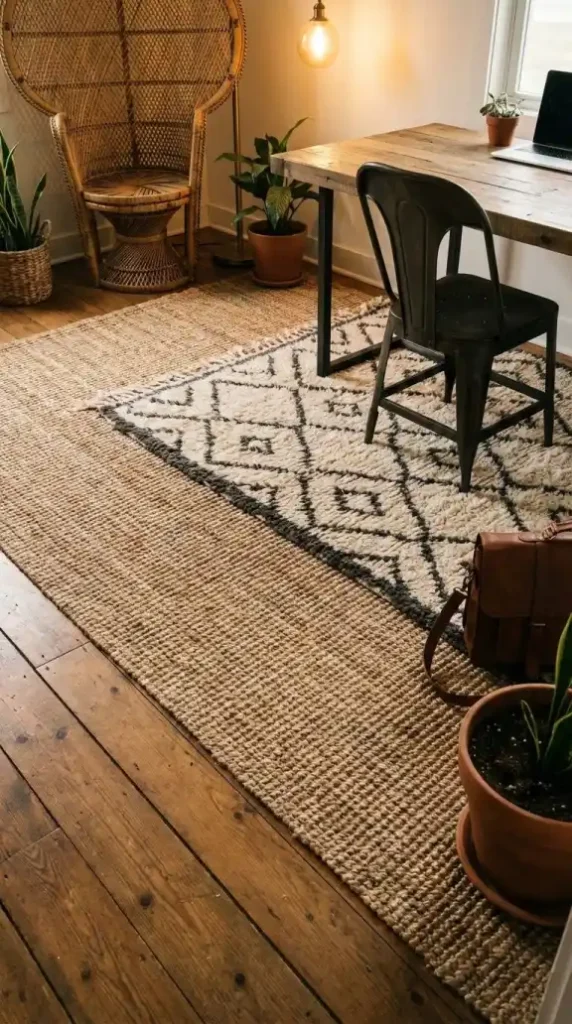
The office floor layer applies the same two-rug logic as the bedroom and living room — with one functional consideration specific to the workspace: the desk chair caster wheels.
A large jute or sisal base rug covers the primary floor zone — extending under the desk, the reading nook chair, and the full working area. Natural jute handles office foot traffic without the pile-compression issues that denser wool rugs experience under daily rolling chair use.
A smaller Moroccan Berber rug in cream and charcoal geometric pattern layered on top at the desk chair position adds the Heritage Accent pattern layer at the floor’s most used zone.
If the desk chair has caster wheels: position the Berber rug so the chair rolls primarily on the jute base rather than the Berber pile. The jute handles caster use without pile distortion. The Berber sits at the desk’s visual center — visible from the entry point and from the reading nook — without bearing the mechanical stress of daily rolling.
A flat-woven kilim in the reading nook corner area is an alternative to the Berber that handles foot traffic better at the secondary seating position — dense flat weave with no pile to compress under the rattan chair’s legs.
Lighting: Moroccan Lanterns, Raffia Pendants, and Brass Task Light
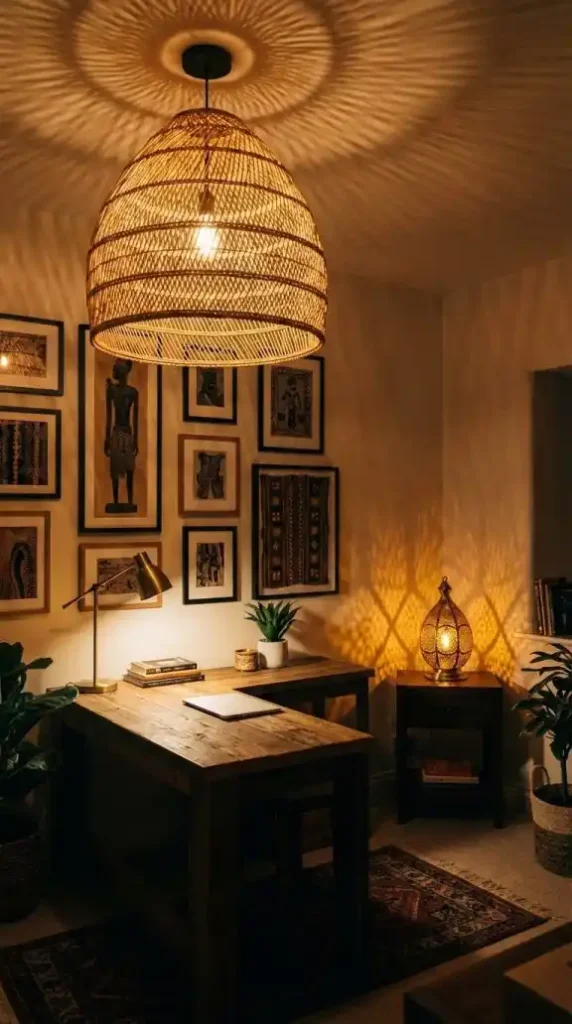
The Afro Bohemian office lighting runs on three sources at three heights — and each source serves a distinct functional and atmospheric purpose.
A raffia or rattan pendant overhead is the room’s primary atmospheric source. The open weave casts intricate shadow projections across the ceiling and gallery wall after dark — adding a visual layer to the room’s peripheral zones that deepens the cultural richness of the gallery wall composition without requiring additional objects.
A minimalist brass desk lamp at the work surface is the task light — focused, warm, directional. The brass finish bridges the contemporary and handmade material registers at the desk position. It’s the room’s most contemporary-adjacent object and it works precisely because its scale is small enough to be framed by the organic elements around it rather than dominating them.
A Moroccan lantern on a side table beside the reading nook provides the third light source at the peripheral zone — casting geometric amber pattern projections onto the adjacent wall that shift with the candle or bulb inside. The Moroccan lantern is the office’s most atmospheric single lighting piece — its projected geometric patterns add a fifth design layer to the reading nook zone that exists only after dark.
All three sources at 2700K. Overhead fluorescents and cool-white downlights are the single fastest way to flatten every earth-pigment surface in the office and destroy the golden hour glow the palette depends on.
The Tech-Organic Balance: Hiding the Modern Within the Handmade
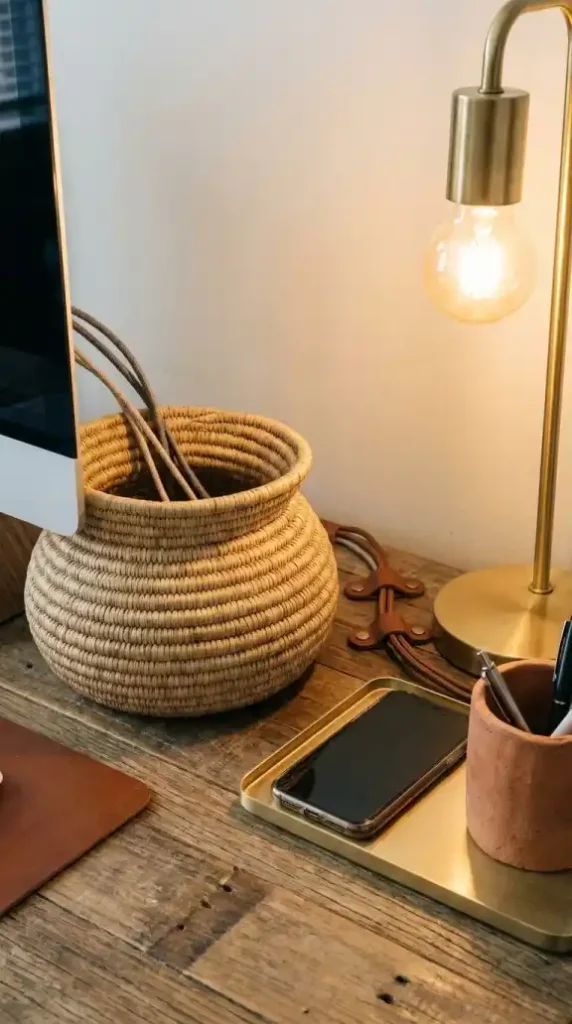
The modern office’s most aesthetically disruptive elements — cables, power strips, tech accessories, charging stations — are also its most functionally essential ones.
The tech-organic balance resolves this tension through concealment and material substitution rather than elimination.
Bolga baskets on the desk surface and shelving hold power strips, cable management supplies, and charging cables inside their woven exteriors. From the desk position and from the room entry point, the basket reads as a decorative Ghanaian craft object. From the back of the basket, every cable exits through the open weave in an organized system.
Leather cord organizers along the desk back edge route remaining visible cables through a material that reads as cohesive with the aesthetic’s leather pouf and aged patina vocabulary — tan or deep brown leather cord clips rather than plastic cable management clips.
A minimalist brass wireless charging tray beside the terracotta stationery holder provides the charging function at the desk surface level through an object that contributes to the brass accent layer rather than disrupting it.
The monitor — the office’s most unavoidable contemporary object — is positioned so the gallery wall reads as its background from the desk chair’s perspective. Video calls project the heritage gallery wall as the visual backdrop — which is both functionally correct and aesthetically intentional.
Greenery: The Organic Layer That Activates the Workspace
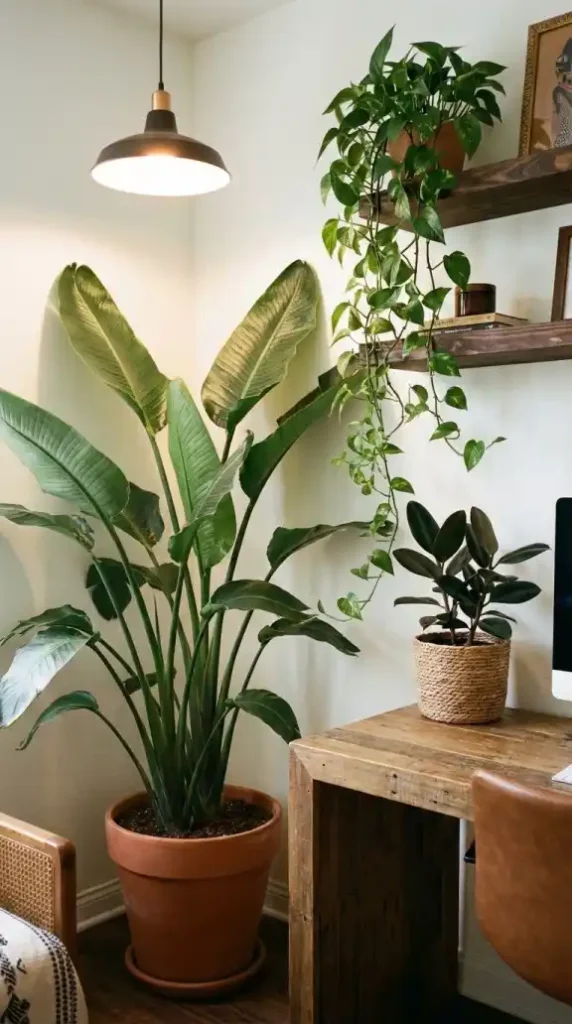
Greenery in the Afro Bohemian office is both structural and productivity-functional — plants in a workspace are documented to reduce stress, increase focus, and improve air quality in enclosed rooms.
Three positions. Three plant scales. Three spatial zones.
The large corner zone: a Bird of Paradise or Fiddle Leaf Fig in a terracotta pot at the office’s most open corner. The broad tropical leaf silhouette fills the floor-to-ceiling zone with botanical drama — a foreground presence the eye rests on during thinking pauses rather than processing as work content.
The high shelf zone: a trailing Pothos or Spider Plant cascading from the top of the floating shelves. The vines fill the upper wall zone above the shelving with organic movement — softening the hard architectural line between the shelf top and ceiling and providing the cascading greenery layer the boho side of the aesthetic requires.
The desk zone: a small Rubber Tree or Snake Plant in a woven basket planter or glazed ceramic pot at the desk surface corner — positioned so it doesn’t obstruct the monitor sightline. The close-range botanical presence at the desk provides the most direct productivity benefit — the plant the working eye rests on during micro-pauses between tasks.
Container materials vary by zone: terracotta for the floor corner plant, dark ceramic for the high shelf trailing plant, woven basket for the desk surface plant. Three distinct container materials at three distinct heights — the container vocabulary as varied as the plant selection.
Auditing Your Office Before You Change Anything
Walk through the space and answer these questions first:
- Is there a clear distinction between the desk surface zone and the wall and floor zones in terms of visual complexity? If the desk surface is as visually dense as the gallery wall the functional logic of the space is inverted — the maximalist layer needs to be relocated to the peripheral zones before any additional elements are introduced.
- What is the current lighting situation? Overhead fluorescents or cool-white downlights need to be replaced with a raffia or rattan pendant and a brass desk lamp before any surface or object is evaluated under its actual conditions.
- Is there a wall large enough to hold a gallery composition — mask, framed textile fragment, botanical print, and basket cluster — at four distinct scales? Measure before buying any wall piece. The gallery needs a wall with at least 180cm width to hold a composed multi-element arrangement without crowding.
- Is there a corner with enough floor space and indirect natural light for a Bird of Paradise or Fiddle Leaf Fig? Identify the position before buying the plant.
- Are the current cables and tech accessories visible from the desk chair position? Identify which Bolga basket size can conceal the power strip and cable management system at the desk surface or shelf position before buying the basket.
- Is there space for a reading nook — a corner or wall section with enough floor clearance for a rattan peacock chair and a small side table? The reading nook requires approximately 80cm square of floor space and a clear sightline away from the desk to function as a genuinely distinct cognitive zone.
The Afro Bohemian office resolves the tension between soulful maximalism and productive functionality not by compromising one for the other but by applying each to the zones of the room that benefit from it.
The gallery wall carries the heritage depth. The layered rugs carry the textile richness. The reading nook carries the contemplative warmth. The Bolga baskets carry the craft object logic into the functional storage layer. The raffia pendant and Moroccan lantern carry the golden hour atmosphere.
The desk carries none of this. The desk is clear, tactile, and minimal — a reclaimed walnut surface with a brass lamp, a terracotta pen holder, and a short mud cloth runner that adds texture without demanding attention.
That’s not a limitation of the aesthetic. That’s the aesthetic at its most intelligent — knowing precisely where each element belongs and applying it there with full commitment.
Take the Afro Bohemian Office further:
- 11 Afro Bohemian Office Ideas for a Warm and Productive Space — Pull 11 specific ideas organized by desk zone, wall layer, and reading nook
- How to Style an Afro Bohemian Office — Follow the full room-building sequence from lighting installation to the final sensory layer
- Afro Bohemian Office Decor Must-Haves for Beginners — Get the exact pieces and two-track buying sequence if you’re starting from scratch