Afro Bohemian Wallpaper: The Complete Style Guide
Wallpaper is the Afro Bohemian room’s most powerful single surface decision — and the most consequential one to get wrong.
Every other element in the room can be repositioned, replaced, or removed without structural commitment. Wallpaper changes the room’s architectural register — it transforms a neutral background into an active design participant that every other element responds to rather than sits in front of.
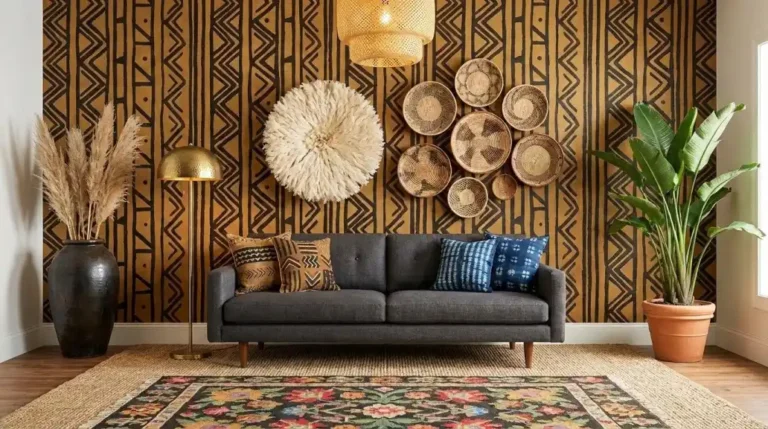
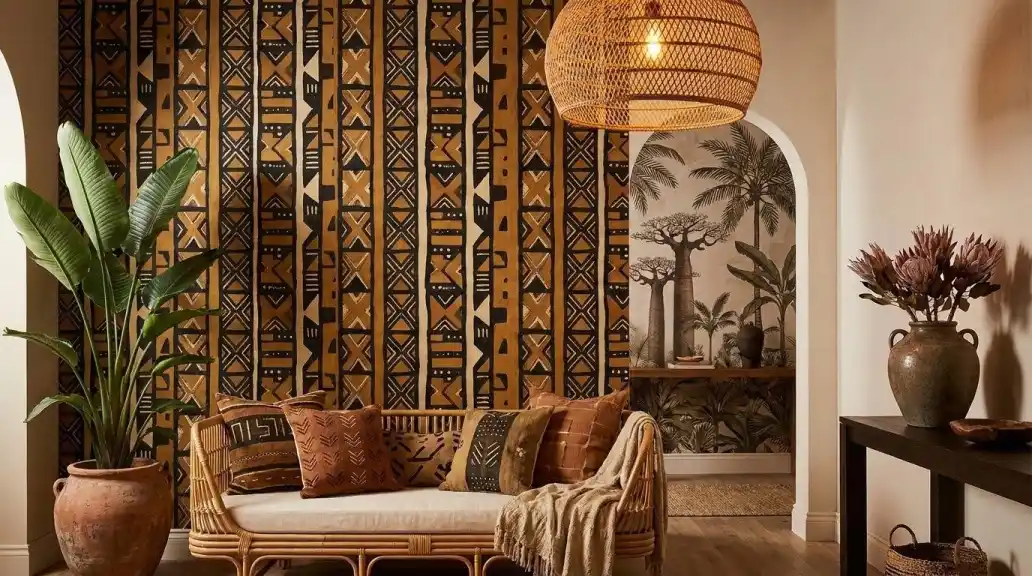
When it’s correct — a bold mud cloth geometric pattern in ochre and warm black behind a low rattan sofa, or a lush botanical mural featuring protea and Bird of Paradise on a terracotta ground behind a carved wood console — the wallpaper makes the room feel like it was designed from the inside out rather than decorated from the outside in.
When it’s wrong — a generic botanical print that could belong to any aesthetic, a pattern that competes with the textile layer rather than anchoring it — the wallpaper becomes the most expensive design mistake in the room because it’s the hardest to undo.
This guide covers the full Afro Bohemian wallpaper system — from the cultural motifs and botanical elements that define the aesthetic to the palette, application logic, and room-by-room considerations that make wallpaper work as the room’s design foundation rather than its dominant distraction.
Quick Takeaway:
- Afro Bohemian wallpaper operates across five motif categories — cultural geometric patterns, botanical elements, textural material simulation, figural mask imagery, and Adinkra symbol systems — each applied at a distinct wall position and scale.
- The one-wall rule is non-negotiable in most rooms — one accent wall at full pattern commitment, every adjacent wall in the Grounded Neutral palette. The pattern concentration on one surface makes the wallpaper more impactful than distributing it across all four walls.
- The wallpaper’s colorway is chosen in response to the room’s existing earth palette — ochre and warm black for rooms running on High Contrast, terracotta and sage for rooms running on botanical warmth, indigo and cream for rooms needing the cooling Life tone accent.
The Five Wallpaper Motif Categories
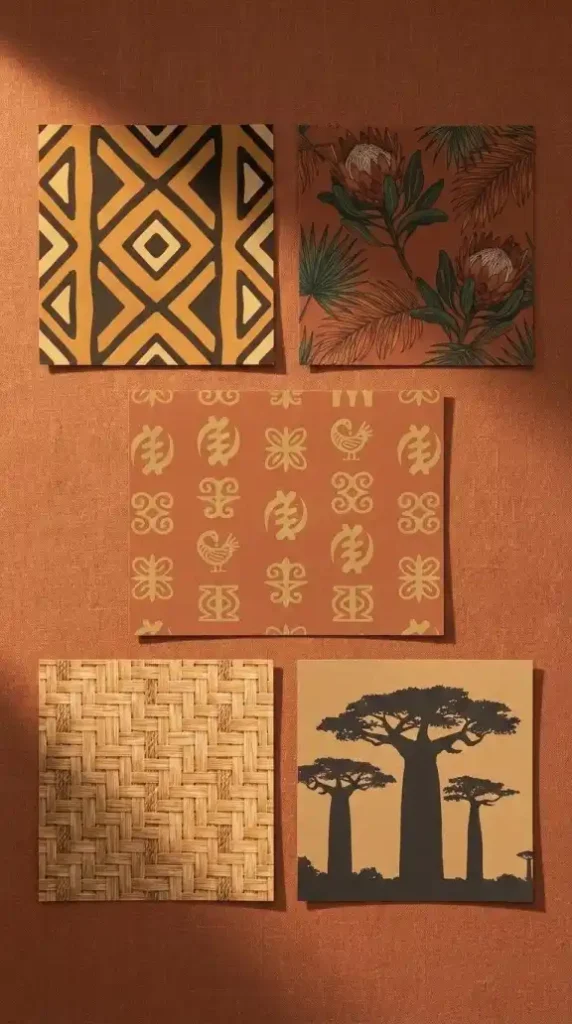
Five wallpaper motif categories define the Afro Bohemian wallpaper vocabulary — and understanding which category belongs at which wall position is what separates a cohesive wallpaper application from a pattern collision.
Cultural geometric patterns — mud cloth Bògòlanfini, Kente weave structures, Kuba cloth irregular patchwork — are the High Contrast anchor patterns. Bold geometric repeats in warm black and cream, ochre and umber, or muted gold and terracotta. These belong at the room’s primary accent wall — the most architecturally significant vertical surface — where their visual weight functions as the room’s foundation statement rather than a secondary decoration.
Botanical elements — protea florals, Bird of Paradise forms, baobab and acacia silhouettes, palm fronds and monstera, savannah grass textures — are the Boho half of the equation. Lush, layered, earth-grounded botanical motifs that bring the African landscape indoors in a naturalistic rather than geometric visual language. These work at the accent wall position in rooms where the textile layer is already carrying the geometric pattern load, or as the primary motif in rooms that need the botanical register rather than the geometric one.
Textural material simulation — rattan weave pattern, jute and sisal fiber texture, wicker geometric structure, hammered brass metallic accent — provides the material vocabulary in wallpaper form. Rather than introducing pattern as the primary visual element, these wallpapers simulate the tactile materials the broader Afro Bohemian system relies on — bringing the organic warmth of natural fiber into rooms where installing actual rattan or jute isn’t feasible.
Adinkra symbol systems — West African symbols from the Akan people of Ghana representing concepts and aphorisms — provide the culturally specific symbolic pattern at the wallpaper scale. Gye Nyame, Sankofa, Nyame Dua and other Adinkra symbols rendered in muted gold, terracotta, or charcoal on a warm ground create a wallpaper that functions as both visual pattern and cultural text simultaneously.
Mask imagery — stylized interpretations of Baule, Dan, or Benin bronze mask forms arranged as a repeat pattern or large-scale mural — delivers the figural cultural heritage element at the wallpaper scale. Abstract mask silhouettes in charcoal on cream or muted gold on terracotta create a pattern that carries the ancestral ceremonial depth of actual masks at a two-dimensional wall surface scale.
The Palette System: Global Earth Tones Over Stark Whites
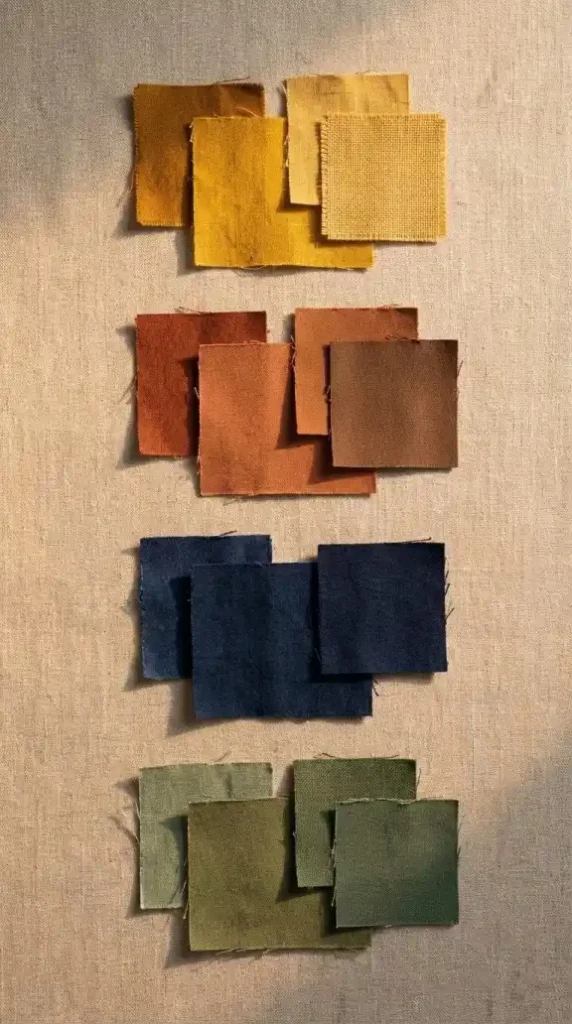
The Afro Bohemian wallpaper palette moves deliberately away from the stark whites and cool greys that dominate conventional wallpaper selections — replacing them with Global Earth Tones that reference the African landscape and traditional pigment traditions.
Ochre and mustard — the deep sun-drenched yellows that read as warm and luminous under 2700K light. Wallpaper with an ochre ground transforms an entire wall into a warm light-reflective surface — making the room feel as if it’s perpetually bathed in golden afternoon light. Against a mud cloth geometric pattern in warm black this ochre ground is the most classically Afro Bohemian single wallpaper combination available.
Burnt sienna — the primary bridge between red and brown. A burnt sienna ground on botanical wallpaper featuring protea flowers and palm fronds creates the sun-baked earth quality that distinguishes Afro Bohemian botanicals from the standard cool-ground botanical prints that dominate conventional boho wallpaper. The burnt sienna reads as a fired clay tone — connecting the wallpaper’s color to the terracotta pots, the ceramic vessels, and the earth pigment palette throughout the room.
Indigo — the deep blue derived from traditional West African dye pits. Indigo wallpaper provides the cooling Life tone contrast that prevents the warm earth palette from reading as oppressively warm. A hand-painted indigo ground with geometric pattern or Adinkra symbols in cream delivers the cooling accent at the architectural wall scale — the largest possible application of the indigo batik tradition in an interior space.
Sage and olive — the organic greens that ground the palette with botanical life. Sage wallpaper with botanical botanical palm frond or monstera patterns works in rooms where the indigo cooling accent would be too strong — the sage sits closer to the earth palette while still providing the green botanical tone that connects the wallpaper to the room’s living plant layer.
Cultural Geometric Wallpaper: Mud Cloth, Kente, and Adinkra
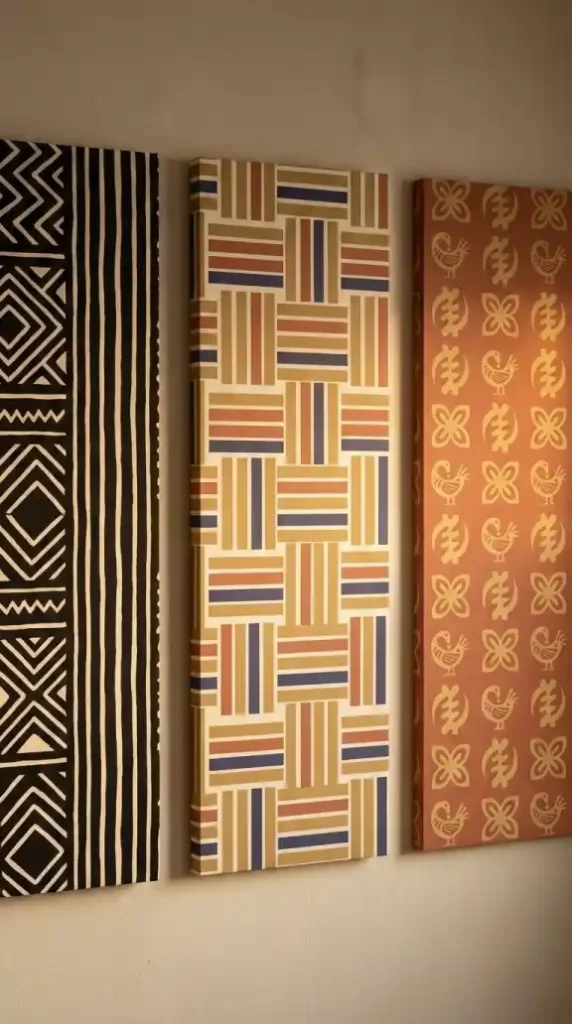
Cultural geometric wallpaper is the Afro Bohemian system’s most architecturally powerful wallpaper category — the patterns with enough visual weight to function as a room’s primary design foundation rather than its accent element.
Mud cloth geometric wallpaper — bold linear geometric patterns in warm black and cream or ochre and umber, hand-painted or digitally rendered to reference the fermented mud dyeing tradition of Bògòlanfini from Mali — delivers the High Contrast pattern at the wall scale that mud cloth textiles deliver at the sofa and bed scale. The geometric language is the same. The scale is architectural.
Kente weave-inspired wallpaper — structured multicolored geometric forms in muted gold, terracotta, and indigo on cream ground — brings the Ghanaian strip weaving tradition to the wall at a scale that makes each geometric unit readable from across the room. The muted color interpretation keeps the pattern within the earth palette rather than at the traditional high-chroma Kente colorway that would dominate rather than anchor a room.
Adinkra symbol wallpaper — a grid of West African symbolic forms in muted gold or terracotta on a warm ground — is the most culturally specific wallpaper pattern available in this aesthetic. Each Adinkra symbol carries a specific conceptual meaning: Gye Nyame represents the supremacy of God, Sankofa represents the importance of learning from the past, Nyame Dua represents God’s presence and protection. A wall covered in Adinkra symbols is not merely decorated — it’s inscribed with meaning at the architectural scale.
Botanical Wallpaper: African Flora at the Maximalist Scale
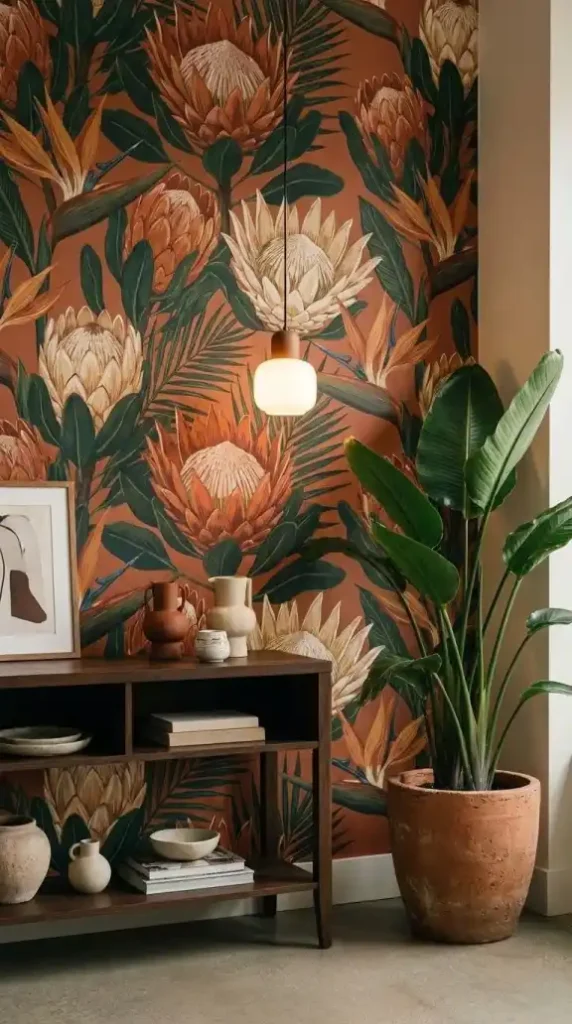
Botanical wallpaper is the Boho half of the Afro Bohemian equation applied at the wall surface scale — bringing the African landscape’s flora indoors in a maximalist visual language that living plants can’t achieve at the wall position.
Protea wallpaper — featuring South Africa’s national flower in its distinctive sculptural form — introduces a botanical motif that is both exotic and earth-grounded. Protea flowers on a burnt sienna or terracotta background create a sun-baked botanical quality that instantly differentiates the pattern from the standard pastel-ground botanical prints of conventional bohemian wallpaper.
Bird of Paradise and palm frond botanical murals create the Jungle Boho sub-niche within the Afro Bohemian wallpaper vocabulary — maximalist scale botanical compositions where individual flower and leaf forms are large enough to read at close range while the overall layered composition reads as lush and immersive from across the room.
Baobab and acacia tree silhouette wallpaper — the iconic African landscape tree forms rendered in charcoal or warm black on a sand or ochre ground — creates a graphic landscape effect at the wall scale. The silhouette approach keeps the pattern within the High Contrast Neutral palette category while delivering the African landscape reference at the architectural surface level.
Savannah grass and dried botanical texture wallpapers — fine repeated line work creating the impression of dried pampas or fountain grass texture on a terracotta or warm sand ground — provide the most subtle botanical wallpaper option. The grassland texture reads as organic surface depth rather than bold botanical pattern — appropriate for rooms where the textile layer is already carrying significant pattern commitment and the wallpaper needs to contribute texture rather than compete at the same visual intensity.
Textural Wallpaper: Rattan, Jute, and Hammered Brass
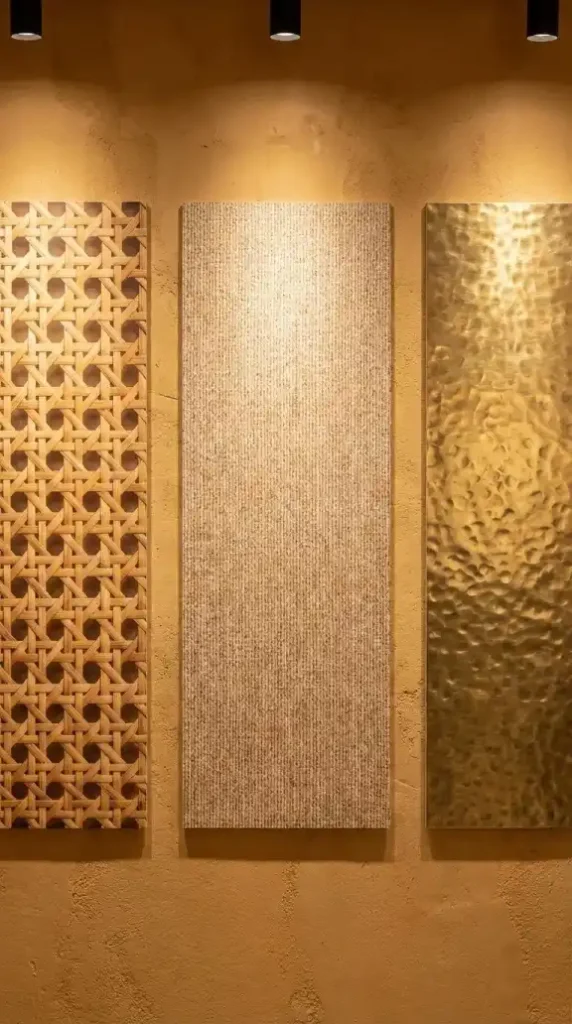
Textural simulation wallpaper brings the Afro Bohemian material vocabulary to wall surfaces in rooms where installing actual rattan, jute, or hammered brass elements isn’t feasible — or as a background layer that deepens the material richness of rooms where those physical materials already exist.
Rattan and wicker weave pattern wallpaper — geometric open-weave patterns in natural honey tones that simulate the visual texture of rattan furniture and basket weave — creates a wall surface that reads as materially cohesive with the rattan pendant overhead and the Malawi cane chair in the reading nook. The rattan weave simulation at the wall scale wraps the room in the natural fiber vocabulary rather than limiting it to furniture and object positions.
Jute and sisal fiber texture wallpaper — fine horizontal line work in warm neutral ochre and sand tones that simulates the rough surface of natural jute fiber — provides a textural neutral ground that carries material warmth without pattern commitment. In rooms where the textile layer is already maximally patterned with mud cloth, Kuba cloth, and kilim, a jute texture wallpaper provides the visual breathing room that a solid paint color would provide — but with the organic material quality that paint can’t replicate.
Hammered brass metallic wallpaper — an irregular surface pattern in warm muted gold that simulates the multiple small light-catch points of a hammered metal surface — is the most luxurious textural wallpaper option in the Afro Bohemian system. Used sparingly — as a single accent wall in a bathroom or a feature panel in a dining room — the hammered gold metallic creates a warm reflective surface that amplifies 2700K light across the room’s full ambient zone.
The One-Wall Rule: Application Logic by Room
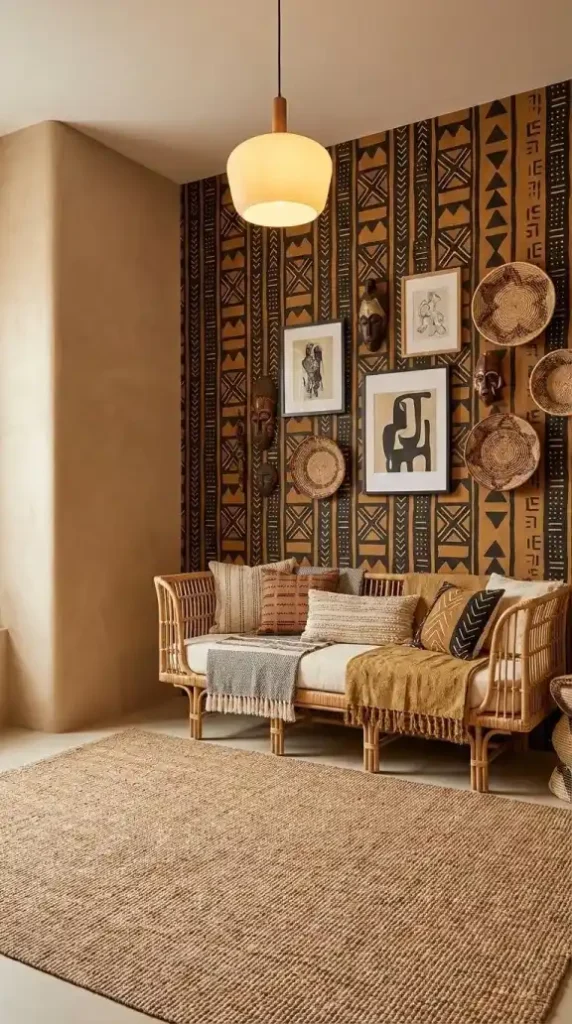
The one-wall rule is the application logic that prevents Afro Bohemian wallpaper from overwhelming the room’s other design layers.
One accent wall at full pattern commitment. Every adjacent wall in the Grounded Neutral palette — warm sand smooth plaster, ochre limewash, or terracotta paint in a solid earth tone.
The pattern concentration on one surface makes the wallpaper more impactful than distributing the same pattern across all four walls — because the adjacent neutral walls provide the visual breathing room that makes the patterned wall read as bold and intentional rather than inescapably busy.
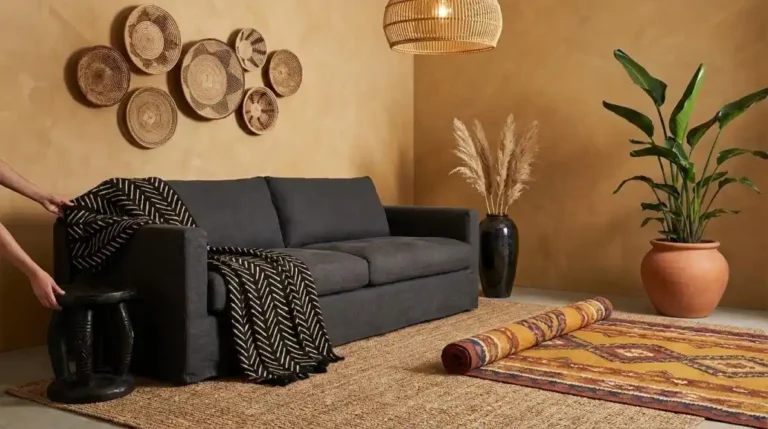
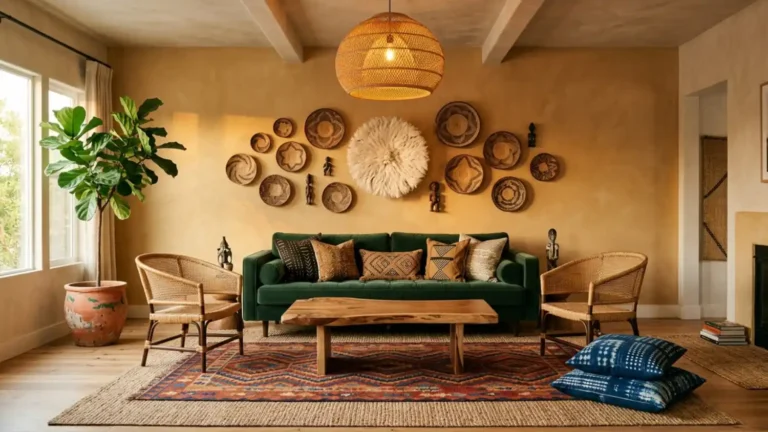
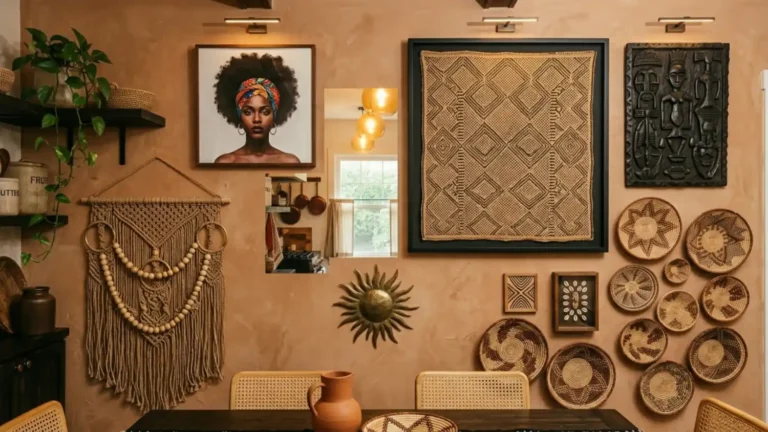
In the living room: the wall behind the primary sofa position is the accent wall. The wallpaper functions as the gallery’s backdrop — the pattern visible behind and around the sofa, the Tonga basket cluster, and the Afro Queen portrait, adding the wall surface depth that painted plaster can’t provide at the same visual richness.
In the bedroom: the wall behind the headboard is the accent wall. The wallpaper functions as the headboard’s architectural extension — the pattern creating a visual zone around the bed that defines the sleeping position as a distinct spatial area within the room.
In the bathroom: any single wall — behind the vanity, behind the toilet, the shower-facing wall — is the accent wall. At bathroom proximity the wallpaper’s pattern reads at close range, making the choice of botanical detail versus geometric boldness more consequential than in larger rooms.
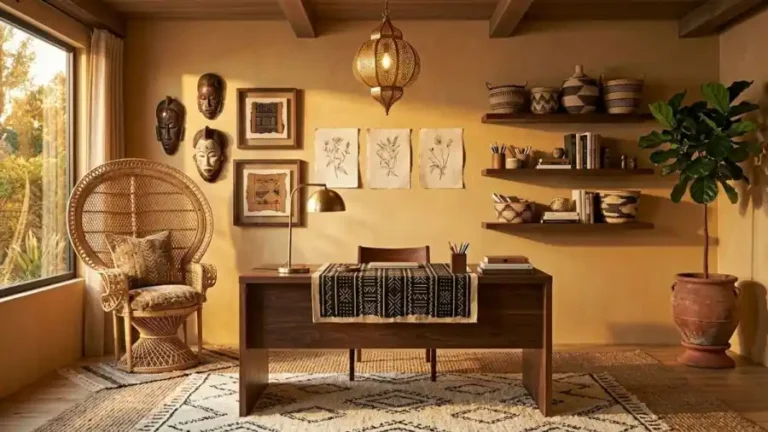
In the office: the wall behind the desk — the wall the monitor faces — is the accent wall. It functions as the gallery wall backdrop and the video call background simultaneously, projecting the Afro Bohemian aesthetic to every person who joins a call.
Artisanal and Hand-Painted Wallpaper: The Human Touch
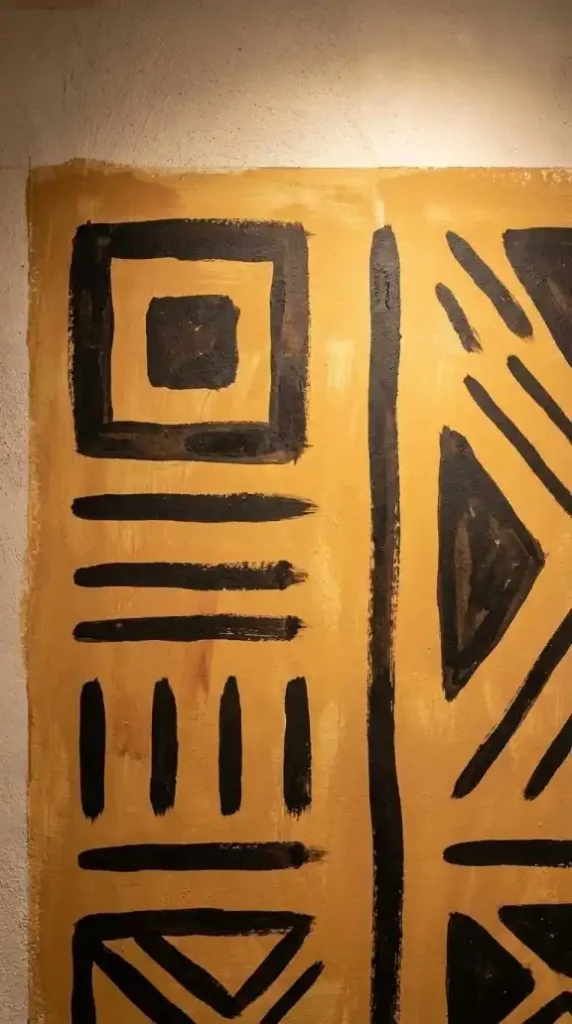
Hand-painted and artisanal wallpaper is the highest expression of the Afro Bohemian wallpaper vocabulary — and the most aligned with the aesthetic’s core value of the human touch over industrial perfection.
Machine-printed wallpaper produces perfectly uniform repeats — every geometric element identical, every color application consistent, every line crisp and regular. Hand-painted wallpaper produces slight irregularity in every unit — brush stroke variation visible in the ground color, slight edge imperfection in the geometric forms, pigment depth variation across the pattern repeat.
That irregularity is not a flaw. It’s the material honesty that makes hand-painted wallpaper read as authentic within the Afro Bohemian system rather than as a mass-produced surface decoration.
The Global Chic aesthetic — a design philosophy centered on cultural appreciation and the marks of human craft — is expressed most completely in wallpaper that carries visible evidence of the hand that made it. An artisan-painted mud cloth mural where each geometric form is slightly different from the last reads as a genuine connection to the Malian textile tradition. A machine-printed mud cloth repeat reads as a visual reference to that tradition from a safe representational distance.
Removable hand-painted wallpaper panels — a modern format that allows artisanal wallpaper to be applied without permanent commitment — bring the human touch to rented spaces, temporary installations, and rooms where reversibility is required without sacrificing the cultural depth that permanent wallpaper installations provide.
Choosing the Right Wallpaper for Your Room’s Existing Palette
Walk through the existing room and answer these questions before committing to any wallpaper pattern or colorway:
- What is the room’s current dominant palette category — Foundation Earth Tones, High Contrast Neutrals, or Lush Accents? The wallpaper should introduce the underrepresented category rather than amplifying the dominant one. A room already running heavily on terracotta and ochre earth tones needs an indigo or sage botanical wallpaper rather than another ochre geometric pattern.
- What pattern scale is the room’s existing textile layer operating at? Identify the geometric repeat scale of the most prominent textile — the mud cloth throw, the kilim rug, the Kuba cloth cushion. The wallpaper pattern should be at a distinctly different scale — either significantly larger or smaller than the existing textile patterns. Same-scale wallpaper and textile patterns create visual competition at two different room surfaces simultaneously.
- Is the room’s existing material layer operating primarily at the geometric or the botanical register? If the textiles are carrying the geometric pattern load the wallpaper should deliver the botanical register and vice versa. The wallpaper category that the textile layer isn’t covering is the wallpaper category the room needs.
- What is the room’s natural light quality? North-facing rooms with limited natural light need an ochre or mustard ground wallpaper that generates warmth from the wall surface itself rather than depending on natural light to activate it. South-facing rooms with strong natural light can support the deeper indigo or charcoal ground wallpapers without the room reading as oppressively dark.
- Is the room a permanent installation or a rental situation? Hand-painted removable wallpaper panels allow the full Afro Bohemian wallpaper vocabulary to be applied in rental spaces without permanent commitment — identifying the correct format before choosing the pattern prevents the most costly application mistake.
Afro Bohemian wallpaper works when it’s understood as the room’s design foundation rather than its surface decoration.
The mud cloth geometric wallpaper behind the sofa isn’t a backdrop for the furniture. It’s the surface the furniture responds to — the pattern that sets the geometric scale, the colorway, and the cultural reference that the Kuba cloth cushions, the Tonga basket gallery, and the Adinkra brass accent piece all read against.
The botanical protea mural in the bedroom isn’t a decorative feature. It’s the architectural extension of the room’s botanical layer — the wall surface participating in the same plant and earth palette that the Bird of Paradise in the corner and the dried pampas in the floor vase are delivering at the object scale.
When wallpaper participates in the room’s design logic at that level of integration — when every other element responds to it rather than sitting in front of it — the Afro Bohemian room achieves the quality that makes it most distinctive.
Not a decorated room. A designed one.
One More Thing:
- 11 Afro Bohemian Wallpaper Ideas for a Warm and Layered Home — Browse 11 specific wallpaper moves across every motif category and room position, each one with the pairing logic that makes it work within the broader room system.
- How to Choose and Style Afro Bohemian Wallpaper — Work through the full two-stage selection and styling process — from motif scale and substrate material to the Rule of Three and color pulling — in the sequence that makes every decision easier than the last.
- Afro Bohemian Wallpaper Must-Haves for Beginners — Start in the right zone, choose the right substrate, and build the Heritage Maximalism system one layer at a time — from the first peel-and-stick panel to the full room application.