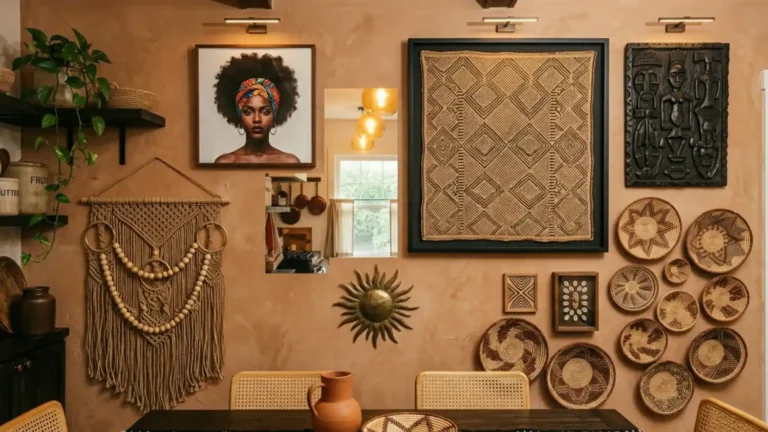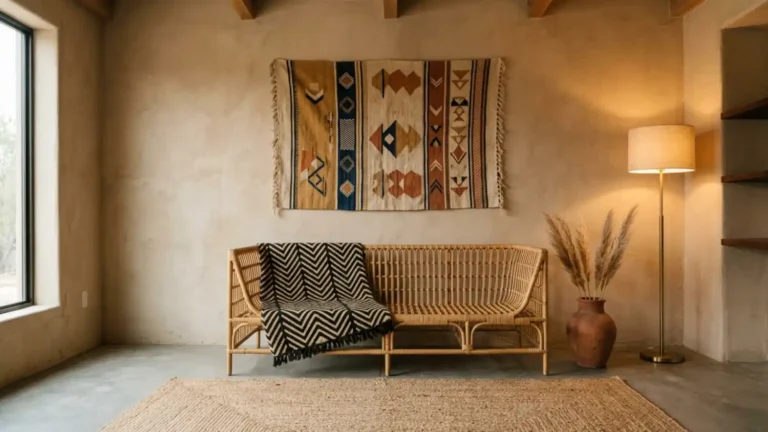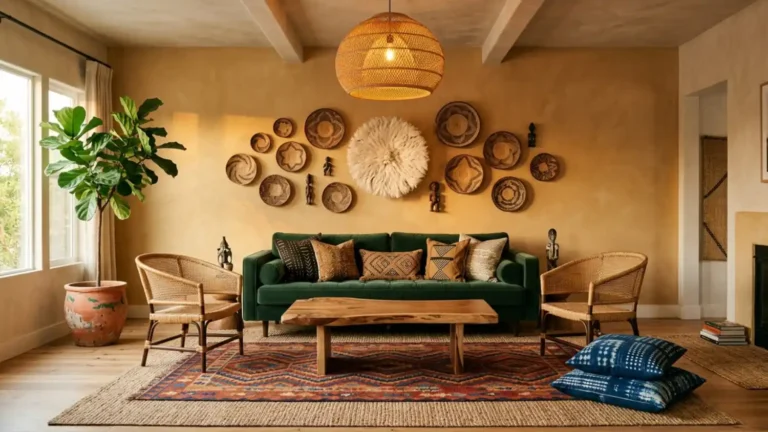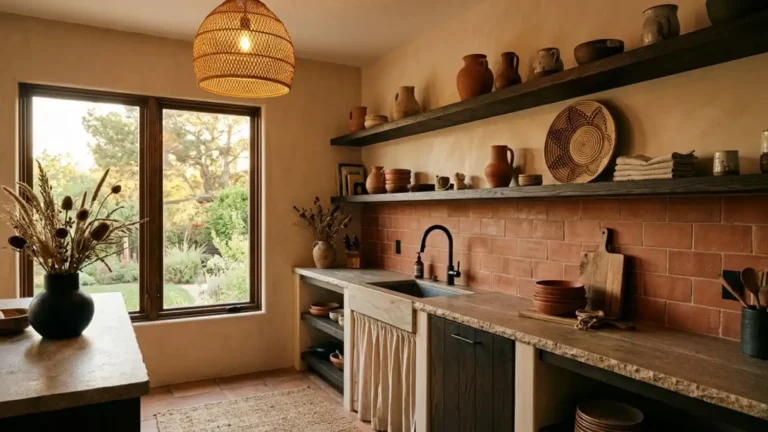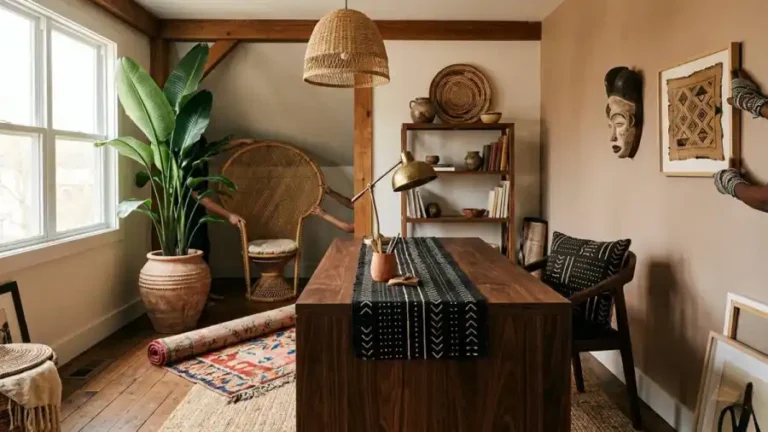
11 Afro Bohemian Wallpaper Ideas for a Warm and Layered Home
Afro Bohemian wallpaper is the room’s most consequential single surface decision.
Everything else — the sofa, the rugs, the textiles, the plants — can be repositioned, swapped, or removed. Wallpaper changes the room’s architectural register. It makes the wall surface an active design participant that every other element responds to rather than a neutral background that objects sit in front of.
These 11 ideas cover the full Afro Bohemian wallpaper vocabulary — from bold mud cloth geometric accent walls to subtle grasscloth texture simulations — with the pairing logic that makes each wallpaper choice work within the broader room system rather than dominating it.
Quick Takeaway:
- One accent wall at full pattern commitment — every adjacent wall stays in the Grounded Neutral earth palette. Pattern concentration on a single surface is more impactful than distributing the same pattern across all four walls.
- The wallpaper category that the room’s textile layer isn’t covering is the wallpaper the room needs — geometric wallpaper in rooms where botanical textiles dominate, botanical wallpaper in rooms where geometric textiles dominate.
- Earthy matte finishes only — chalky clay-like pigments rather than high-gloss surfaces. High-gloss wallpaper reads as contemporary and cool. Matte earthy finishes read as warm, handmade, and materially cohesive with the natural fiber vocabulary of the room.
1. Apply a Mud Cloth Geometric Pattern as the Primary Accent Wall
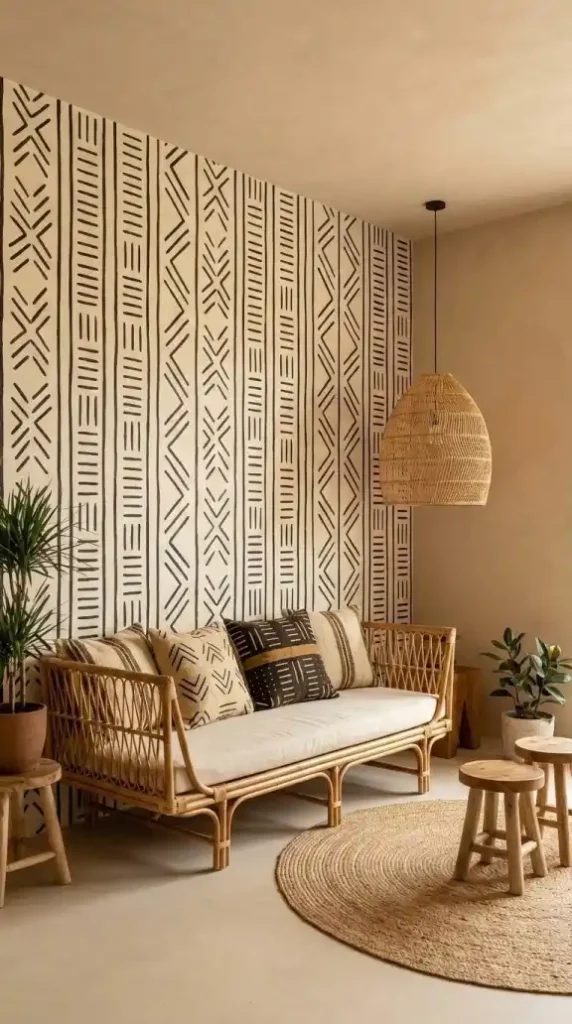
Mud cloth geometric wallpaper — bold linear and geometric patterns in cream and warm black referencing the Bògòlanfini hand-painting tradition of Mali — is the Afro Bohemian wallpaper system’s most architecturally powerful single statement.
The geometric language is the same as the mud cloth throw on the sofa. The scale is architectural.
Applied to the primary accent wall — the wall behind the sofa or behind the bed headboard — the mud cloth wallpaper transforms the room’s most visible vertical surface from a neutral background into the room’s design foundation.
Apply to one wall only.
The adjacent walls stay in warm sand smooth plaster or ochre limewash — the Grounded Neutral palette that makes the patterned accent wall read as bold and intentional rather than overwhelming.
Pair with: a low rattan sofa, Kuba cloth and Adire indigo cushions, a Bird of Paradise in a terracotta pot, and a macramé wall hanging layered at the sofa’s outer edge. The macramé adds the soft tactile layer over the structured geometric wallpaper — the organic jute cord of the fiber art reading against the crisp geometric pattern behind it.
Finish: earthy matte. Never high-gloss. The chalky clay-like pigment quality of matte mud cloth wallpaper reads as hand-painted and authentic. High-gloss reads as a contemporary graphic print.
2. Use Kente-Inspired Geometric Wallpaper as a Bedroom Headboard Wall
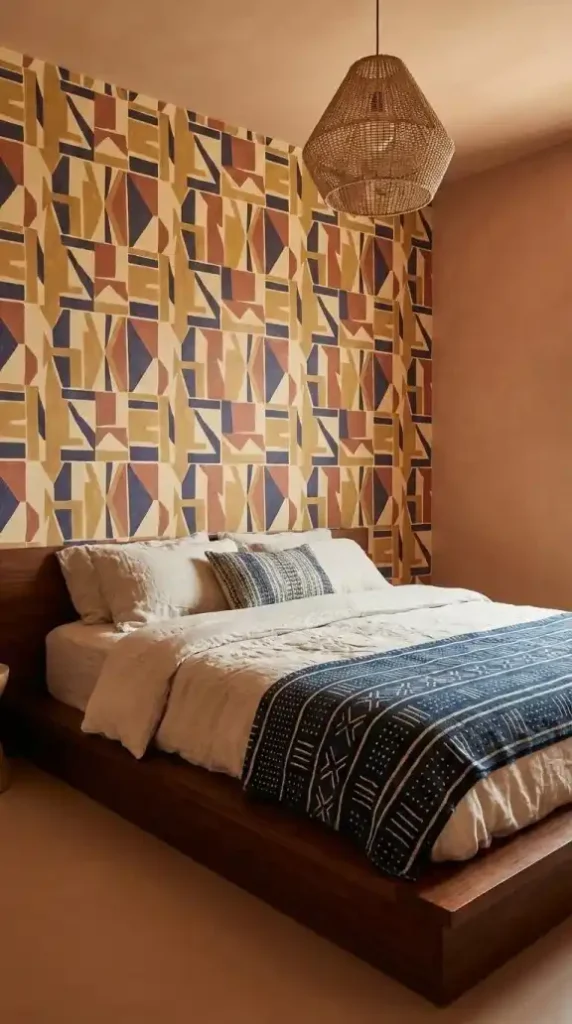
Kente-inspired geometric wallpaper — bold interlocking shapes in muted gold, terracotta, and indigo that mimic the structured strip weaving tradition of Ghana — brings the Ghanaian geometric vocabulary to the bedroom’s headboard wall at an architectural scale that the textile layer alone can’t achieve.
The multicolored geometric structure sits across all three Afro Bohemian palette categories simultaneously — muted gold in the Vibrant category, terracotta in the Grounded category, indigo providing the High Contrast cooling accent.
The headboard wall is the bedroom’s most architecturally significant vertical surface — the wall the sleeping position faces first upon waking and last upon sleeping. A Kente-inspired geometric wallpaper at this position creates a visual architectural zone around the bed that defines the sleeping position as a spatially distinct area within the room.
Pair with: a low dark teak platform bed, bone linen bedding layered with a mud cloth throw at the foot, hammered brass bedside lamps, and a Bird of Paradise in a terracotta pot at the far corner. The dark teak bed frame against the warm multicolored Kente wallpaper creates the High-Low Mix at the furniture-to-wall scale — the contemporary clean-lined bed reading against the ancestral geometric pattern tradition behind it.
3. Hang a Protea and Bird of Paradise Botanical Mural
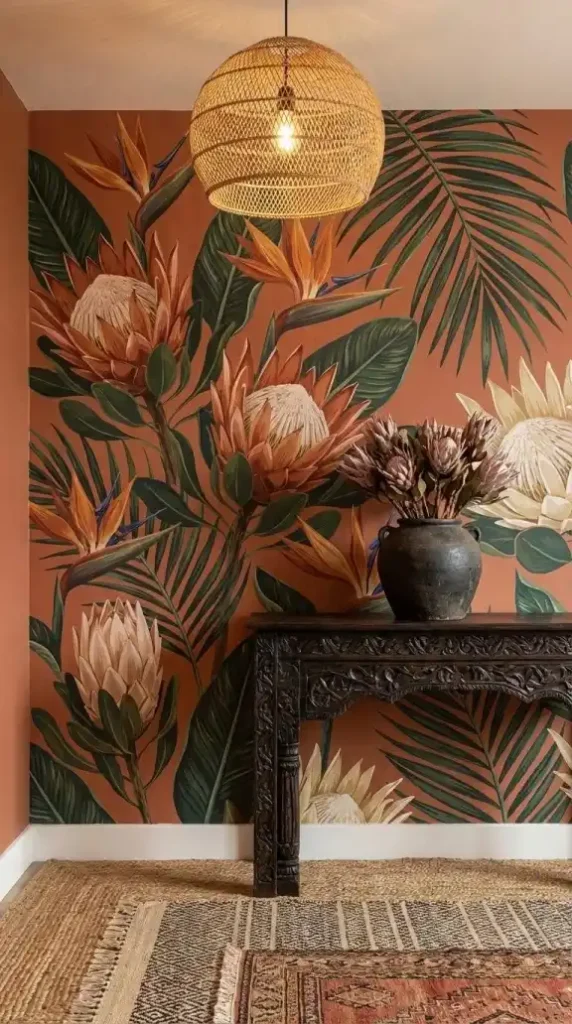
A botanical mural featuring protea flowers, Bird of Paradise strelitzia forms, and palm fronds on a terracotta or burnt sienna background is the Jungle Boho sub-niche of the Afro Bohemian wallpaper vocabulary — the maximalist botanical statement that brings the African landscape indoors at the wall surface scale.
Protea — South Africa’s national flower — adds a sculptural exotic floral touch that standard boho botanical prints don’t access. Its distinctive artichoke-like form reads as both exotic and earth-grounded against the terracotta background.
Bird of Paradise forms in their distinctive orange and blue bloom structure provide the most vibrant botanical element in the Afro Bohemian flora vocabulary — the bloom’s colors introducing the Vibrant palette accents of burnt orange and muted indigo blue within the botanical composition.
Apply at full accent wall scale — the botanical mural needs architectural scale to read as immersive rather than decorative.
Pair with: a hand-carved dark ebony or teak console positioned in front of the mural wall, a heavy dark ceramic vase with actual dried protea stems on the console surface echoing the mural’s botanical motifs, and a living Bird of Paradise plant in a terracotta pot beside the wall. The pairing of the botanical mural, the dried botanical arrangement, and the living plant creates three botanical registers at three spatial depths — two-dimensional wall surface, three-dimensional dried object, and living organic presence — all referencing the same flora vocabulary simultaneously.
4. Use Adire Indigo Print Wallpaper for the Cooling Accent Wall
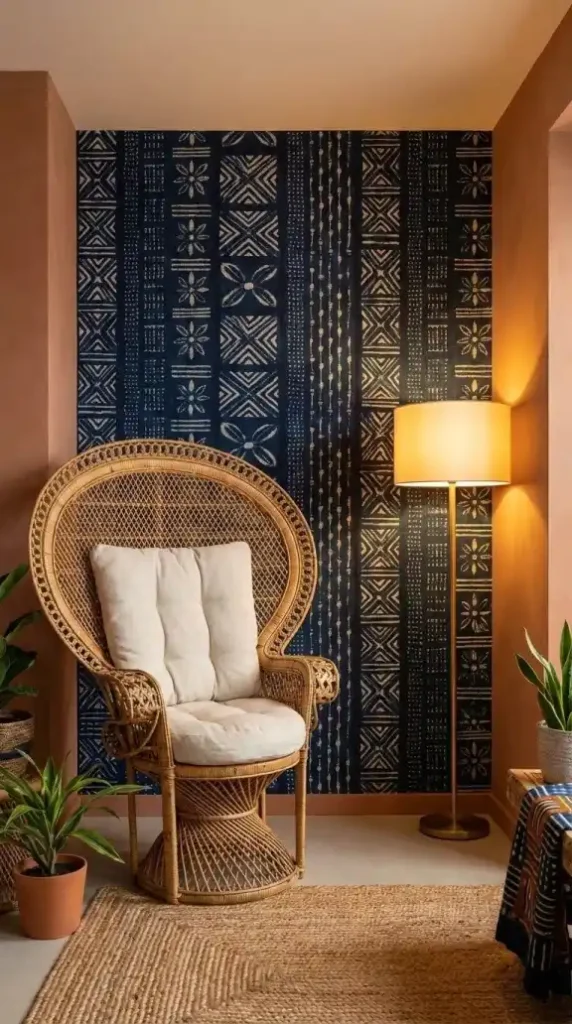
Adire indigo print wallpaper — referencing the hand-dyed wax-resist batik tradition of the Yoruba people with deep indigo grounds and cream abstract floral and geometric symbols — is the Afro Bohemian wallpaper system’s cooling accent wall option.
The deep indigo ground provides the Life tone cooling contrast that prevents the warm earth palette from reading as oppressively warm throughout a room running heavily on terracotta, ochre, and burnt orange.
Adire patterns — often featuring abstract floral forms, geometric symbols, and organic flowing shapes created through the wax-resist dyeing process — carry an organic irregularity that machine-printed indigo wallpaper can’t replicate. The slight variation in the resist pattern, the tonal depth variation across the indigo ground — these are the artisanal qualities that place Adire print wallpaper within the hand-painted and artisanal wallpaper category.
Position the Adire indigo accent wall opposite the room’s primary warm earth tone surface — the indigo cooling the room’s overall temperature balance while the warm earth tones on adjacent walls prevent the indigo from reading as cold rather than rich.
Pair with: a rattan or Malawi cane chair with cream or natural linen upholstery in front of the indigo wall, snake plants in terracotta pots adding the Grounded earth element beside the cool indigo surface, and a macramé wall hanging in natural jute cord layered at the wall’s outer edge. The jute macramé’s honey-warm fiber tone against the deep indigo wallpaper creates the warm-cool material contrast that makes both elements more legible by opposition.
5. Apply Grasscloth or Raffia Texture Wallpaper as a Neutral Base
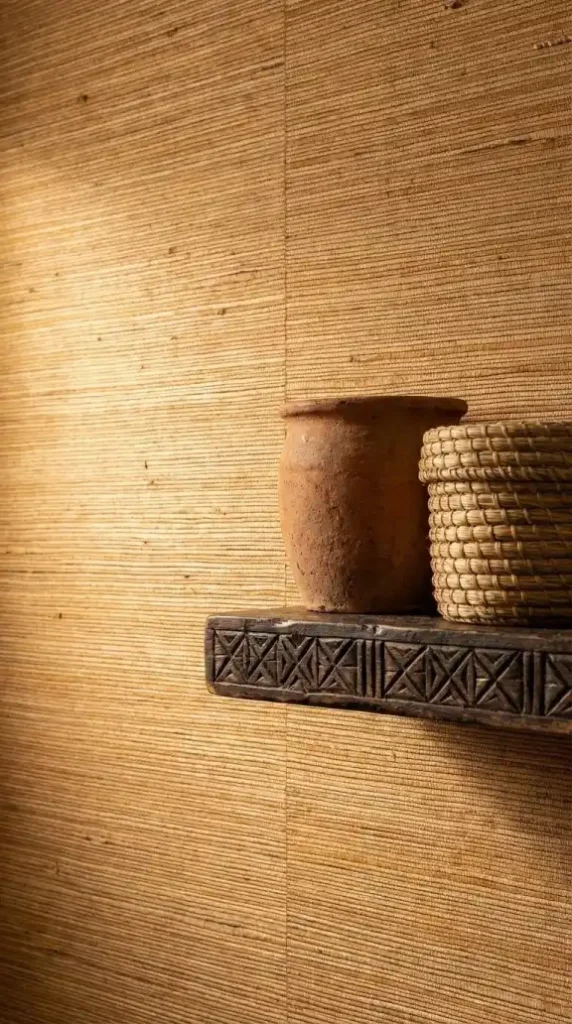
Grasscloth and raffia texture wallpaper — natural fiber weave patterns in warm honey, ochre, and natural linen tones that simulate the tactile quality of hand-loomed sisal and jute textiles — is the Afro Bohemian wallpaper system’s most versatile neutral base option.
Rather than introducing pattern as the primary visual element these wallpapers bring organic material warmth to the wall surface — wrapping the room in the natural fiber vocabulary that the jute rug, the rattan pendant, and the seagrass baskets are delivering at their respective positions.
Applied as the primary wall treatment across all four walls rather than as a single accent the grasscloth texture creates a room that reads as uniformly warm and materially rich without the visual intensity of a bold geometric or botanical pattern — making it the correct choice for rooms where the textile layer is already at maximum pattern commitment and the walls need to contribute texture without competing.
Earthy matte finish is essential. The chalky clay-like quality of matte grasscloth wallpaper reads as hand-woven and authentic. The same pattern in a semi-gloss finish reads as a graphic surface simulation rather than a genuine material reference.
Pair with: hand-carved dark ebony or teak wood shelving against the grasscloth wall — the deep dark wood tone creating maximum value contrast against the warm honey ground. A Fiddle Leaf Fig in a terracotta pot in the room’s corner. Mud cloth textiles at the sofa. The grasscloth provides the materially cohesive wall ground that makes every dark wood and natural fiber element in the room read as part of the same organic material system.
6. Try Tribal Silhouette Wallpaper for an Art Deco African Statement
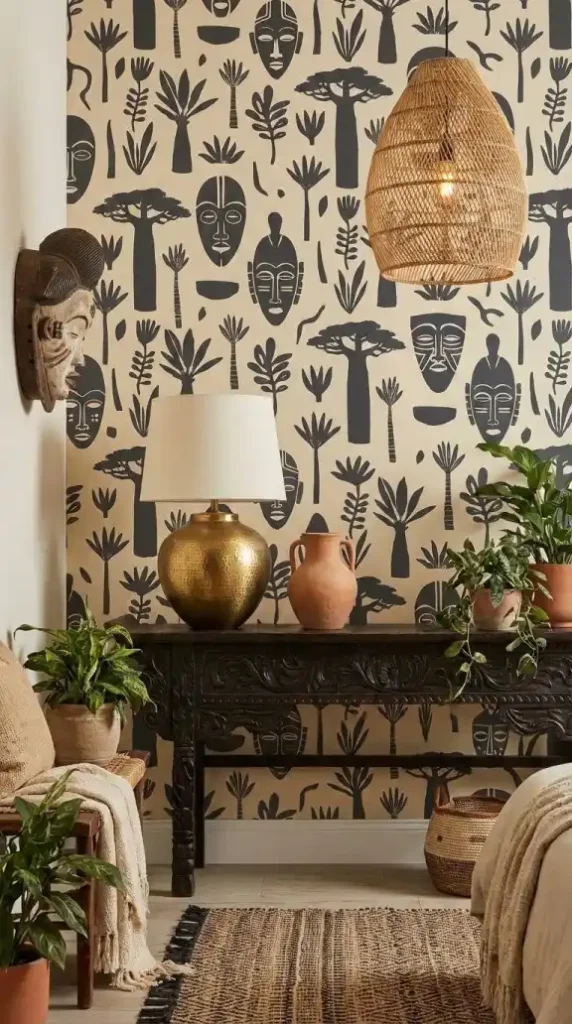
Tribal silhouette wallpaper — art deco style renderings of African mask forms, Baobab tree silhouettes, and stylized African flora in charcoal or warm black on a cream or sand ground — delivers the ancestral figural imagery at the wall surface scale that carved masks provide at the three-dimensional object scale.
The art deco rendering style — geometric abstraction of organic forms, high contrast between the silhouette and ground, confident graphic simplicity — translates the figurative ancestral imagery into a contemporary wallpaper format that reads as sophisticated rather than literal.
Baobab tree silhouettes create the African landscape reference at the architectural scale — the iconic branching form of Africa’s tree of life recognizable from any distance across the room and carrying the landscape heritage reference that the botanical mural delivers through flora.
Position a mounted carved African mask beside — not in front of — the tribal silhouette wallpaper. The contrast between the flat two-dimensional silhouette renderings on the wallpaper and the three-dimensional carved relief of the actual mask creates the depth opposition that makes both elements more powerful than they would be alone.
Pair with: a dark hand-carved wood console, a hammered brass desk or table lamp at the brass metallic accent position, and macramé hangings in black cord at the wall’s outer edge position. The black cord macramé echoes the charcoal silhouette colorway of the wallpaper while extending the gallery composition from the flat wall surface into the room’s three-dimensional depth.
7. Apply Faux Thatch or Reed Texture Wallpaper in a Transitional Zone
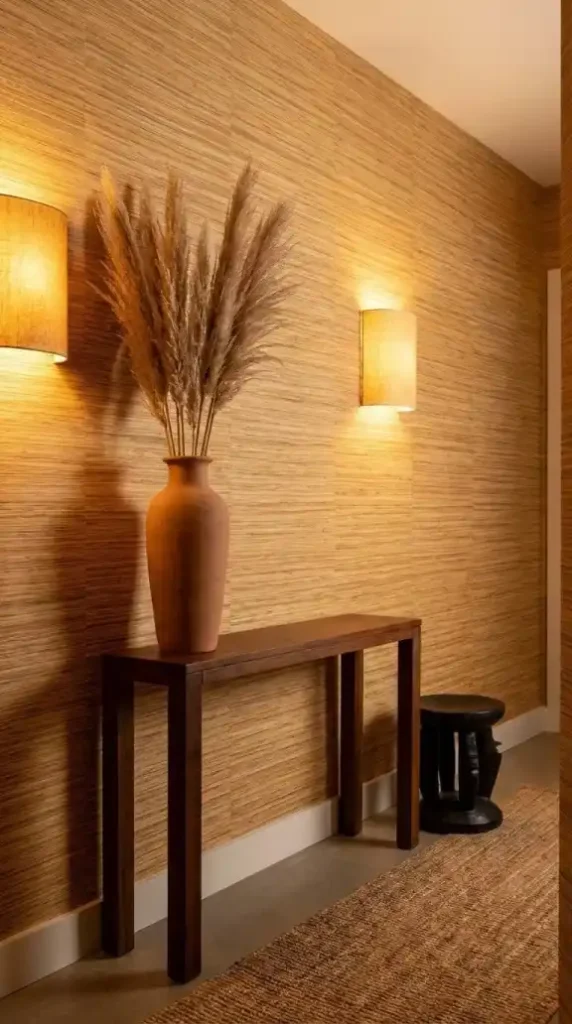
Faux thatch or reed texture wallpaper — organic horizontal line patterns that suggest traditional African thatched architectural materials in warm ochre and honey tones — is the transitional zone wallpaper that brings the Afro Bohemian material vocabulary to hallways, entries, and stairwells where full mural or geometric accent walls would be spatially overwhelming.
The organic horizontal lines create a directional movement that naturally extends a hallway’s perceived length — the eye follows the horizontal texture lines along the corridor’s length rather than stopping at individual wall elements.
The traditional architectural reference — thatch and reed construction materials used throughout Sub-Saharan Africa — carries the cultural heritage connection at the material level rather than through pattern or figural motif.
This is the Afro Bohemian wallpaper system’s most subtle cultural reference point — and in a transitional zone where the viewer moves past rather than sits in front of the wall, the subtlety is appropriate. The thatch texture registers as warm, earthy, and materially specific without demanding the sustained visual attention that a bold geometric or botanical mural requires.
Pair with: a narrow dark teak console, a single tall terracotta floor vase with dried pampas grass, and a hand-carved Ashanti stool beside the console. The High-Low Mix at the transitional zone scale — the contemporary narrow console beside the ancestral ceremonial stool, both against the traditional architectural material texture of the faux thatch wallpaper.
8. Use Kuba Cloth Raffia Texture Wallpaper in the Office or Study
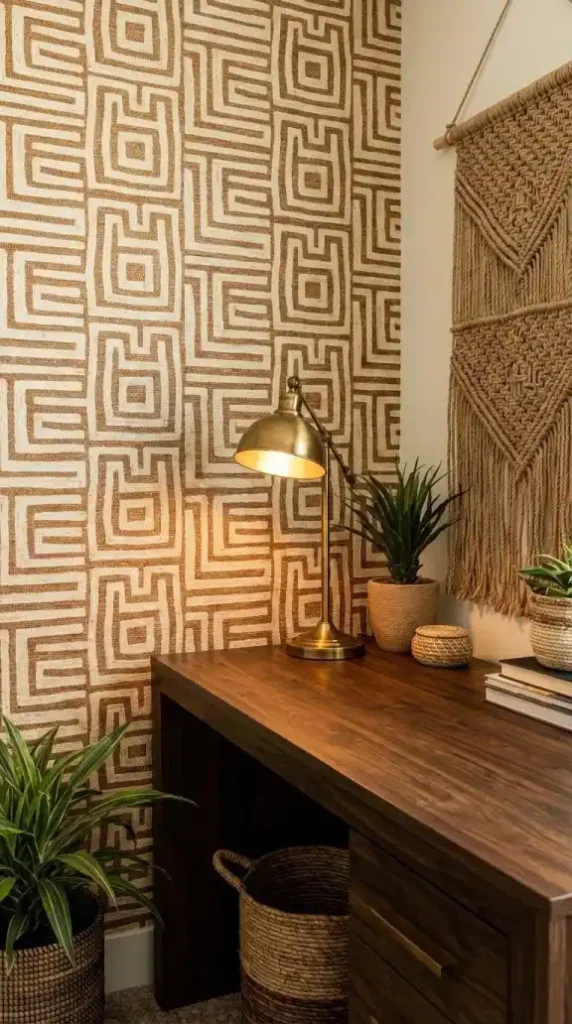
Kuba cloth raffia-inspired texture wallpaper — the irregular patchwork and earthy labyrinth patterns of the Congo’s raffia textile tradition rendered in chalky clay-like pigments of cream and warm brown — is the Afro Bohemian office’s most appropriate accent wall choice.
The Kuba cloth’s irregular cut-pile texture quality translates into wallpaper as a dense, slightly tactile-reading surface pattern rather than a bold geometric — providing visual richness at the peripheral wall zone without the high-contrast intensity of mud cloth geometric wallpaper at the immediate desk work surface viewing distance.
The earthy labyrinth quality of Kuba cloth pattern — its improvisational, non-repeating geometric structure that reads as complex without being decipherable as a single fixed repeat — provides sustained visual interest for the peripheral sightline during long work sessions without demanding the cognitive processing that a bold high-contrast geometric would require.
Pair with: a reclaimed dark walnut or ebony-stained desk, a minimalist brass desk lamp, a jute macramé wall hanging at the wallpapered wall’s outer edge, and a Fiddle Leaf Fig or Snake Plant in a terracotta pot at the room’s corner. The Fiddle Leaf Fig’s broad structured leaves against the Kuba cloth texture wallpaper behind creates the botanical-textile pattern pairing that the office’s peripheral zones benefit from — visually rich without being distracting.
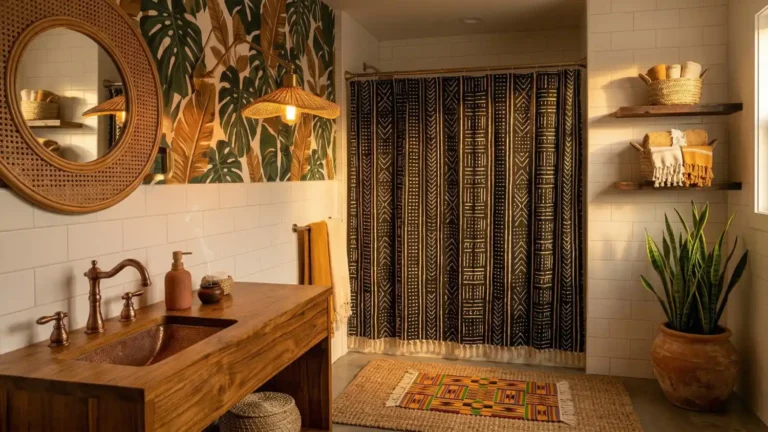
9. Create a Bathroom Feature Wall With Mudcloth or Adinkra Symbols
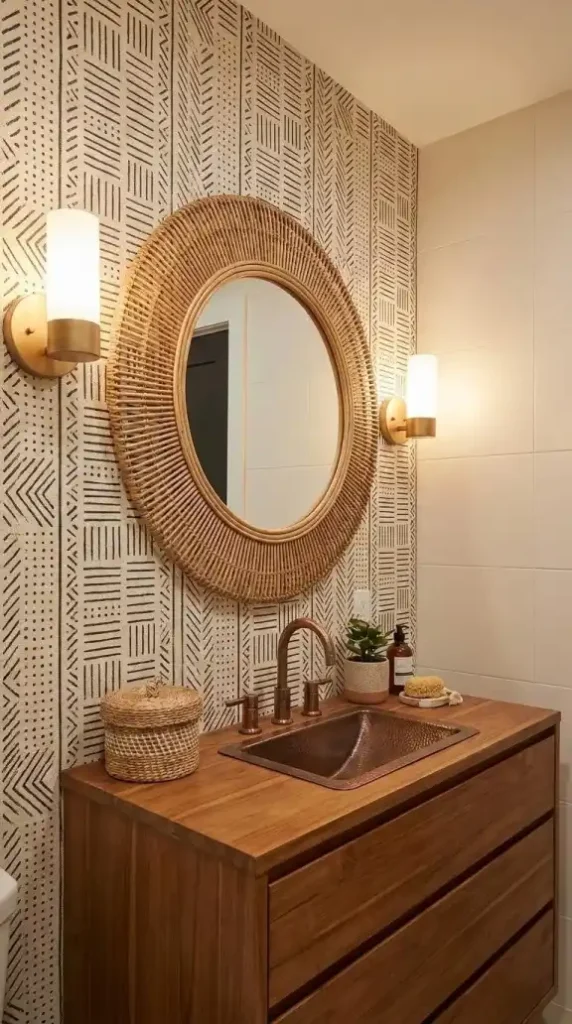
Mud cloth geometric wallpaper or Adinkra symbol pattern wallpaper applied to the bathroom’s primary accent wall — the wall behind the vanity, the shower-facing wall, or the wall behind the toilet — creates the most concentrated Afro Bohemian pattern statement in the house.
Bathroom proximity — closer than any other room allows — makes the wallpaper pattern readable at close range. This means pattern detail that reads as a single unified surface from across a living room reads as individual geometric units and symbol forms at bathroom viewing distance.
Mud cloth geometric patterns become more culturally specific at close range — the linear and geometric forms readable as intentional symbol systems rather than decorative repeats. Adinkra symbol wallpaper becomes even more resonant at bathroom proximity — the individual symbols Gye Nyame, Sankofa, and Nyame Dua readable as distinct forms rather than as a pattern field.
Apply to one bathroom wall only. Adjacent walls remain in smooth cream, warm sand, or terracotta tile — the 60% neutral base that makes the single patterned wall read as bold rather than claustrophobic at bathroom scale.
Pair with: a circular rattan-framed mirror mounted on the patterned wall — the circular organic frame breaking the rectangular geometry of the tile and wallpaper with the same logic a Juju hat breaks a living room wall. Hammered copper faucet and hardware. Turkish cotton fringe towels in undyed natural cotton on hammered copper towel rings.
10. Pair Sage or Olive Botanical Wallpaper With Dark Wood and Rattan
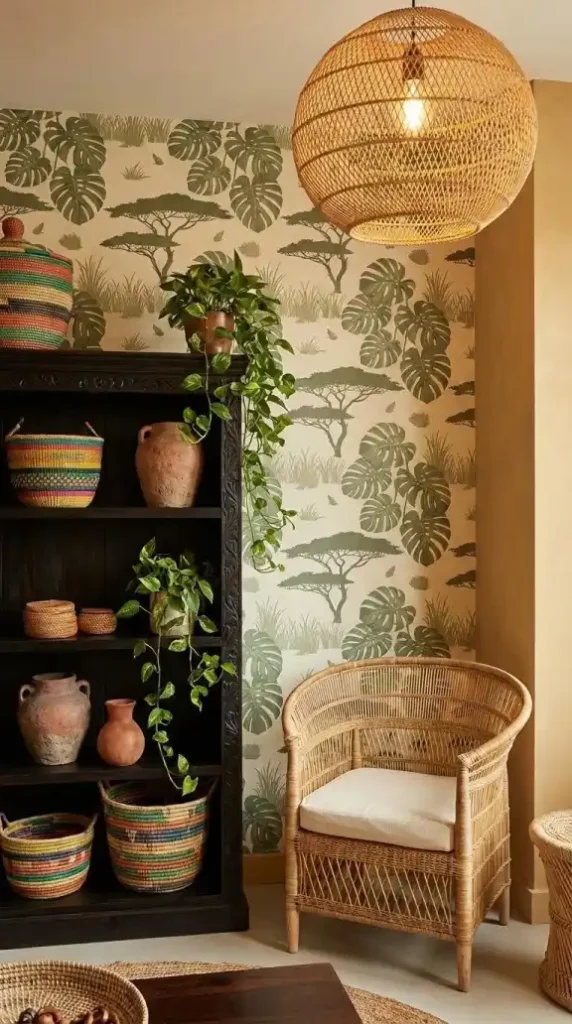
Sage and olive botanical wallpaper — monstera leaves, savannah grass silhouettes, and acacia tree forms in sage and olive green on a warm sand or cream ground — is the Afro Bohemian wallpaper system’s most restrained botanical option and the one with the broadest room application range.
The sage and olive green palette sits within the organic Life tone accent category — connecting the wallpaper to the African savannah and jungle landscape reference while staying within the earth palette’s organic green range rather than tipping into the cool synthetic greens that sit outside the Afro Bohemian vocabulary.
Savannah grass silhouettes and acacia tree forms provide the African landscape botanical reference at a more graphic and less lush register than the full botanical mural — suitable for rooms where the maximalist protea and Bird of Paradise mural would be too visually intense but where the plain grasscloth texture would be too restrained.
Pair with: dark hand-carved ebony or teak wood furniture as the primary High-Low contrast element against the sage green botanical ground — the deep dark wood tone providing maximum value contrast. Rattan and Malawi cane chairs at the secondary furniture position. A trailing Pothos or Heartleaf Philodendron cascading from the highest shelf position beside the wallpapered wall — the living plant extending the sage botanical wallpaper’s plant vocabulary into the three-dimensional organic layer.
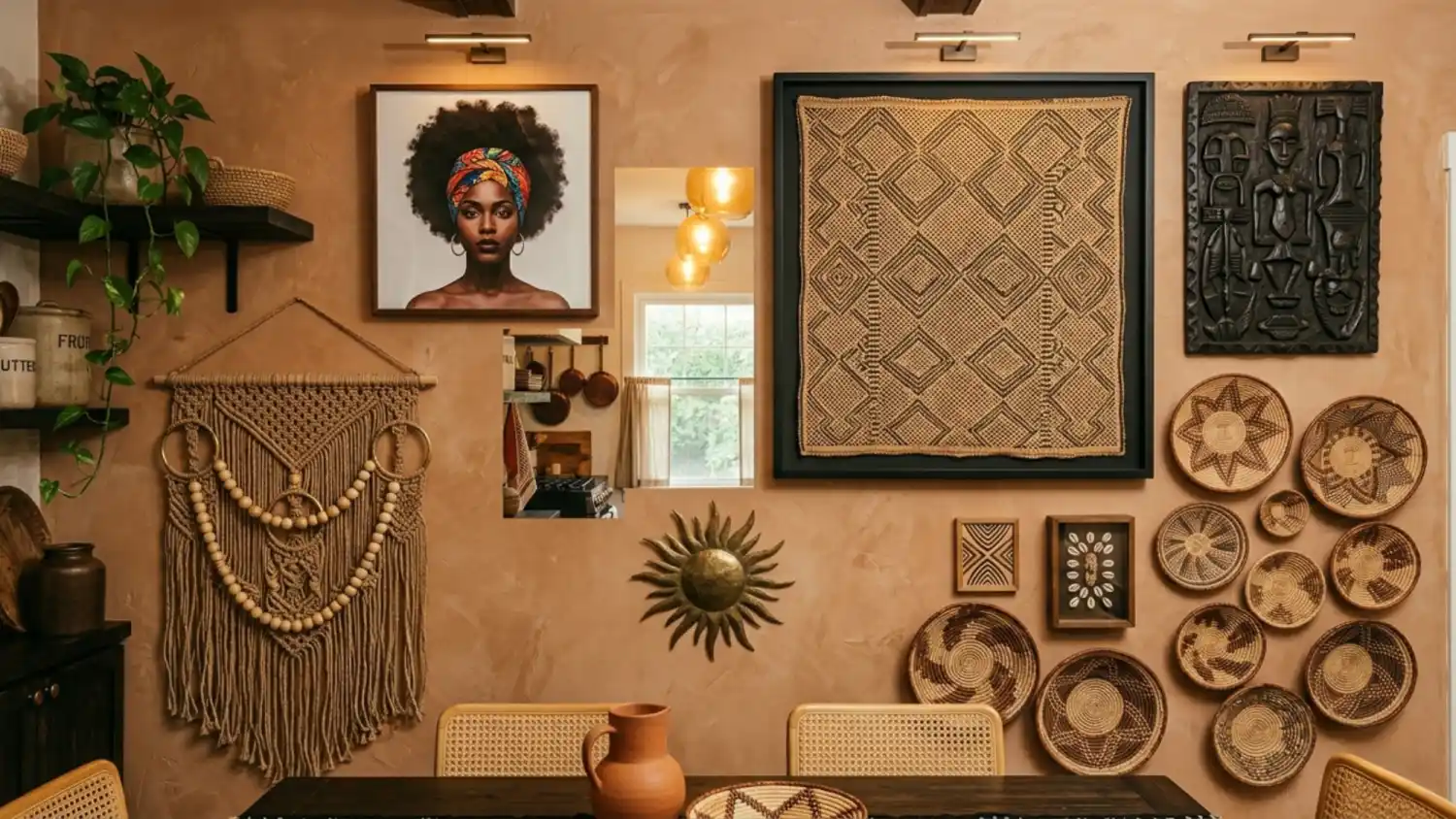
11. Layer a Macramé Hanging Over the Geometric Wallpaper
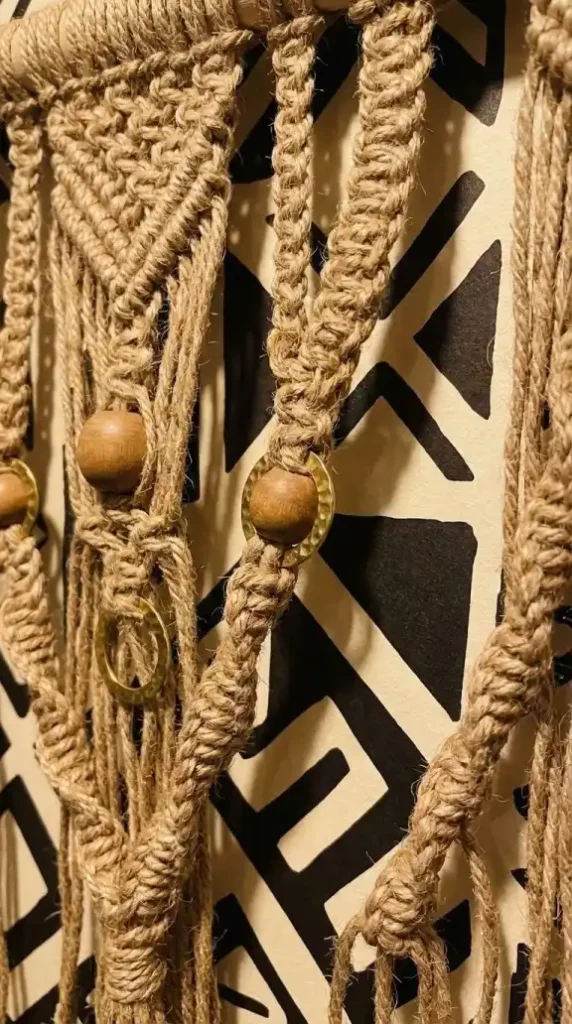
Layering a macramé wall hanging in front of geometric wallpaper is the most sophisticated application technique in the Afro Bohemian wallpaper system — extending the wall from a two-dimensional patterned surface into a multi-layer three-dimensional composition.
The jute cord macramé’s rough twisted fiber surface creates a three-dimensional textural foreground layer against the bold flat geometric wallpaper behind it. The macramé partially obscures sections of the geometric pattern — revealing the wallpaper through the knotwork gaps and creating shadow depth against the pattern surface as the jute cord casts shadows onto the wall beneath it.
The two layers together create a wall composition that changes with viewing angle and light source position — different sections of the geometric wallpaper visible through different macramé knotwork gaps at different viewing angles. This visual dynamism is something that neither the wallpaper alone nor the macramé alone could produce.
Natural jute cord macramé against mud cloth geometric wallpaper — both in the Grounded earth palette, both in the natural material vocabulary — reads as cohesive rather than competing. Black cord macramé against the same geometric wallpaper creates a High Contrast layering where the dark cord picks up the warm black of the mud cloth geometric pattern, the macramé and the wallpaper reading as part of the same tonal system at two different spatial depths.
Use wooden beads and hammered brass ring accents within the macramé knotwork to connect the layered fiber art to the room’s broader brass accent thread — the metallic elements visible through the wallpaper-macramé composition tying the wall layer to the desk lamp, the curtain rod, and the hardware throughout the room.
Choosing the Right Wallpaper for Your Room Before You Commit
Before committing to any wallpaper pattern or colorway answer these six questions:
- What is the room’s current dominant pattern category — geometric or botanical? The wallpaper should introduce the underrepresented category. A room carrying mud cloth throws, kilim rugs, and Kuba cloth cushions is already at maximum geometric pattern load — it needs a botanical or textural wallpaper, not another geometric pattern.
- Is the accent wall the room’s most architecturally significant vertical surface — the wall behind the primary sofa, the headboard wall, the vanity wall? The wallpaper accent wall must be the room’s primary sightline wall. Wallpaper on a secondary or side wall loses the visual impact that the one-wall rule is designed to create.
- What is the room’s natural light quality and direction? North-facing rooms with limited natural light need ochre, mustard, or warm terracotta ground wallpapers. South-facing rooms with strong light can support deep indigo or charcoal ground patterns without the room reading as dark and oppressive.
- Is the room a permanent installation or a rental? Identify this before choosing the wallpaper format. Removable wallpaper panels in the Afro Bohemian vocabulary allow the full pattern commitment without permanent application — preventing the most costly single wallpaper application mistake.
- What finish does the wallpaper have — matte or gloss? Reject any Afro Bohemian wallpaper with a high-gloss or semi-gloss finish regardless of how correct the pattern and colorway appear. Earthy matte chalky finishes are the only finish that reads as cohesive with the natural fiber, clay pottery, and carved wood material vocabulary of the broader Afro Bohemian room.
- What is the wallpaper’s scale relative to the room’s existing textile patterns? Identify the geometric repeat scale of the mud cloth throw and the kilim rug already in the room. The wallpaper repeat should be at a distinctly different scale from both — either significantly larger at the mural or architectural scale, or significantly smaller at the detail texture scale.
Afro Bohemian wallpaper at its most effective is the room’s design foundation — the surface that sets the cultural reference, the palette, and the pattern scale that every other element responds to.
The mud cloth geometric wallpaper behind the sofa isn’t a backdrop. It’s the foundation the Kuba cloth cushions, the Bolga basket gallery, and the carved mask gallery wall all read against.
The botanical protea mural behind the console isn’t a feature wall. It’s the architectural extension of the room’s botanical layer — the wall surface participating in the same plant vocabulary as the Bird of Paradise in the corner and the dried protea on the console.
When the wallpaper is chosen correctly — the right motif category, the right palette, the right finish, applied at the right scale to the right wall — the room doesn’t look wallpapered.
It looks built.
Explore More:
- Afro Bohemian Wallpaper: The Complete Style Guide — Understand the full five-motif category system — from cultural geometric patterns to botanical elements and textural simulations — as the design foundation every other room element responds to.
- How to Choose and Style Afro Bohemian Wallpaper — Work through the full two-stage selection and styling process — from motif scale and substrate material to the Rule of Three and color pulling — in the sequence that makes every decision easier than the last.
- Afro Bohemian Wallpaper Must-Haves for Beginners — Start in the right zone, choose the right substrate, and build the Heritage Maximalism system one layer at a time — from the first peel-and-stick panel to the full room application.