How to Style an Afro Bohemian Kitchen
Most kitchen styling guides tell you to clear the counters and add a plant.
That’s not styling. That’s tidying with optimism.
An Afro Bohemian kitchen is styled at eight distinct levels simultaneously — the wall, the hardware, the vignette, the textile, the shelf, the lighting, the counter, and the sensory layer. Each level contributes something the others can’t. Miss one and the kitchen reads as a correct palette with an incomplete execution.
This guide covers all eight — in the sequence that makes each level’s decisions easier rather than harder.
Quick Takeaway:
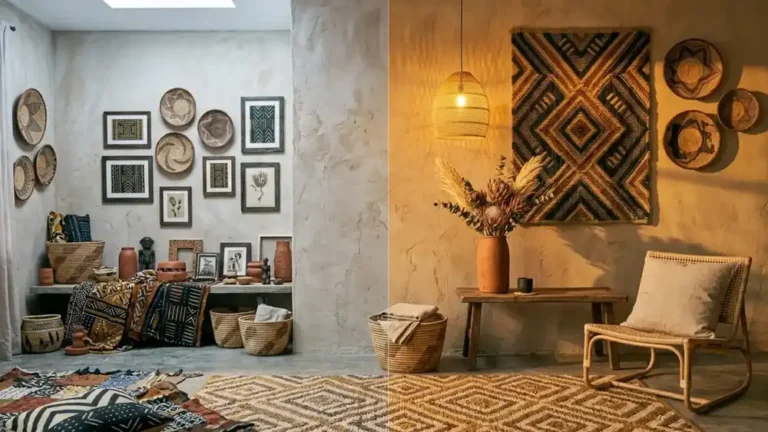
- The vertical wall gallery replaces standard art with functional African craft objects — Binga baskets and carved wooden pieces that break up the linear cabinetry without consuming counter space.
- Every counter vignette needs three distinct surface types — smooth, rough, and living — or the grouping reads as objects placed together rather than a composed arrangement.
- Lighting runs on two tracks: bright 2700K task lighting under shelves and dimmable amber pendant mood lighting overhead — the two tracks create the day-to-night flexibility the kitchen needs.
Level 1: Build the Vertical Wall Gallery
Standard kitchen wall art — framed prints, small decorative tiles — reads as decoration applied to a functional space.
African craft objects used as wall elements read as the aesthetic itself.
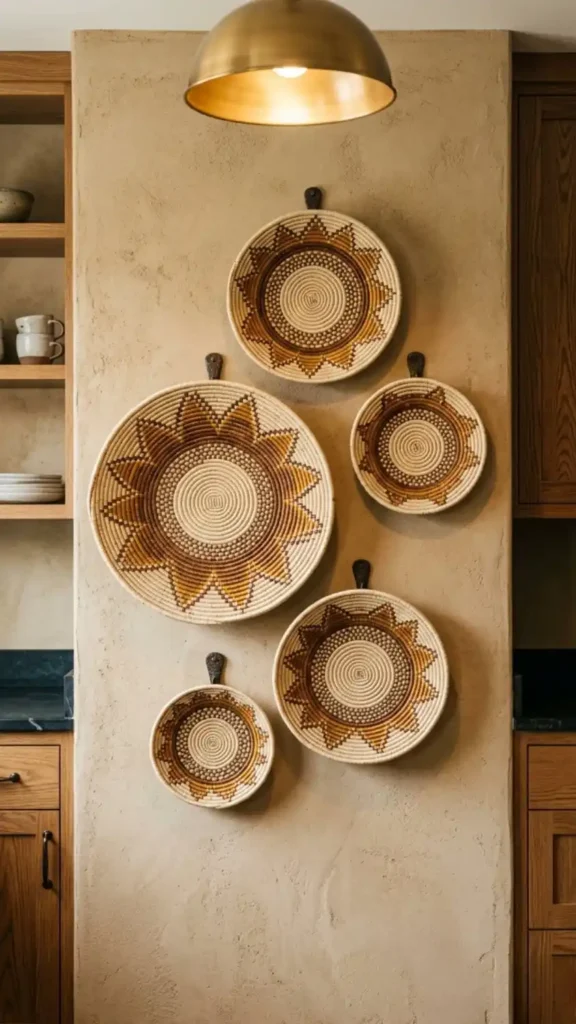
Binga and Tonga baskets from Zimbabwe carry radial geometric patterns that do two things standard art can’t: they introduce the circular form that breaks up the linear geometry of cabinet rows, and they function as genuine craft objects with material depth rather than printed surface.
Group them in odd numbers — three, five, or seven — in an asymmetric cluster rather than a grid.
Vary their sizes within the grouping: one large anchor basket, two or three mid-size, one small at the edge. The size variation creates the visual movement that a uniform grid eliminates.
Hand-carved wooden ladles, oversized ceremonial spoons, and carved wooden utensils mounted on museum-style wall brackets extend the vertical gallery into the sculptural object layer.
Positioned above the counter line, they read as art. Positioned within reach, they read as function. Either works — the mounting height determines how the piece is read.
Level 2: Replace the Hardware
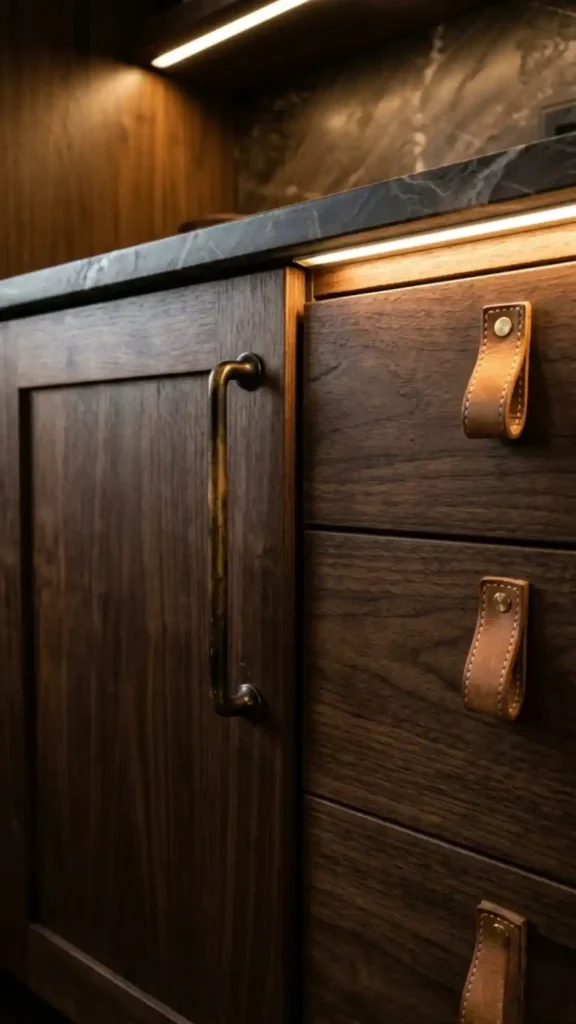
Hardware is the smallest surface area in a kitchen with the largest impact on its tonal reading.
High-shine chrome finishes read as clinical — too resolved, too contemporary, too far from the handmade material logic the aesthetic runs on.
Oil-rubbed bronze and antique brass have a living quality that chrome doesn’t: they patina over time, developing surface variation that deepens rather than degrades with use.
That patina behavior mirrors the logic of every other handmade material in the room — the terracotta vessel that darkens with handling, the wood cutting board that develops grain character with oiling.
Leather tab pulls on lower cabinet faces add a tactile element at hand-height — the one level where touch, not sight, is the primary sense.
Tan or deep brown leather in a simple loop or tab format keeps the hardware understated while adding material contrast that metal alone can’t provide.
Level 3: Compose the Counter Vignettes
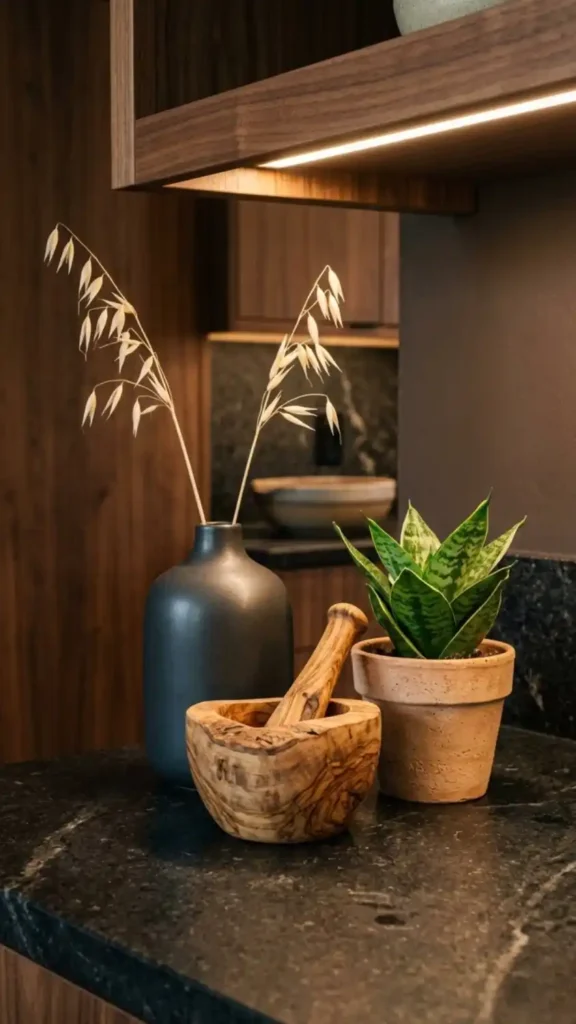
The Rule of Three isn’t a styling cliché in this context — it’s a material logic.
Every counter vignette needs exactly three distinct surface types present simultaneously: something smooth, something rough, and something alive.
Smooth: a ceramic vase, a glazed stoneware jar, a polished dark wood bowl.
Rough: an olive wood mortar and pestle, an unglazed terracotta vessel, a stone pestle, a hand-carved wood object.
Alive: a Sansevieria in a terracotta pot, a small trailing pothos, a single succulent in a dark ceramic.
The living element does something the other two can’t — it introduces organic irregularity that changes slightly over time, preventing the vignette from reading as static.
Group the three elements with deliberate negative space on both sides of the arrangement.
The empty counter surface on either side is what makes the vignette readable as a composed grouping rather than objects placed in proximity.
Level 4: Lay the Textile Layer
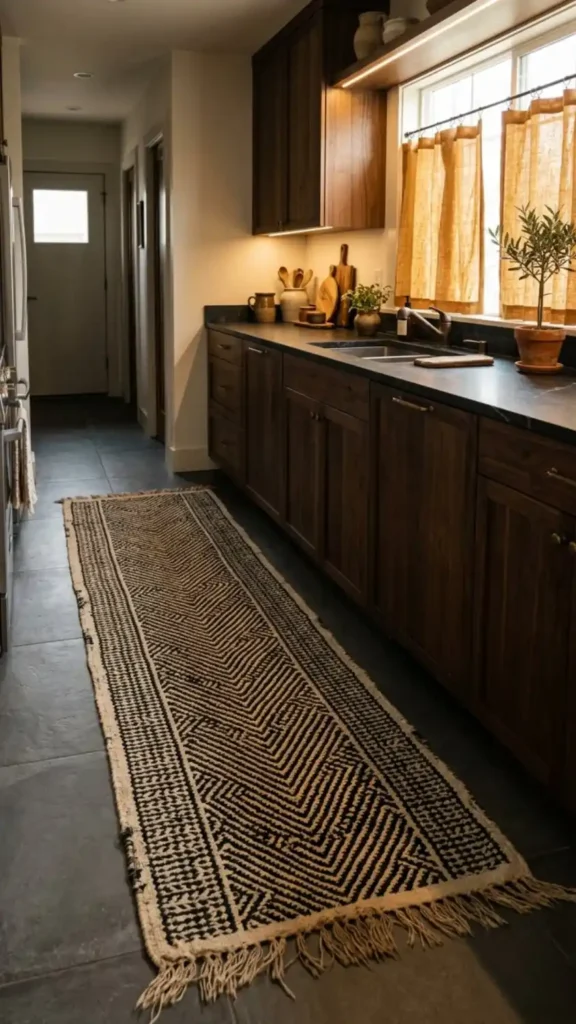
The kitchen can hold two textile positions — the floor and the window — and both should be used.
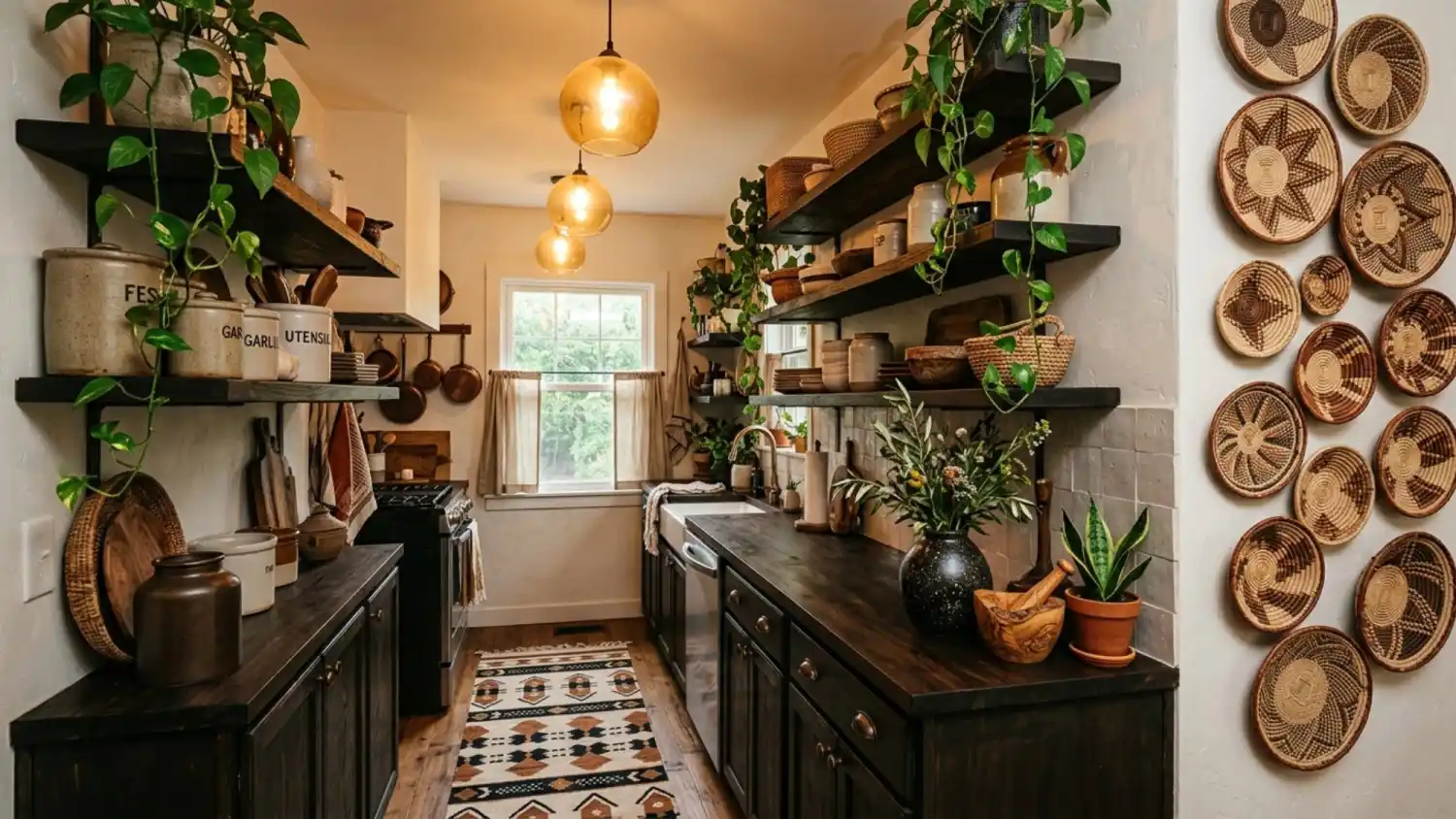
A mud cloth or kilim runner in the galley area introduces the geometric pattern vocabulary at floor level without creating the maintenance issue of a full rug near a cooking zone.
The runner also does something structurally important: it softens the hard-surfaced linearity of a kitchen galley — tile floor, cabinet base, linear counter — with a horizontal textile element that the eye follows rather than bounces off.
Raw linen cafe curtains at the window complete the textile layer at the vertical position.
Heavy-weight raw linen in ochre or charcoal filters natural light without blocking it and introduces the natural fiber vocabulary at the window line.
Half-height cafe curtain mounting — covering only the lower window section — keeps the light quality open overhead while providing the textile softening at eye level.
Level 5: Architect the Open Shelves
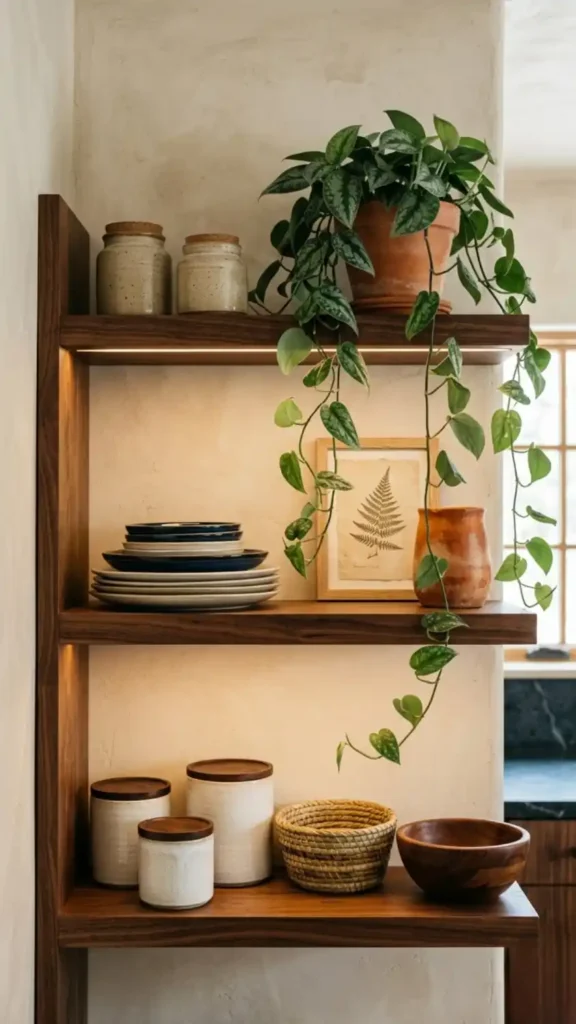
Open shelving fails when it’s styled as a display case and succeeds when it’s styled as functional architecture.
Use clear glass or stoneware canisters for dry goods — their contents visible, their forms varied in height — across the mid shelf level.
The variation in canister height creates visual rhythm without requiring decorative objects.
Integrated greenery at the top shelf level solves the dead zone problem that most kitchens have above the highest shelf — the gap between the top shelf and the ceiling that accumulates visual awkwardness.
A Silver Satin Pothos or a trailing Scindapsus on the highest shelf sends cascading vines downward, drawing the eye upward and filling the vertical space above the shelf line with organic movement.
The plant doesn’t need to be large to be effective — the trailing growth habit does the spatial work regardless of the plant’s overall size.
Level 6: Set the Lighting Architecture
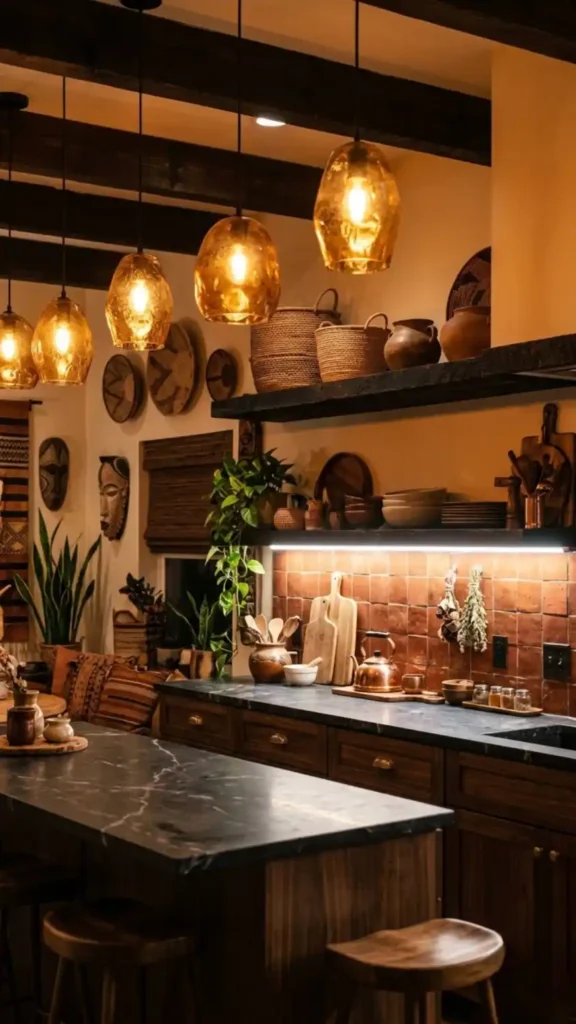
Kitchen lighting runs on two tracks and both tracks need to be resolved independently.
Task lighting — under-shelf strips — should be bright, consistently 2700K, and positioned to rake across the backsplash and counter surface at a low angle. This is the functional light that makes the kitchen workable. It’s also the light that reveals tile surface texture, deepens terracotta tones, and warms the counter objects most effectively.
Mood lighting — pendants and sconces — should be dimmable and fitted with amber or smoke-tinted glass that filters the light through a warm amber lens before it reaches the room.
Amber-tinted glass pendants don’t just warm the light temperature — they add a visual filter that softens the overhead zone into something that reads as atmospheric rather than illuminated.
The dimmer on the pendant circuit is what creates the evening kitchen — the one that shifts from functional daytime workspace to warm social space at 6pm without any rearrangement of objects.
Install the dimmer before evaluating whether the pendant light itself is working correctly. The same fixture reads completely differently at 40% versus 100%.
Level 7: Style the Living Countertop
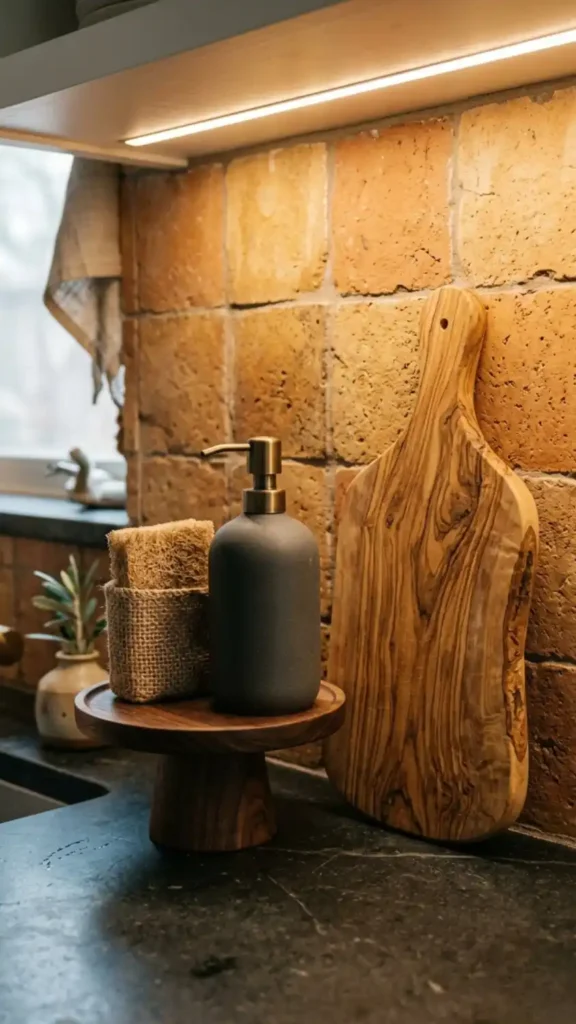
The Afro Bohemian kitchen doesn’t hide what it uses — it elevates how those things are displayed.
A small dark wood pedestal or wooden tray under the dish soap dispenser and sponge holder removes the mundane-object problem by treating everyday functional items as intentional vignette elements rather than practical necessities to be concealed.
The pedestal does the framing work — anything placed on a raised platform reads as considered rather than incidental.
Olive wood cutting boards with organic, irregular natural edges leaned against the backsplash replace the standard rectangular board with a form that references the natural material logic of the aesthetic.
The irregular edge of a live-edge olive wood board reads as a found natural object as much as a kitchen tool — and that ambiguity between function and form is exactly what the Afro Bohemian living countertop is built on.
Level 8: Add the Sensory Layer
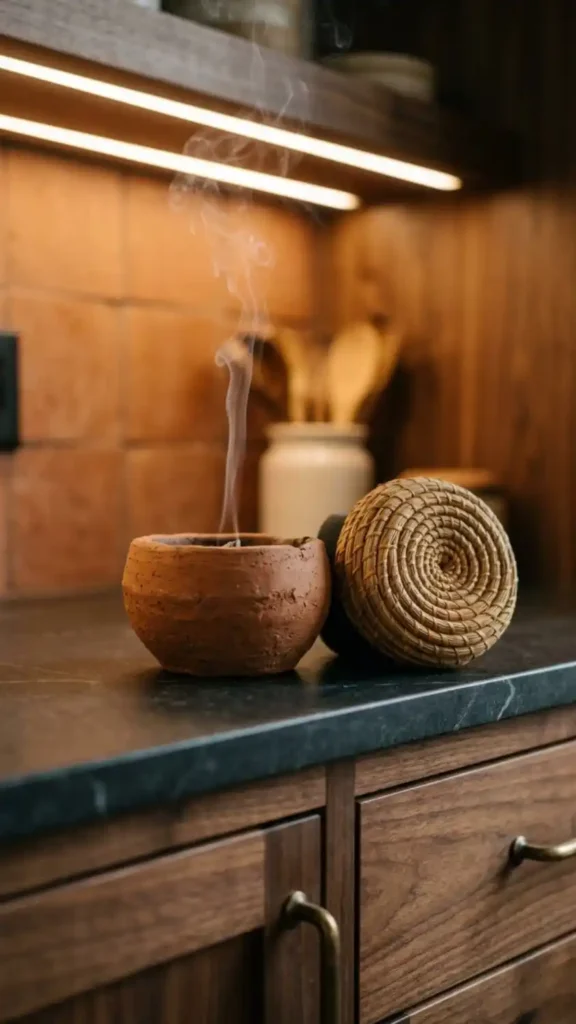
A kitchen styled only for the eyes is a kitchen that’s half-finished.
Scent is the sensory layer that makes the aesthetic immersive rather than visual — and the kitchen is the one room where scent has both a design role and a natural functional presence.
A terracotta incense burner positioned as a counter object — not hidden, not purely functional — brings the earth material vocabulary into the sensory layer.
Sandalwood, frankincense, and oud complement the visual warmth of the earth palette through olfactory association — they reference the same material origin as the aesthetic without needing to be explained.
A compact wireless speaker concealed behind a coiled grass basket on the counter or shelf maintains the analog, handmade visual vocabulary of the room while keeping the functional utility of a connected sound system.
The basket doesn’t completely hide the speaker — it frames it, reduces its visual presence, and keeps the surface reading as styled rather than tech-heavy.
The sensory layer is the last thing added and the first thing noticed. Get the visual foundation correct first. Then add scent and sound as the final layer that makes the room feel inhabited rather than decorated.
Auditing Your Kitchen Before You Start
Walk through the space and answer these questions before making any changes:
- Is there a wall section between or beside cabinetry that could hold a vertical basket gallery? Even a narrow section between two cabinet runs holds three baskets in an asymmetric cluster.
- What is the current hardware finish? Chrome and brushed nickel are the first things to replace — oil-rubbed bronze pull replacements are low-cost and high-impact.
- Count the objects on the most decorated counter run. Can you identify one smooth, one rough, and one living element in the current arrangement? If not, the vignette needs to be rebuilt from the material logic rather than rearranged as-is.
- Is there a floor textile position available in the galley or cooking zone? A runner doesn’t require a full kitchen rug position — even a 60cm section of mud cloth in front of the primary work counter functions as a textile anchor.
- What is the current pendant light style and glass type? Clear glass pendants can often be retrofitted with amber or smoke glass shades rather than replaced entirely.
- Is there a dimmer on the pendant circuit? If not, that’s a single electrician visit that changes the kitchen’s entire evening behavior.
- Is the top shelf above the highest cabinet currently empty or cluttered with seldom-used items? Clear it and introduce one trailing plant. The vertical space above the shelf line is the most consistently underused design zone in the kitchen.
The Afro Bohemian kitchen is styled in eight layers — not eight separate decorating decisions.
Each layer reinforces the others. The vertical basket gallery on the wall references the coiled grass basket on the shelf. The oil-rubbed bronze hardware references the dark wood mortar and pestle in the vignette. The amber glass pendant references the terracotta incense burner on the counter. The mud cloth runner on the floor references the raw linen curtain at the window.
When the eight layers are operating together, the kitchen doesn’t read as decorated. It reads as built from a single material logic — which is exactly what it is.
Expand your Afro Bohemian Kitchen knowledge:
- Afro Bohemian Kitchen: How to Bring the Aesthetic Into a Functional Space — Get the foundational logic behind every surface and material decision
- 11 Afro Bohemian Kitchen Ideas for a Warm and Functional Space — Browse 11 targeted ideas organized by kitchen zone and element —
- Afro Bohemian Kitchen Decor Must-Haves for Beginners — Pick up the essential pieces in the right order if you’re starting from scratch