Afro Bohemian Kitchen: How to Bring the Aesthetic Into a Functional Space
The kitchen is the hardest room to apply Afro Bohemian design in — and the reason is obvious once you name it.
Every other room in the house runs on textiles. The mud cloth throw, the woven tapestry, the layered rugs — these are the load-bearing elements of the aesthetic. The kitchen can’t run on textiles. Fabric doesn’t belong at a cooking zone for practical reasons that no amount of styling can override.
So the kitchen has to deliver the Afro Bohemian aesthetic entirely through surface material, object curation, and lighting.
That’s a tighter brief — but it’s also a cleaner one. And when it works, the kitchen reads as one of the most cohesive rooms in the house precisely because every element is doing functional and aesthetic work simultaneously.
Quick Takeaway:
- The kitchen delivers the Afro Bohemian aesthetic through surface material — terracotta tile, dark wood shelving, warm plaster — not through textiles.
- Counter object curation follows the same odd-number, material-contrast logic as the rest of the house — but with functional objects rather than decorative ones.
- Lighting temperature is more critical in the kitchen than any other room — cool-white kitchen lighting destroys earth pigments faster than anywhere else in the house.
Why the Kitchen Requires a Different Application Logic
In every other room, the aesthetic is assembled on top of the architecture. The wall is a backdrop. The floor is a base. The textiles, objects, and lighting do the expressive work.
In the kitchen, the architecture is the aesthetic.
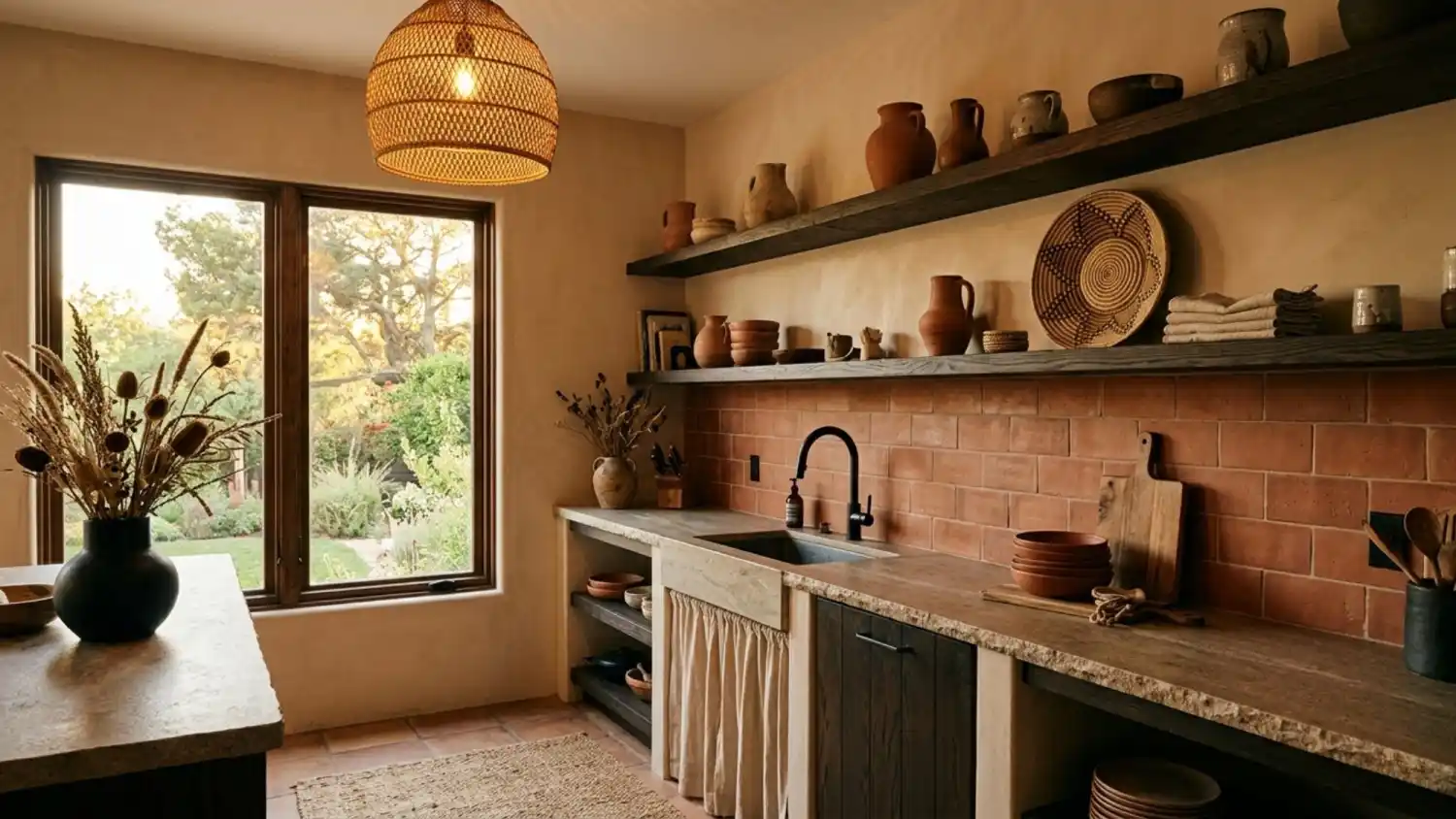
The backsplash tile, the cabinet finish, the shelving material, the countertop surface — these are permanent or semi-permanent decisions that carry the visual weight that mud cloth and woven tapestries carry elsewhere.
This means the kitchen requires decisions at the surface material level — not just the styling level.
If the surface materials are wrong — white subway tile, grey laminate, cool-toned countertop — no amount of terracotta vessels or dried botanicals on the counter will make the room read as Afro Bohemian. The objects will float against an incompatible background rather than integrating with it.
The Backsplash: The Kitchen’s Primary Textile Equivalent
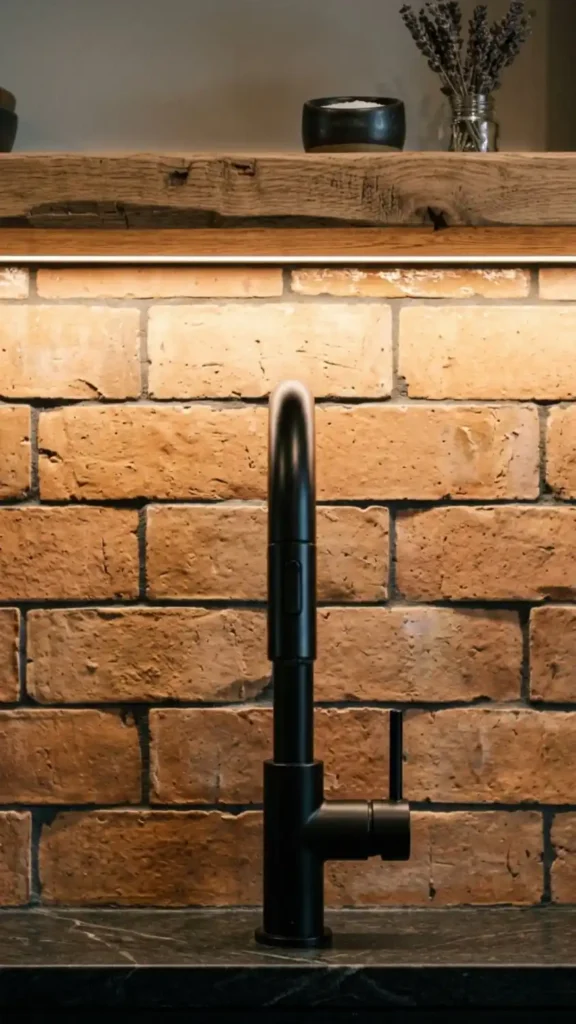
The backsplash occupies the same architectural role in the kitchen that the woven wall tapestry occupies in the living room.
It’s the primary vertical surface, it carries the most visual information, and it sets the material and color tone for everything around it.
Terracotta handmade tile — slightly irregular, with visible glaze variation — is the most direct application of the earth pigment logic to a kitchen surface.
The irregularity of handmade tile does what machine-made tile can’t: it creates light variation across the surface, catching 2700K warm light differently at different points. That differential light response is what gives the backsplash depth rather than flatness.
If a full backsplash replacement isn’t feasible, a terracotta tile section — even just the area behind the cooktop — shifts the room’s material reading significantly more than any styling intervention.
Open Shelving: Where Textile Logic Translates to Kitchen Objects
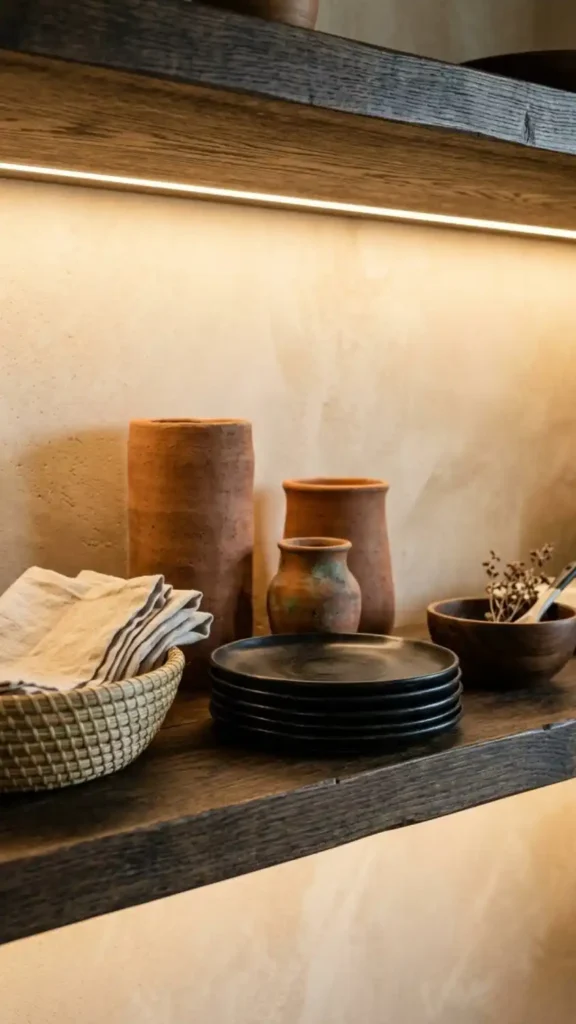
Open shelving in an Afro Bohemian kitchen is the room’s primary object layer — the equivalent of the styled console or vignette arrangement elsewhere in the house.
Dark-stained wood shelving provides the same anchoring function as dark wood furniture in other rooms. Against a warm sand or terracotta wall, the dark wood creates the value contrast that prevents the kitchen from reading as undifferentiated warmth.
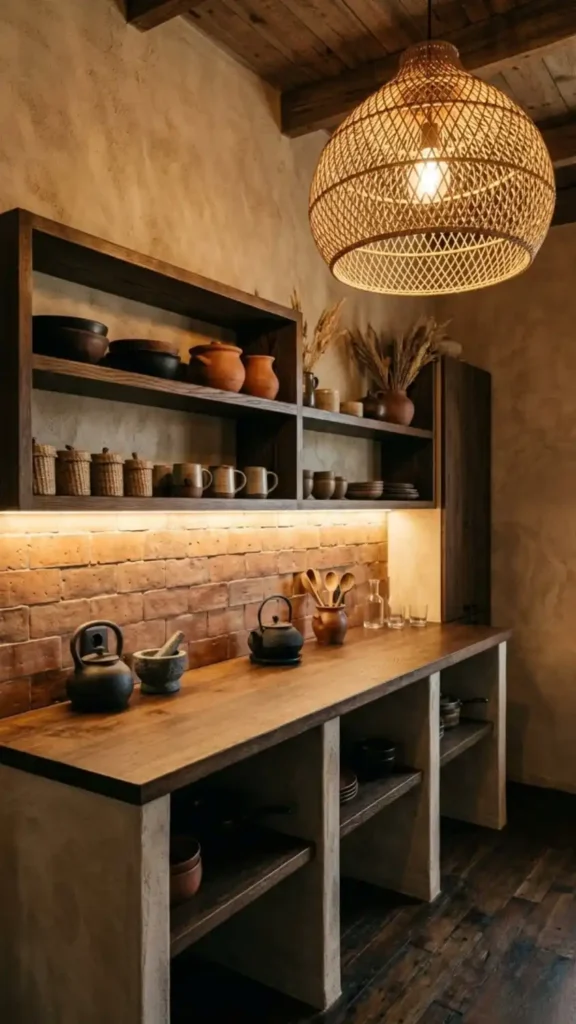
Style open shelves with functional objects that also carry material identity: hand-thrown terracotta or matte black ceramic vessels, stacked linen napkins, coiled grass baskets holding dry goods, dark wood serving boards, matte black cast iron cookware.
The rule is the same as elsewhere — odd-number groupings, varying height and material, deliberate negative space between groups.
The kitchen shelf is not a display case. Every object on it should be used. The aesthetic comes from choosing functional objects with the right material identity — not from adding decorative pieces into a functional space.
Kitchen Lighting: Where the Palette Is Most Vulnerable
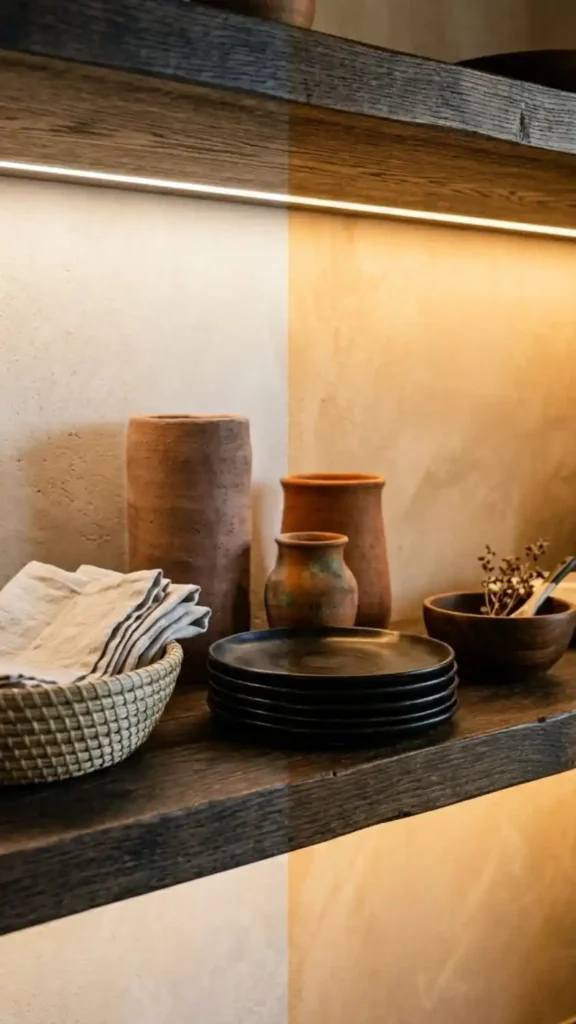
Cool-white kitchen lighting is the single fastest way to destroy an Afro Bohemian palette — and kitchens are the room most commonly fitted with it.
Recessed 4000K downlights, cool-white under-shelf strips, fluorescent overhead panels — all standard kitchen lighting choices that shift terracotta toward grey-brown and ochre toward muddy green.
Replace every kitchen light source with 2700K equivalents.
Under-shelf lighting at 2700K warms the backsplash and counter surface simultaneously — it’s the most effective single lighting position in the kitchen because it rakes light across both the tile surface and the counter objects at a low angle, revealing texture depth in both.
A rattan pendant over the kitchen island or dining area adds the geometric shadow projection that makes the space read as cohesive with the rest of the house.
Counter Curation: Functional Objects With Material Identity
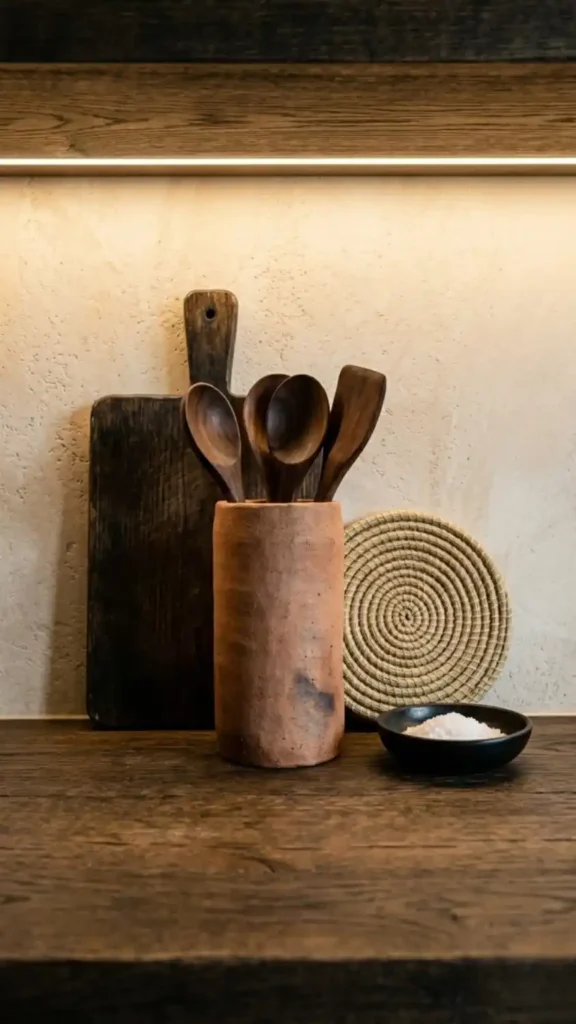
The counter is the kitchen’s most visible horizontal surface — and in an Afro Bohemian kitchen it carries the object layer that textiles carry elsewhere.
Every counter object should be functional and have a clear material identity: a terracotta utensil holder, a dark wood cutting board, a coiled grass trivet, a matte black ceramic salt dish.
Three to five objects maximum on any counter run. More reads as clutter in a functional space where visual clarity is also practical clarity.
Leave significant counter negative space — the empty counter surface provides the visual rest that the kitchen can’t get from a bare plaster wall section the way other rooms can.
The kitchen is the one room where restraint in the object layer is both a design decision and a functional necessity. Let those two requirements reinforce each other.
Cabinet Finish: The Background Decision That Determines Everything Else
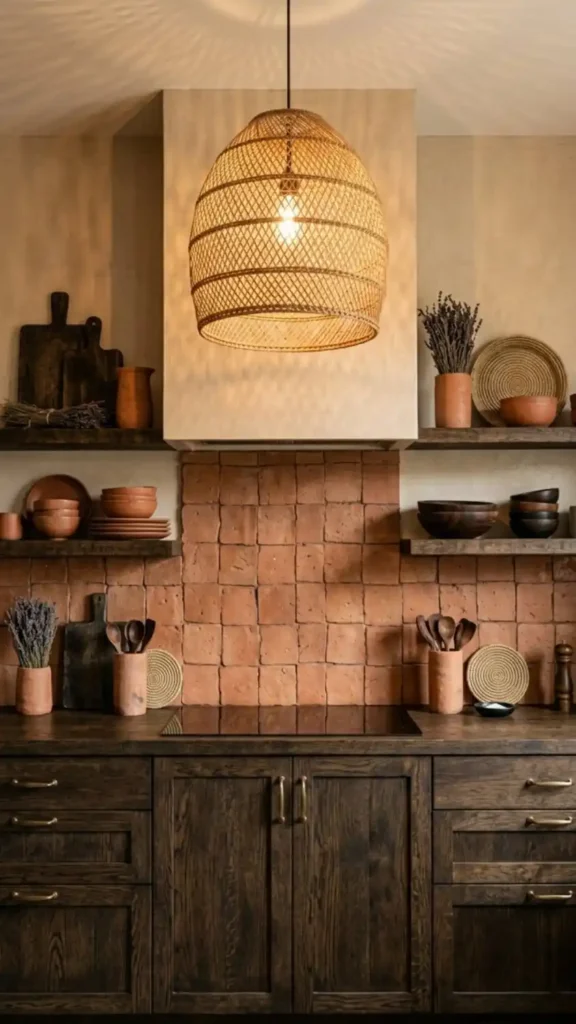
Cabinet finish is the kitchen’s equivalent of the wall tone decision — the largest surface area in the room and the background against which everything else reads.
Dark-stained wood — deep walnut, ebony-stained oak, dark mango wood finish — is the most cohesive cabinet choice for the Afro Bohemian aesthetic. It carries the dark value anchor that the palette needs and references the handmade wood furniture tradition of the broader aesthetic.
Warm sand or raw linen painted cabinets work as an alternative where dark cabinets would make the kitchen feel enclosed. The light value creates space while staying within the earth pigment range.
What doesn’t work: cool grey, bright white, high-gloss anything. These finishes sit outside the material logic and no styling layer applied over them will bring the kitchen into palette coherence.
If cabinet replacement isn’t feasible, dark hardware — matte black or aged bronze handles and fixtures — and open shelving installed above existing closed cabinets shifts the room’s material reading more than any other surface-level intervention.
The One Textile the Kitchen Can Hold
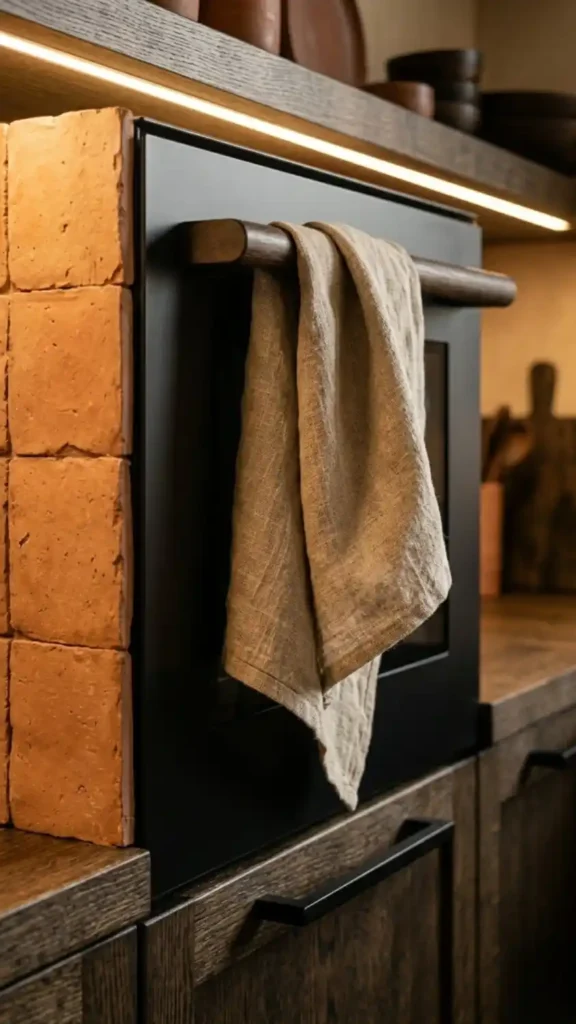
The kitchen can hold exactly one textile — and it’s a functional one.
Raw linen or undyed cotton tea towels draped over an oven handle or folded on a shelf bring the natural fiber vocabulary into the kitchen space without creating a practical problem.
A small raw linen or jute runner on a kitchen island is the one other textile position that works — it’s flat, wipeable, and adds the earth tone surface layer to the island without the maintenance issues of a fabric element near a cooking zone.
Both textiles should be undyed or earth-toned — raw linen, warm sand cotton, or ochre-washed fabric.
That’s the full textile allowance for the kitchen. More than this crosses into impractical and reads as the style being forced into a space that can’t naturally hold it.
Auditing Your Kitchen for Afro Bohemian Coherence
Walk through the kitchen and answer these questions before making any changes:
- What is the current backsplash material and color? Is it within the earth pigment range or does it need to be the first surface-level change?
- What color temperature are the current kitchen bulbs? Replace before evaluating anything else.
- Is there open shelving, or are all storage surfaces closed cabinet doors? Open shelving is the single most effective kitchen feature for delivering the object layer the aesthetic needs.
- Count the objects currently on the counter. How many are functional? How many are purely decorative? In a kitchen, every counter object should earn its place functionally. Remove decorative-only objects and replace any functional objects in synthetic or non-earth materials with natural material equivalents.
- What is the cabinet finish? Is it within the dark wood or warm neutral range or does it sit outside the palette? If outside, identify whether hardware replacement or open shelving installation above existing cabinets is a feasible interim solution.
- Is there a natural light source? If the kitchen runs primarily on artificial light, the 2700K bulb replacement is the highest-priority intervention in the room.
An Afro Bohemian kitchen works when the brief is accepted rather than fought.
The brief is this: deliver the full aesthetic through surface material and object curation, without relying on the textile layer that does the work everywhere else.
That constraint produces a different kind of room — cleaner, more materially specific, more quietly cohesive.
The terracotta tile earns its place the same way the mud cloth throw does in the living room. The dark wood shelf earns its place the same way the carved furniture does in the bedroom. The function is different. The material logic is identical.
Go deeper into the Afro Bohemian Kitchen:
- 11 Afro Bohemian Kitchen Ideas for a Warm and Functional Space — Pull specific ideas for each surface and object decision
- How to Style an Afro Bohemian Kitchen — Walk through all eight styling levels in sequence
- Afro Bohemian Kitchen Decor Must-Haves for Beginners — Start with the exact pieces to buy if you’re just beginning