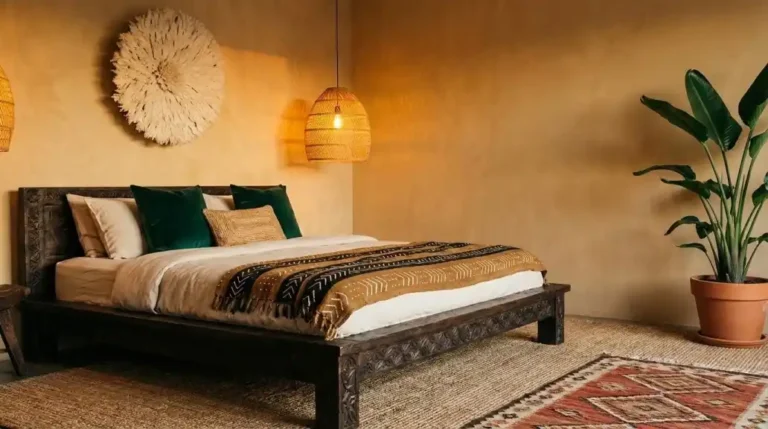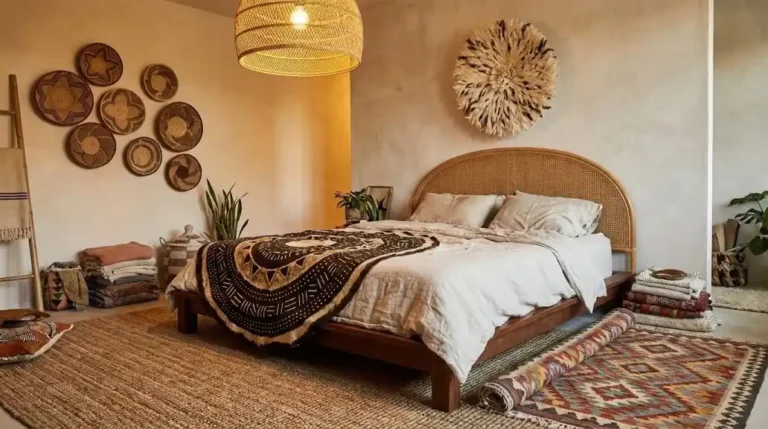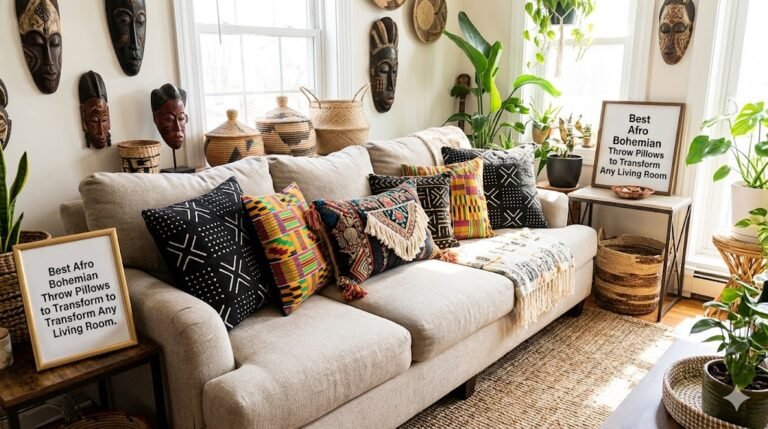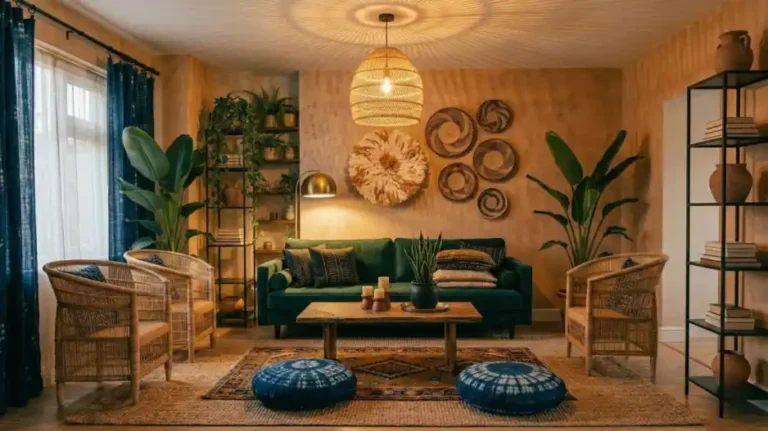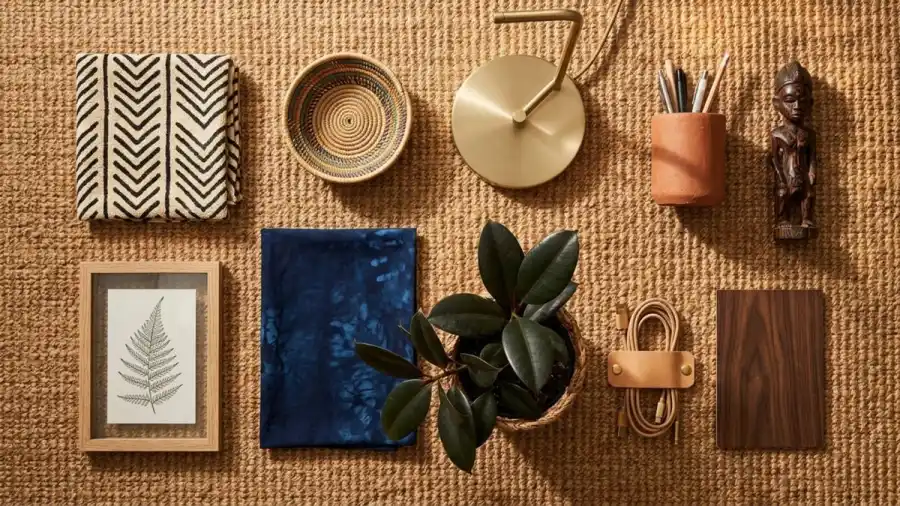
Afro Bohemian Office Decor Must-Haves for Beginners
The Afro Bohemian office has a buying logic that no other room requires.
In every other room, the first purchase sets the palette reference and everything builds outward from it. In the office, the first purchase has to also respect the room’s functional constraint — the desk surface stays minimal, the maximalist layer goes to the walls and floor.
That means two parallel buying tracks operating simultaneously.
The desk track: reclaimed wood desk, brass lamp, terracotta vessel, mud cloth runner. Four pieces. Minimal. Tactile. Functionally correct.
The peripheral track: gallery wall elements, floating shelves, Bolga baskets, layered rugs, reading nook chair, statement plants. Everything else. Built outward from the walls and floor into the corners and ceiling zones.
This list covers both tracks — in the sequence that makes each decision easier rather than harder.
Quick Takeaway:
- The desk and the walls are bought as two separate systems — the desk track stays minimal and tactile, the peripheral track carries the full maximalist layer.
- The Bolga basket is bought before the desk is fully styled — it conceals the power strip and cable management before the aesthetic layer is assembled on top of it.
- The gallery wall starts with one African mask — not a full composition. The mask sets the center axis and scale that every subsequent wall element responds to.
The Framework: Two Parallel Buying Tracks
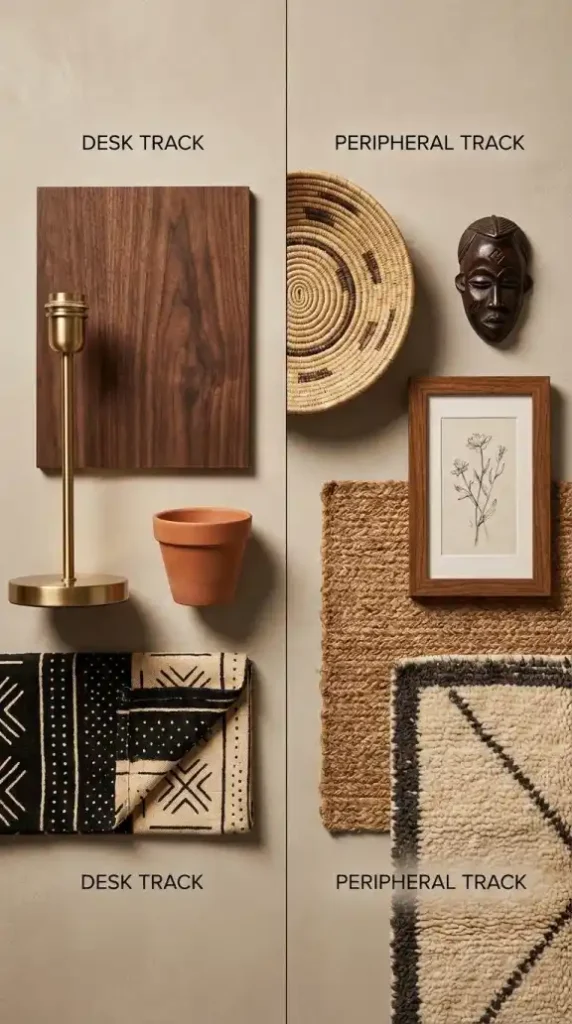
Before buying anything understand the two-track framework.
The Desk Track covers the four objects that live on the desk surface — the reclaimed wood desk itself, the brass lamp, the terracotta stationery vessel, and the mud cloth desk runner. These four pieces establish the desk zone’s minimal tactile register. Nothing beyond these four belongs on the desk surface regardless of how aesthetically correct individual additional objects might be.
The Peripheral Track covers everything at the walls, shelves, floor, and corners — the gallery wall elements, the floating shelves, the Bolga baskets, the layered rugs, the reading nook chair, and the statement plants. This is where the soulful maximalism lives. This track has no object limit — it builds in layers over time as each wall, floor, and corner zone is resolved.
Buy from both tracks simultaneously — not one track fully before starting the other.
The desk track pieces are fewer and faster to acquire. The peripheral track builds over weeks and months. Running both in parallel means the desk is functional from day one and the room’s peripheral richness develops around it rather than arriving all at once.
First Purchase: A Reclaimed Dark Wood Desk
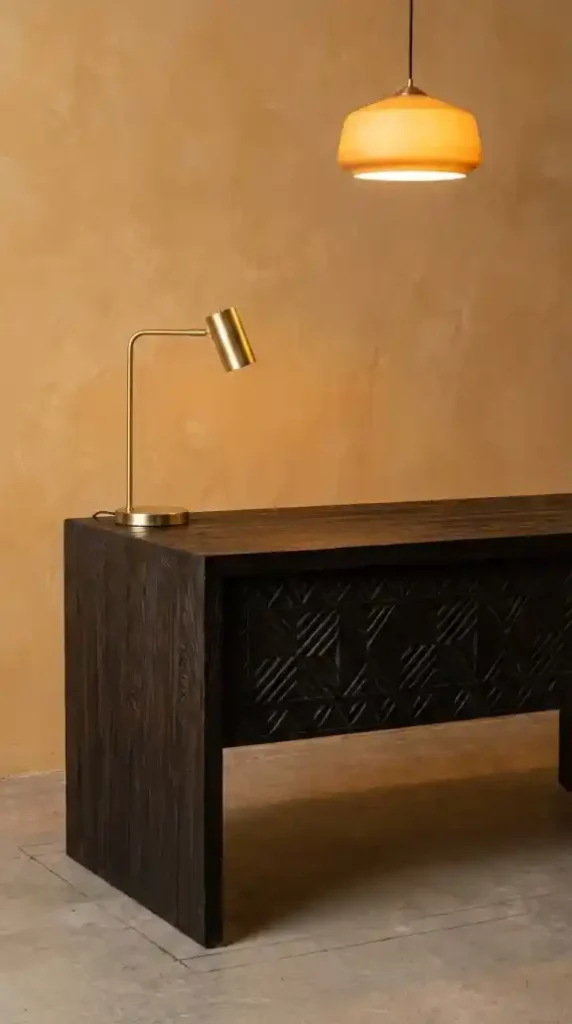
The reclaimed dark wood desk is the office’s first and most consequential purchase — and it comes from the Desk Track.
Its material quality sets the standard that every other wooden object in the room responds to. A machine-finished office desk with a laminate surface will create material tension with every handmade craft object placed around it regardless of how correct those objects are individually.
Dark walnut or ebony-stained reclaimed wood with visible grain variation and hand-carved geometric motif detail on the desk face delivers the handmade heritage quality that the aesthetic depends on at its primary functional surface.
The carved motif detail on the desk face is the cultural reference that reads from the room entry point without occupying any desk surface area.
Buy the desk before any other furniture piece.
The desk position determines the room’s orientation — which wall becomes the gallery wall, where the reading nook goes, where the floor rug extends. Every spatial decision in the office responds to where the desk sits and which direction it faces.
If a full reclaimed wood desk replacement isn’t feasible, a solid dark wood desk top on reclaimed wood or metal trestle legs is the most affordable entry point that maintains the material logic — avoiding laminate and veneer finishes that undermine the tactile register the desk zone needs.
Second Purchase: 2700K Warm Bulbs and a Raffia Pendant
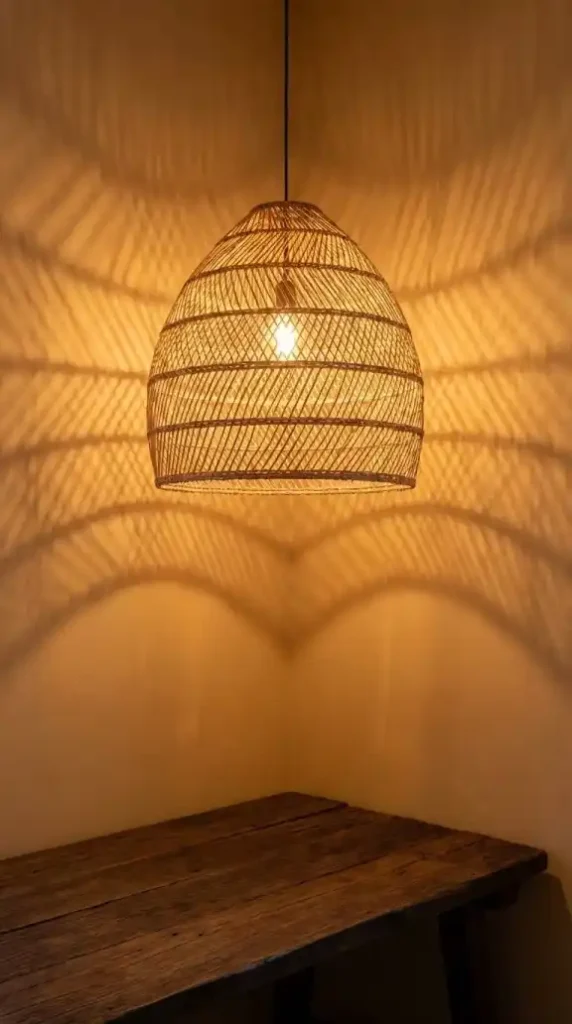
The lighting purchase comes second — before rugs, before gallery wall elements, before the reading nook chair.
Replace every bulb in the office with 2700K warm LED before evaluating the desk’s wood grain tone, the wall color, or any existing rug under its actual conditions.
The raffia or rattan pendant is the office’s primary atmospheric fixture and its ceiling-level shadow projection element simultaneously.
Buy oversized for the room — 60–80cm diameter for a standard office space.
After dark the open weave casts intricate geometric shadow projections across the ceiling and gallery wall — adding a visual layer to the peripheral zones that deepens the heritage gallery composition without requiring additional objects.
Install the pendant before placing any gallery wall elements beneath it.
The pendant’s shadow projection zone on the gallery wall is part of the gallery composition — the shadows animate the space between the framed pieces and the mask, creating depth that the objects alone don’t produce.
Third Purchase: A Minimalist Brass Desk Lamp
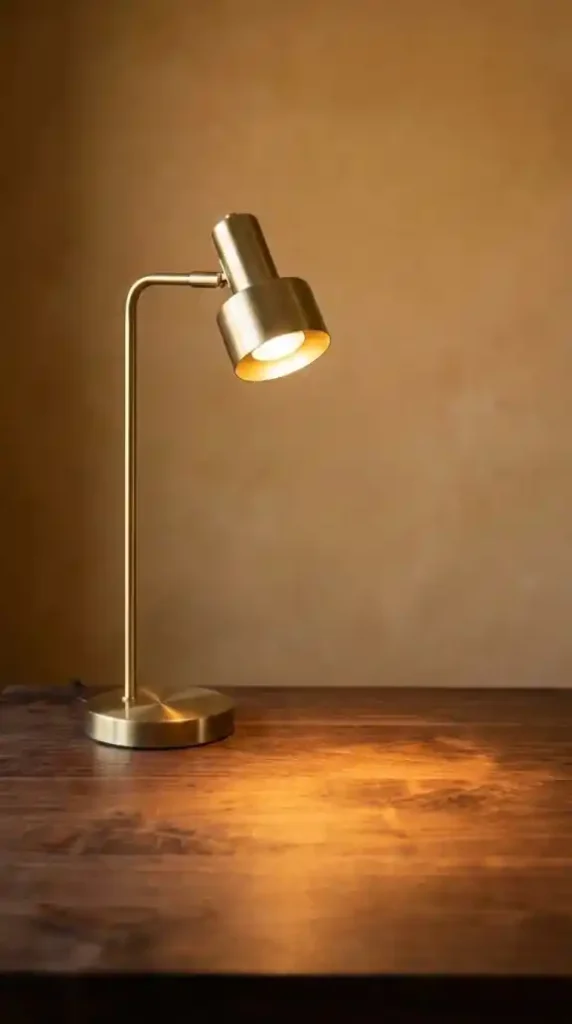
The brass desk lamp is the Desk Track’s second purchase — and it’s the office’s most contemporary-adjacent object.
Its slim modern form and brushed brass finish bridge the contemporary and handmade material registers at the desk’s most functional position.
The brass finish connects the desk lamp to the broader brass accent thread that runs through the room — the hammered brass elements at the shelf and gallery positions, the brass wireless charging tray, the brass hardware accents throughout.
At the desk level the lamp’s contemporary silhouette is precisely what makes the organic elements around it read as intentional craft rather than accumulated decoration.
The thin modern form of the brass lamp frames the reclaimed wood desk surface, the terracotta vessel, and the mud cloth runner as a composed aesthetic arrangement — the contemporary minimalist thread doing its framing work at the most intimate desk scale.
Position it at the non-dominant side corner — left for right-handed workers, right for left-handed — so the task light rakes across the work surface from the side rather than from directly above.
Side-raking warm light reveals the walnut grain depth and the mud cloth runner’s raised weave texture simultaneously — making both materials more legible under the desk’s primary task light than overhead lighting could produce.
Fourth Purchase: A Terracotta Stationery Vessel and Mud Cloth Runner
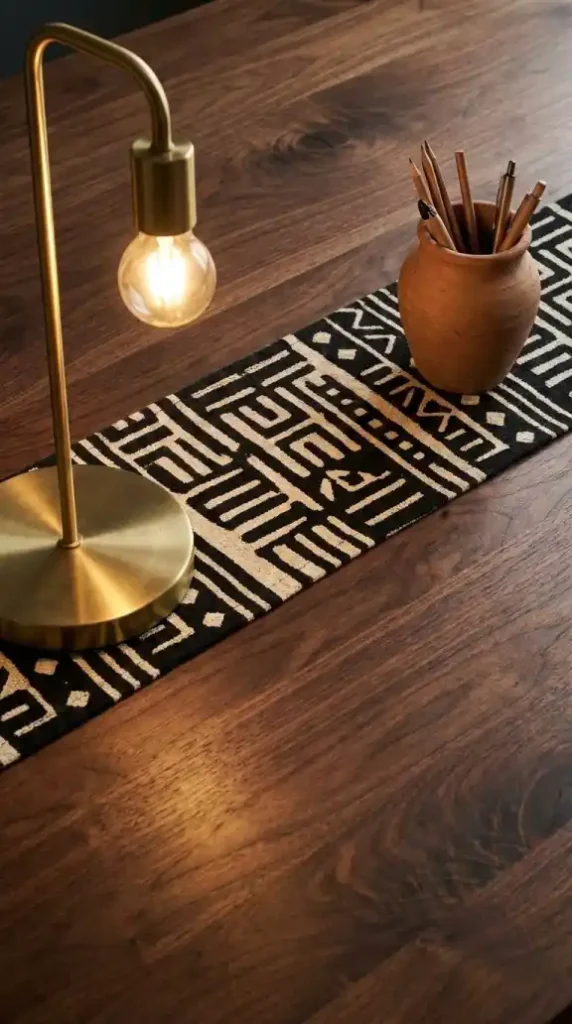
The terracotta vessel and mud cloth runner complete the Desk Track — and they’re bought together because they’re the final two objects that complete the desk’s three-object composition.
The terracotta stationery vessel — rough unglazed clay, slightly irregular form, hand-thrown if possible — holds pens, pencils, and daily stationery. Functional. Earth pigment tone cohesive with the walnut grain. Rough surface providing the tactile contrast to the smooth brass lamp base beside it.
The short mud cloth runner — not a full desk covering, a runner spanning approximately one third of the desk width — adds the natural fiber texture layer at close range. The raised cotton weave of the mud cloth is experienced tactilely by the working hand and perceived visually by the working eye without demanding the cognitive attention that a fully patterned desk surface would require.
Once these two pieces are in place the Desk Track is complete.
Three objects. One brass lamp. One terracotta vessel. One mud cloth runner.
Step back from the desk and commit to leaving it exactly as it is regardless of how the peripheral track develops around it. The instinct to add more to the desk as the room fills in is the single most common mistake in Afro Bohemian office building — and it’s the mistake that tips the desk from functional clarity into visual fatigue.
Fifth Purchase: Bolga Baskets for Cable Management and Storage
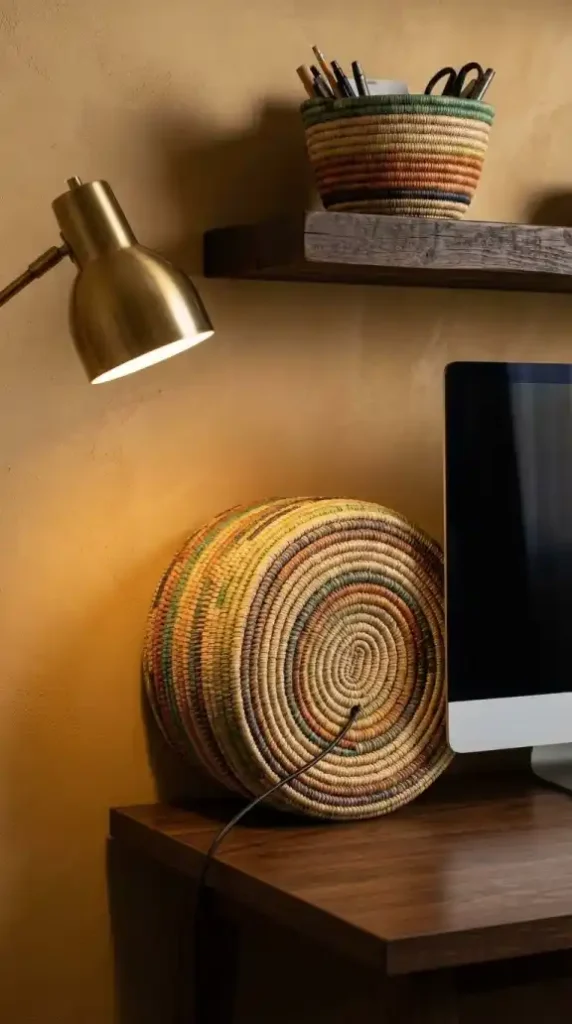
Bolga baskets from Ghana are the Peripheral Track’s first purchase — bought before the gallery wall elements, before the rugs, and before the reading nook chair.
They come this early because the tech-organic balance needs to be resolved before the aesthetic layer is assembled on top of it.
Visible cables and power strips are the single most common element that breaks an Afro Bohemian office’s coherence from inside an otherwise correctly assembled room.
Buy two Bolga baskets — one sized to conceal the desk power strip and cable management system at the desk surface position, one smaller for shelf cable and supply storage.
Load the power strip into the larger basket before positioning it on the desk. Route the necessary cables through the open weave at the basket’s back face.
From the desk chair position and the room entry point both baskets read as traditional Ghanaian craft objects. From the back — out of the primary sightline — every cable exits through the woven exterior in an organized system.
Pair the Bolga baskets with tan leather cord organizers for remaining visible cables along the desk back edge and shelf rear face.
Leather reads as cohesive with the aesthetic’s material vocabulary. Plastic cable management clips are the one material that can be seen from every position in the office simultaneously — they’re also the easiest material to replace before anything else is styled around them.
Sixth Purchase: A Large Jute or Sisal Base Rug
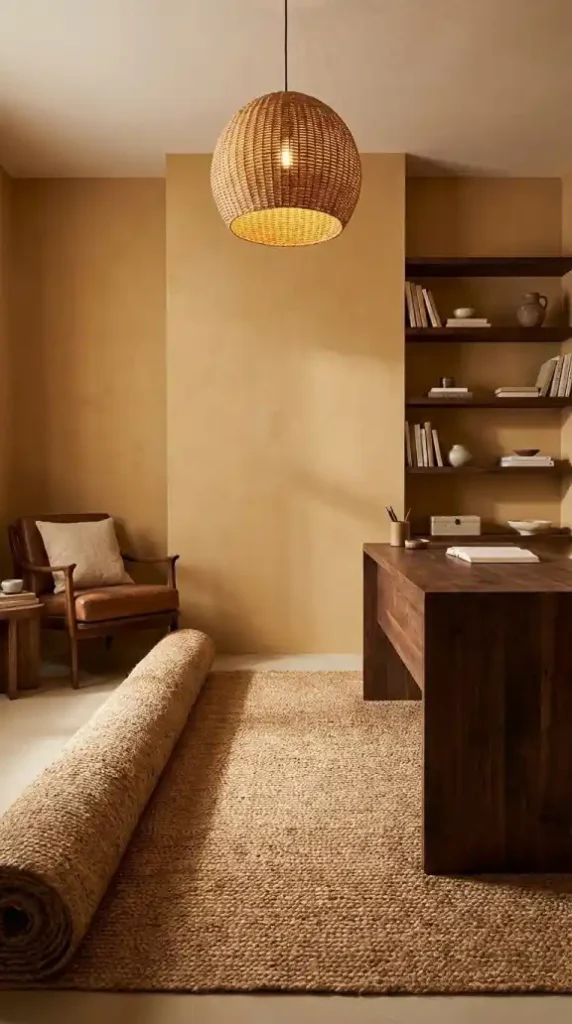
The jute or sisal base rug is the Peripheral Track’s floor foundation — and it must cover the full office floor zone before the Moroccan Berber accent layer is considered.
A large jute base extending under the desk, the reading nook corner, and the floating shelf wall creates the unified natural fiber ground plane that ties the office’s spatial zones together.
Natural jute handles daily office foot traffic and rolling desk chair use without the pile-compression damage that denser wool rugs develop under caster wheels.
Buy the largest jute rug the floor plan allows.
The jute base’s honey-warm fiber tone sits within the Grounded Neutral palette category — providing the natural material ground that the Moroccan Berber accent rug reads against.
Confirm the jute reads correctly under the 2700K pendant before accepting it.
Natural honey-toned jute under warm light reads as grounding and warm. The same jute under cool-white fluorescent reads as grey-beige and flat. If the rug looks correct under your warm pendant and wrong under any remaining cool-white bulbs the issue is the bulb — not the rug. Replace the bulb.
Seventh Purchase: A Moroccan Berber or Kilim Accent Rug
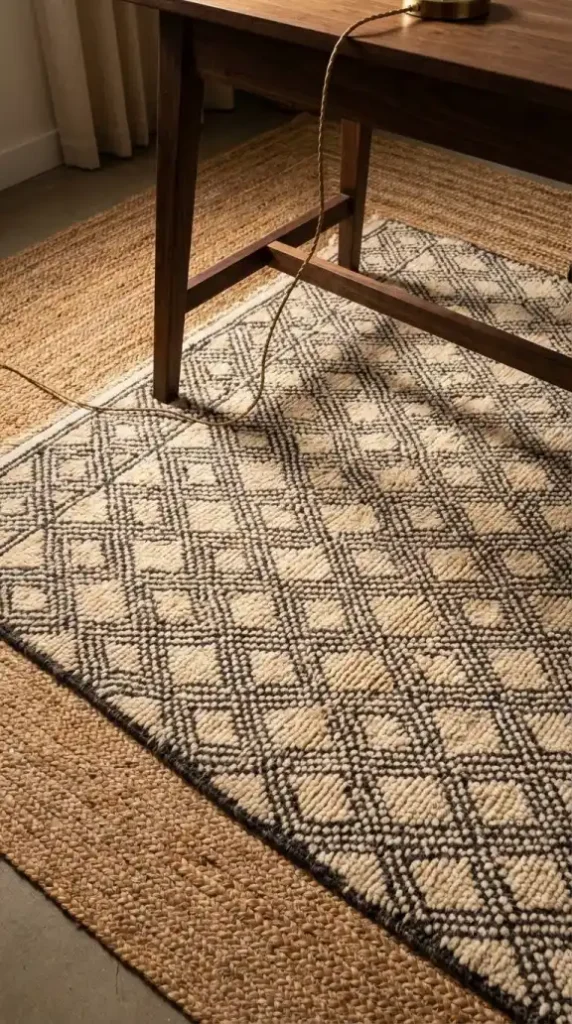
The Moroccan Berber or kilim accent rug is placed after the jute base is confirmed — chosen in response to the jute’s neutral honey tone and the desk’s dark walnut color rather than selected in isolation.
A Moroccan Berber in cream and charcoal geometric diamond pattern introduces the High Contrast palette component at the floor’s most prominent zone — the desk chair position visible from the room entry point.
Position it so the desk chair rolls primarily on the jute base rather than the Berber pile.
The Berber sits at the desk’s visual center from the entry point — its geometric pattern adding floor-level richness to the zone the desk occupies — without bearing the mechanical stress of daily rolling chair use.
A flat-woven kilim in earth tones at the reading nook corner completes the floor layer at the secondary zone.
The kilim’s dense flat weave handles the rattan peacock chair’s legs without pile compression and its geometric pattern in ochre, terracotta, and indigo connects the nook floor to the desk zone’s Berber composition.
Two accent rugs. Two distinct floor positions. One jute base unifying both zones beneath them.
Eighth Purchase: An African Mask for the Gallery Wall
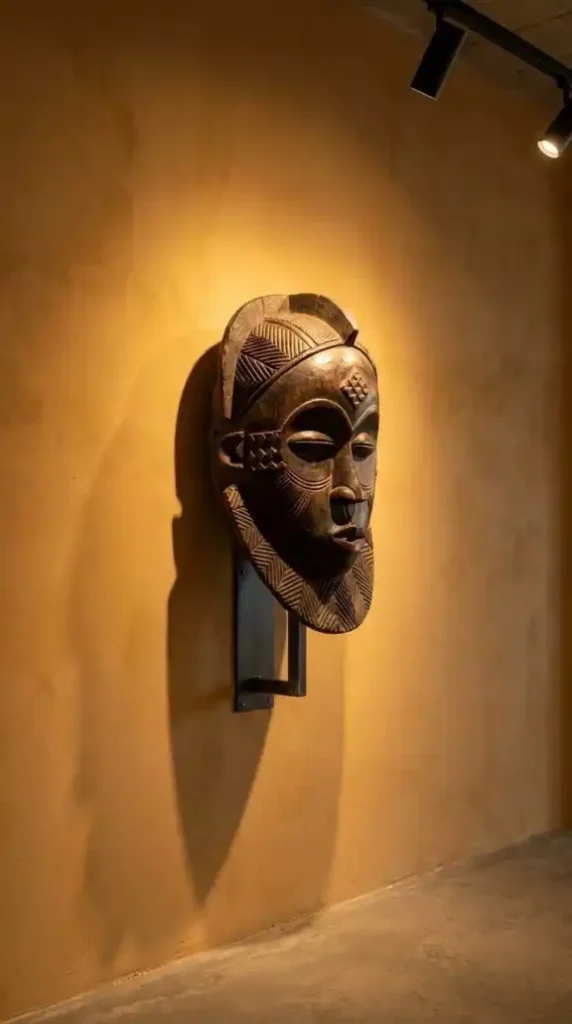
The African carved mask is the gallery wall’s first purchase — and it’s bought before the framed Kuba cloth, before the botanical prints, and before any basket wall element.
The mask sets the gallery’s center axis and primary focal scale. Every subsequent wall element is chosen and positioned in response to it.
Buy one mask. Large enough to read as a primary focal element — at least 30cm in height — with significant carved surface detail that catches warm track light in deep highlight and shadow.
Mount it on a museum-style wall bracket at approximately 165cm from floor to mask center. Confirm its position before buying any adjacent wall piece.
The empty wall around the single mounted mask is not incompleteness — it’s the beginning of the gallery composition with its center axis established.
Live with the single mask on the wall for at least a week before adding anything beside it.
The week gives the eye time to calibrate the mask’s scale and position against the room’s spatial context — and it prevents the rushed addition of secondary gallery elements at the wrong scale or wrong position relative to the anchor piece.
Ninth Purchase: A Rattan Peacock Chair for the Reading Nook
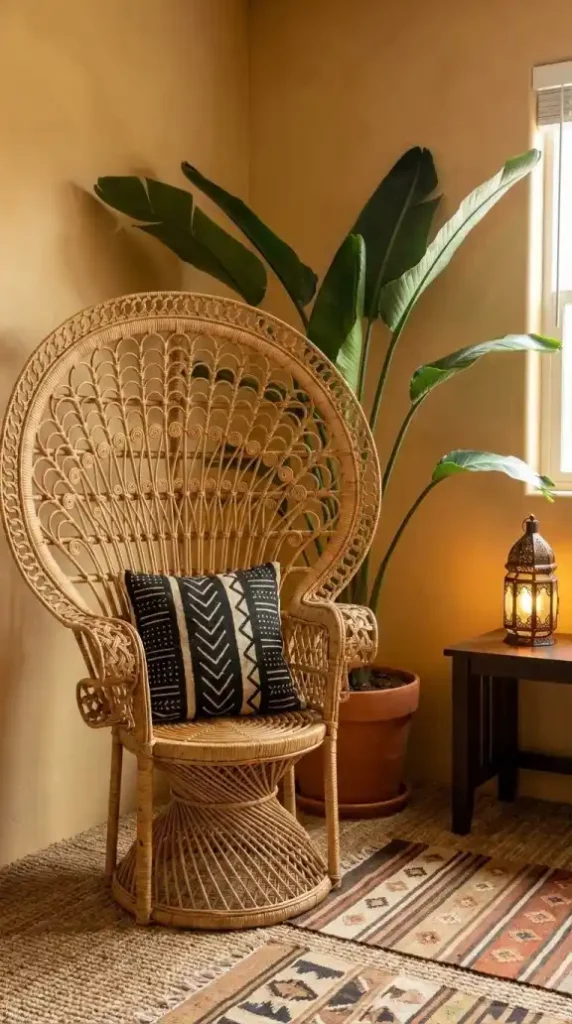
The rattan peacock chair or Malawi cane chair is the reading nook’s defining piece — and it comes before the nook’s side table, lamp, and plant because the chair’s position determines where every other nook element sits.
The fan-shaped open weave back of the peacock chair should be fully visible from the desk chair position — readable as a distinctive silhouette element from across the room.
Don’t compress it against the wall or obscure it behind the desk.
The chair’s silhouette is the reading nook’s primary visual identifier from the work zone — the signal that a distinct cognitive space exists within the office separate from the desk.
A mud cloth cushion in black and cream geometric pattern on the seat connects the nook’s primary seating to the desk’s mud cloth runner — the same textile tradition at two distinct scales in two distinct zones of the same room.
A Bird of Paradise in a terracotta pot placed directly behind the chair frames the nook with broad tropical leaf presence — defining the reading zone as a distinct botanical enclosure within the office.
Tenth Purchase: Statement Greenery at Three Zones
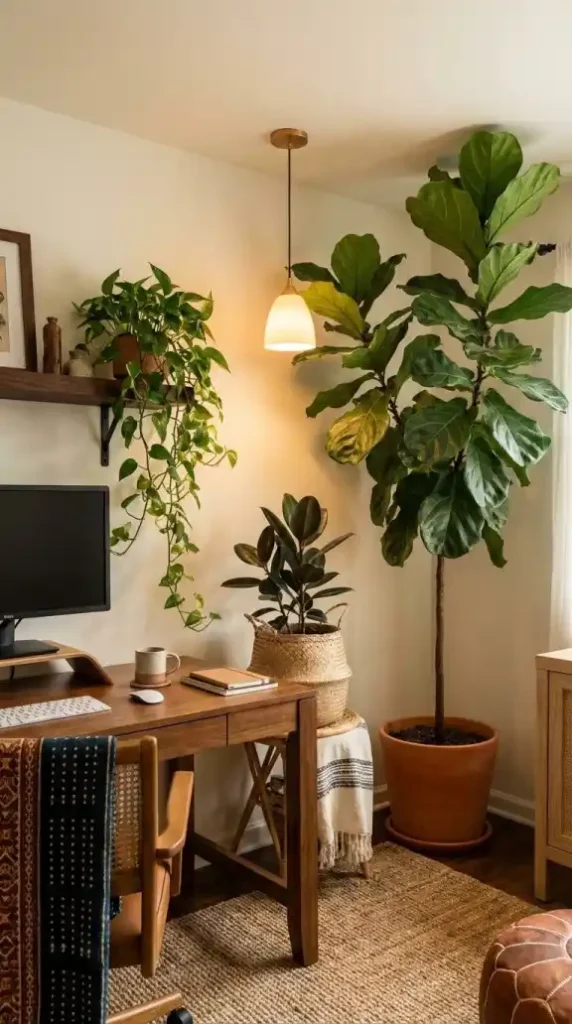
Office greenery is the final structural layer — and it’s placed last because each plant’s position is determined by the spatial gaps the assembled room reveals.
Three zones. Three plants. Three distinct spatial and productivity contributions.
The large corner zone: a Fiddle Leaf Fig or Bird of Paradise in a terracotta pot at the office’s most open corner with access to indirect natural light. The broad leaf silhouette fills the floor-to-ceiling zone and provides the visual rest object the working eye returns to during thinking pauses. Terracotta pot grounds the plant within the earth palette.
The high shelf zone: a trailing Pothos or Spider Plant cascading from the top shelf of the floating shelves. Positioned during the shelf styling step — confirmed here as correct now that the fully assembled room reveals whether the cascading vines have clear fall distance without being blocked by shelf objects below.
The desk zone: a small Rubber Tree in a woven basket planter at the desk surface corner — the fourth and final desk object, added now rather than during the desk styling step because its position needs to be confirmed against the monitor sightline that only becomes clear once the monitor is in its final position.
Position the Rubber Tree so it sits in the peripheral sightline from the working position — visible during micro-pauses between tasks, not blocking the monitor or the primary working field.
All three plants repotted before entering the space.
Terracotta for the corner plant. Dark glazed ceramic for the trailing shelf plant. Woven basket for the desk plant. No plastic nursery containers visible anywhere in the assembled office.
What to Buy Last — Not First
Three categories beginners consistently buy too early in the office context:
Framed botanical prints and vintage photography.
Both belong in the gallery wall composition — but both are secondary elements that respond to the African mask already mounted. Bought before the mask exists they have no gallery anchor to organize around and will read as isolated wall decoration rather than components of a composed heritage gallery.
The Moroccan lantern.
The reading nook’s dedicated atmospheric light source belongs in the nook after the peacock chair and the Bird of Paradise are in position. Bought before the nook furniture exists the Moroccan lantern has no zone to define — it reads as a decorative object on a side table rather than the nook’s atmospheric anchor.
Velvet desk chair.
The deeply saturated velvet desk chair is a significant investment — and it should be bought after the desk, the rugs, and the gallery wall’s first elements are in place. The velvet color needs to respond to the assembled room’s palette rather than be chosen against a mood board. Forest green or rust — the correct choice is the one that the assembled room needs to balance its existing palette distribution.
The Beginner Buying Sequence at a Glance
Before making any purchase answer these questions:
- Is the current office lighting at 2700K warm? If not replace every bulb before evaluating the desk grain, wall color, or any existing rug under actual conditions. The earth pigment surfaces read correctly only under warm light — cool-white fluorescents and downlights actively misrepresent every material in the room.
- What is the current desk material? Laminate and veneer finishes create material tension with every handmade craft object placed around them. Identify whether a full desk replacement or a solid dark wood desk top on trestle legs is the more feasible entry point before buying any other furniture.
- Are there visible cables and power strips from the desk chair position? Identify the Bolga basket size that conceals the power strip before buying the basket. The basket must fit the tech it’s concealing while sitting correctly on its surface position.
- Is there a wall with at least 180cm width and 200cm height available for the gallery composition? Measure before buying the African mask. The mask’s mounting height at 165cm from the floor needs at minimum 35cm of clear wall above it and 80cm of clear wall on either side for the subsequent gallery elements to read correctly.
- Is there a corner with 80cm square of clear floor space with access to indirect natural light? Identify the corner for the Fiddle Leaf Fig or Bird of Paradise before buying the plant — light availability determines the plant’s long-term health and therefore its structural contribution to the office.
- Is there a second corner or wall section with 80cm square of clear floor space for the reading nook? The peacock chair’s distinctive fan-shaped back needs clearance on all sides to read as a full silhouette from the desk position. Confirm the floor clearance before buying the chair.
Ten pieces. Two parallel tracks. The full beginner Afro Bohemian office.
The reclaimed dark wood desk sets the material standard at the primary functional surface. The 2700K raffia pendant and brass lamp reveal it correctly at atmospheric and task levels. The terracotta vessel and mud cloth runner complete the desk’s three-object minimal composition. The Bolga baskets resolve the tech-organic balance before the aesthetic layer is assembled on top of it. The jute base rug grounds the full office floor plane. The Moroccan Berber adds Heritage Accent pattern at the desk zone’s visual center. The African mask anchors the gallery wall’s center axis. The rattan peacock chair defines the reading nook as a distinct cognitive zone. The statement greenery fills the three spatial zones that no object can address.
Each piece earns its place by doing something no other piece on the list is already doing.
Soulful maximalism at the walls, floor, shelves, and corners. Productive clarity at the desk.
That’s the Afro Bohemian office — built for the work it has to do and beautiful in the way it does it.
Go further with the Afro Bohemian office series:
- Afro Bohemian Office: The Complete Style Guide — Understand the complete desk-zone versus peripheral-zone logic before buying any piece
- 11 Afro Bohemian Office Ideas for a Warm and Productive Space — Explore 11 specific office ideas to apply once your foundation pieces are in place
- How to Style an Afro Bohemian Office — Follow the step-by-step styling sequence after your starter purchases are assembled