Afro Bohemian Living Room: The Complete Style Guide
The living room is where soulful maximalism either holds together or collapses into chaos.
Every other room in the house has a single primary function that organizes the space — the bedroom centers on the bed, the kitchen centers on the work zone, the bathroom centers on the fixtures. The living room has no such organizing anchor. It’s a social space, a rest space, a visual space — and it has to perform all three simultaneously.
That’s what makes it both the most challenging and the most rewarding room to build in the Afro Bohemian aesthetic. When the system is correct — textiles layered in hierarchy, furniture collected over time, walls functioning as a heritage gallery, lighting set to golden hour — the living room becomes the room that defines the entire house’s visual identity.
This guide covers the full system from first decision to finished room.
Quick Takeaway:
- The living room is built on soulful maximalism — layered textiles, curated artifacts, and artisanal furniture — held together by a strict color logic and a modern industrial contrast layer that stops the room from reading as themed.
- The velvet sofa is the room’s structural furniture anchor — its color sits in the Heritage Accent or Wildcard category and every other furniture and textile decision responds to it.
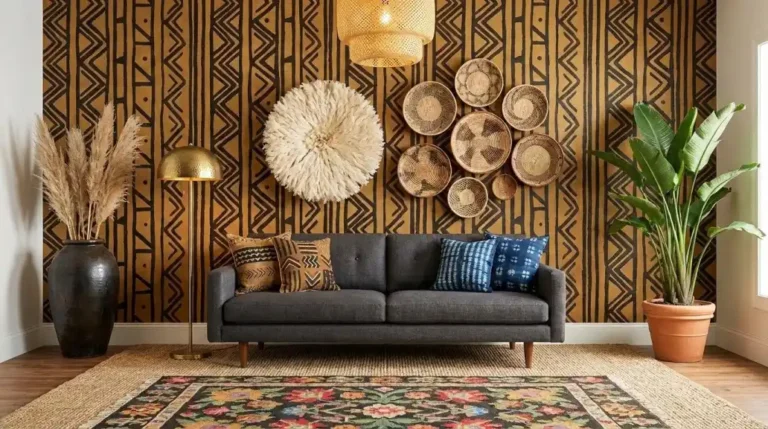
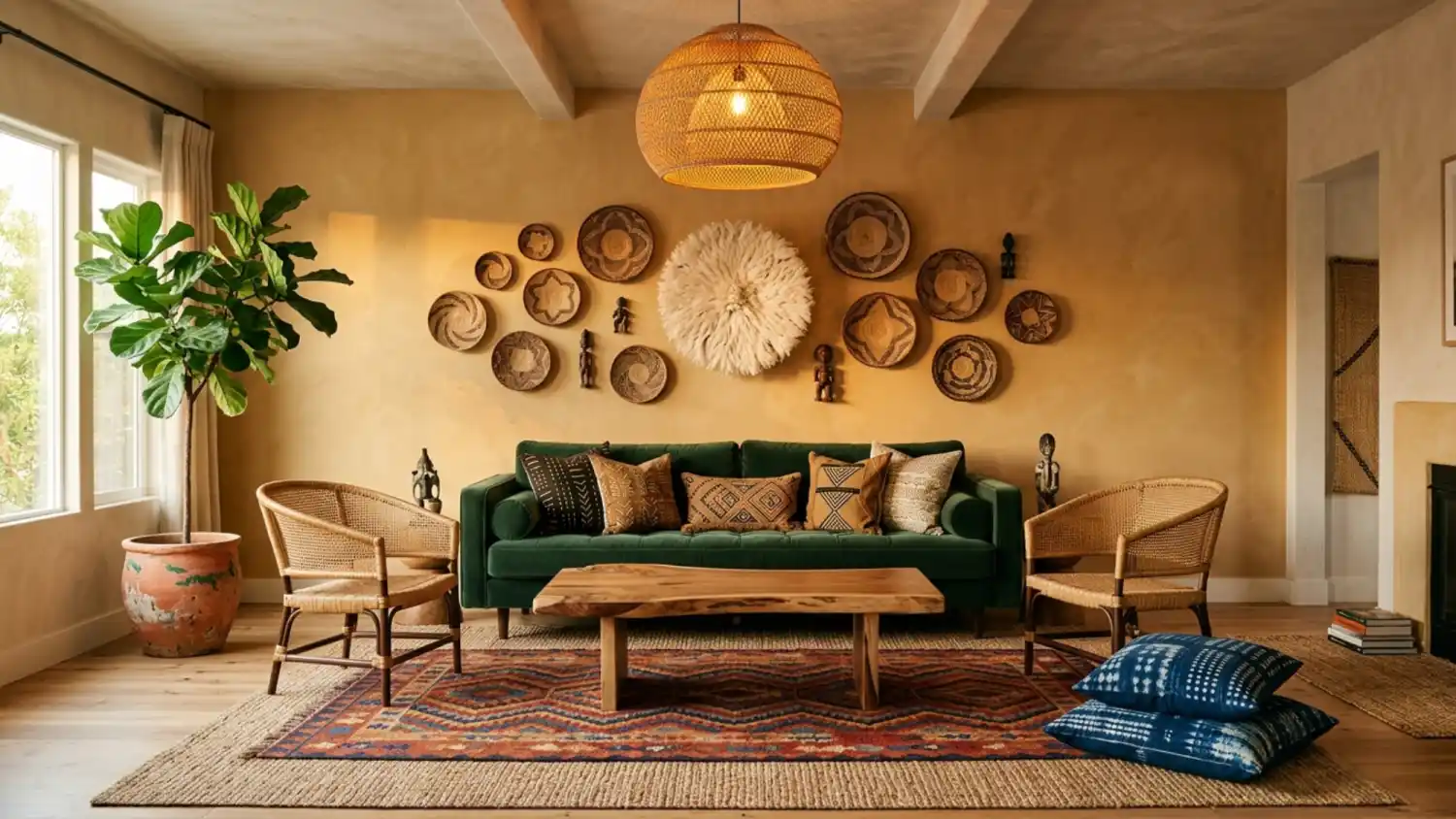
- The wall functions as a heritage gallery — Juju hat, basket cluster, Bamileke mask, and large-scale photography operating at four distinct scales and four distinct material registers simultaneously.
The Sofa: Where the Room’s Color Commitment Lives
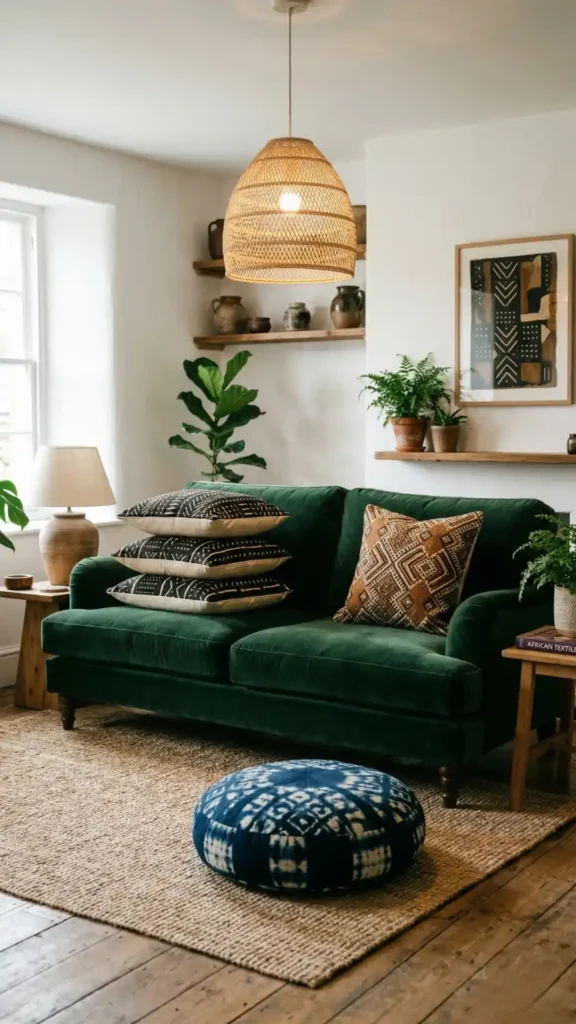
The sofa is the living room’s largest single furniture surface — and in Afro Bohemian design it carries the room’s primary color commitment.
A deep forest green or rust velvet sofa is the wildcard element that anchors the space with mid-century luxury while remaining materially cohesive with the woven and handmade objects around it. Velvet’s plush pile reads as tactile richness — it belongs in the same material conversation as mud cloth and Kuba cloth because all three are textile surfaces with depth, just at different registers of softness and structure.
Forest green sits in the Life tone category — the vibrancy that prevents the earth palette from reading as flat. Rust sits at the intersection of Earth and Heritage Accent tones — warmer, more terracotta-adjacent, more immediately cohesive with the ochre wall and jute rug.
The sofa choice determines the room’s color register before anything else is placed.
Forest green reads as bold and culturally confident — it references plant-dye traditions and works against ochre and warm sand walls with high contrast. Rust reads as warm and grounded — it sits closer to the earth palette and requires the Life tone accent to come from elsewhere in the room through indigo cushions or mustard throws.
Choose one. Then build everything else in response to it.
The Rug Stack: Building the Floor Layer in Two Materials
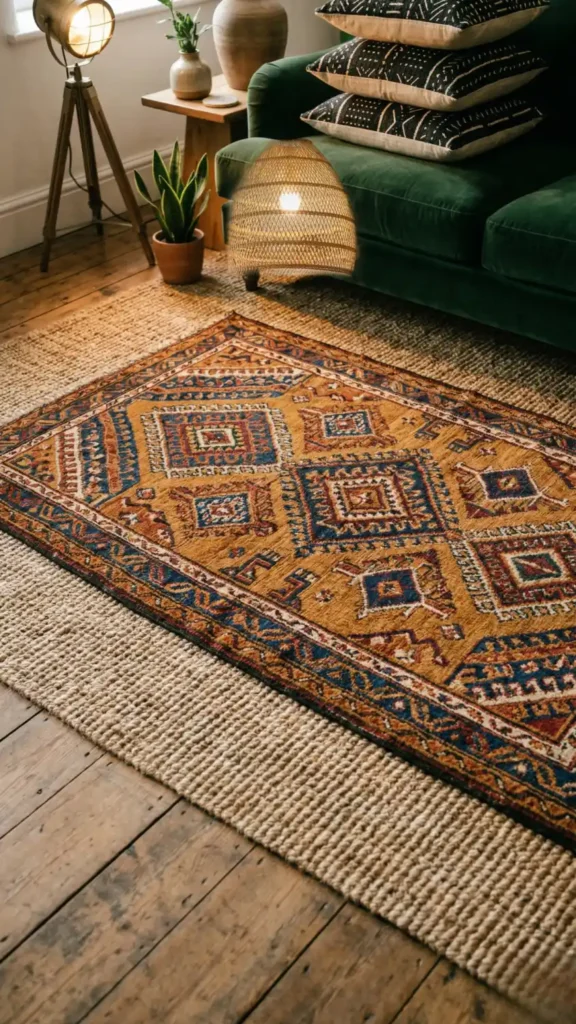
The living room floor layer runs on two rugs — and the sequence of how they’re laid determines whether the floor reads as composed depth or layered confusion.
The large jute or sisal base rug comes first and covers the full seating zone — extending under the front legs of the sofa, the coffee table, and all chairs in the arrangement. A rug that doesn’t reach under the furniture creates visual disconnection between the floor layer and the furniture layer. The jute base is the room’s natural fiber ground — neutral in color, rough in texture, grounding in function.
The smaller hand-knotted kilim or geometric Beni Ourain layered on top at the center seating zone adds the vibrant pattern and dense wool pile that plain jute can’t provide. Kilim in ochre, burnt orange, and indigo sits across all three palette categories simultaneously — earth tones in the ochre and orange, Heritage Accent in the burnt orange, Life tone in the indigo.
The layered composition creates material and tactile contrast at the floor level that mirrors the textile layering logic of the bedroom — two distinct rug characters, two distinct material registers, one cohesive floor composition.
Authentic Pattern Textiles: Mud Cloth, Kuba Cloth, and Adire
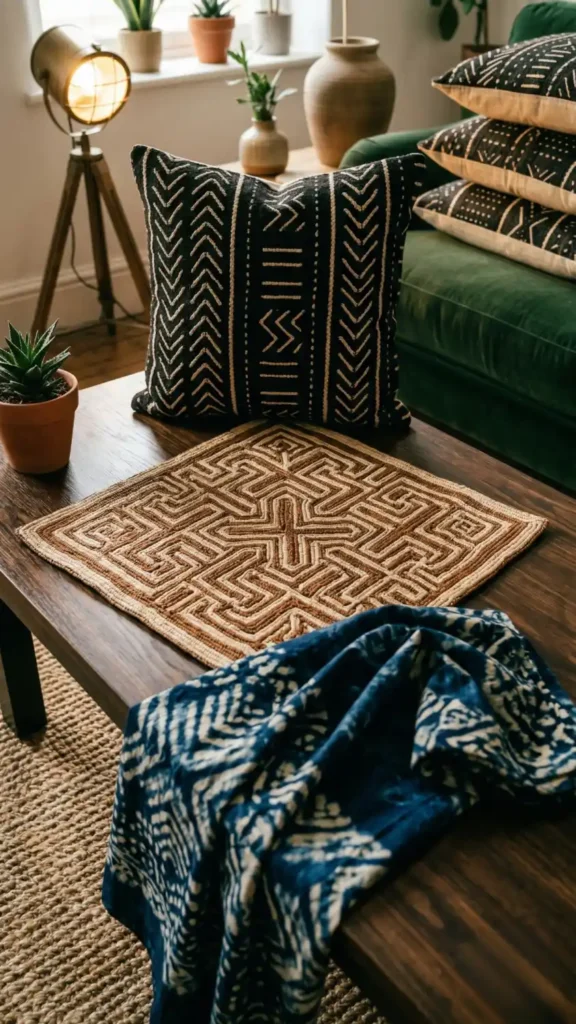
Three textile traditions anchor the Afro Bohemian living room pattern vocabulary — and each one occupies a distinct position in the room rather than appearing interchangeably.
Malian mud cloth sits at the cushion and throw level — the most intimate textile scale in the living room seating arrangement. Its black and cream geometric patterns provide the High Contrast component that makes the pattern vocabulary legible. Stack mud cloth cushions against the velvet sofa back where the contrast between the rough cotton weave and the plush velvet pile is most visually productive.
Kuba cloth operates at the structured wall hanging level — mounted or stretched as a panel, its dense interlocking raffia-inspired geometric patterns read as wall art rather than soft furnishing. At this larger scale, the Kuba cloth’s maximalist pattern density becomes an architectural element rather than a textile accent.
Yoruba Adire — Yoruba indigo batik from Nigeria — introduces the cooling deep blue through drapery panels or oversized floor cushions. The hand-dyed wax-resist patterns carry an organic irregularity that machine-printed indigo fabric can’t replicate. Positioned as floor cushions beside the sofa or as curtain panels at the window, the Adire indigo provides the Life tone cooling accent that balances the room’s warm earth dominant.
Artisanal Furniture: Collected Over Time, Not Purchased at Once
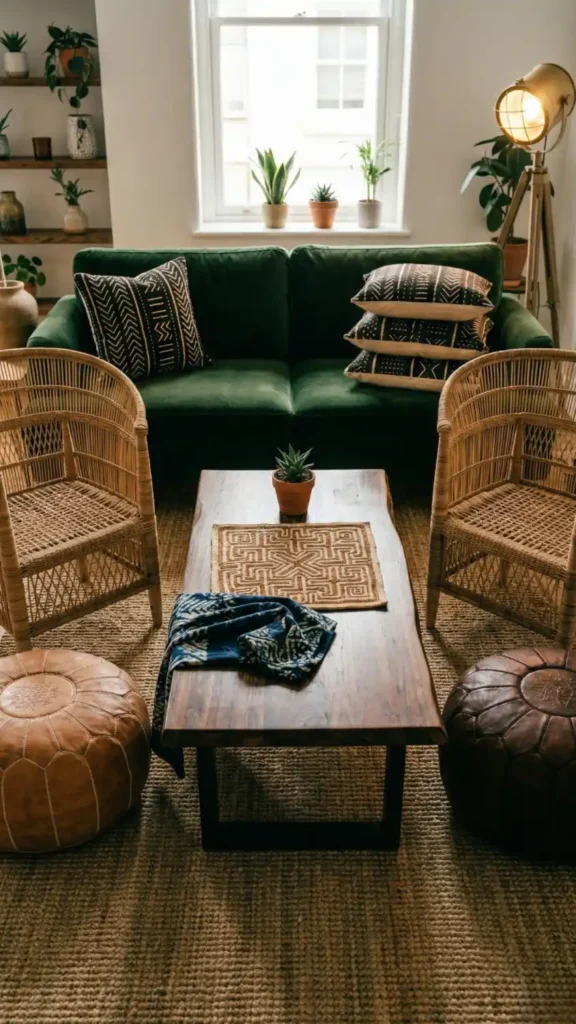
The furniture in an Afro Bohemian living room should feel collected — as if each piece arrived from a different source over a different period. That accumulated quality is what creates the aesthetic’s “lived-in” depth that single-source furniture shopping can never replicate.
The live-edge reclaimed teak or mango wood coffee table is the room’s grounding centerpiece. The live edge — the natural irregular boundary of the wood slab retained rather than cut square — reads as a found material object as much as a furniture piece. Hand-carved details across the surface add the visible craft evidence that machine-finished tables eliminate.
Malawi cane chairs or rattan peacock chairs introduce the airy tropical silhouette that the velvet sofa’s weight needs as a counterpoint. Their open weave structure keeps the seating arrangement visually light — the eye passes through them rather than stopping at them the way it stops at solid upholstered pieces.
Moroccan or Nigerian leather poufs in tan or chocolate brown add flexible seating at ground level. Their low profile keeps the sightline open across the room while the rich patinated leather surface adds a material register — smooth, aged, deeply warm — that none of the woven or carved furniture pieces provide.
The Wall as Heritage Gallery
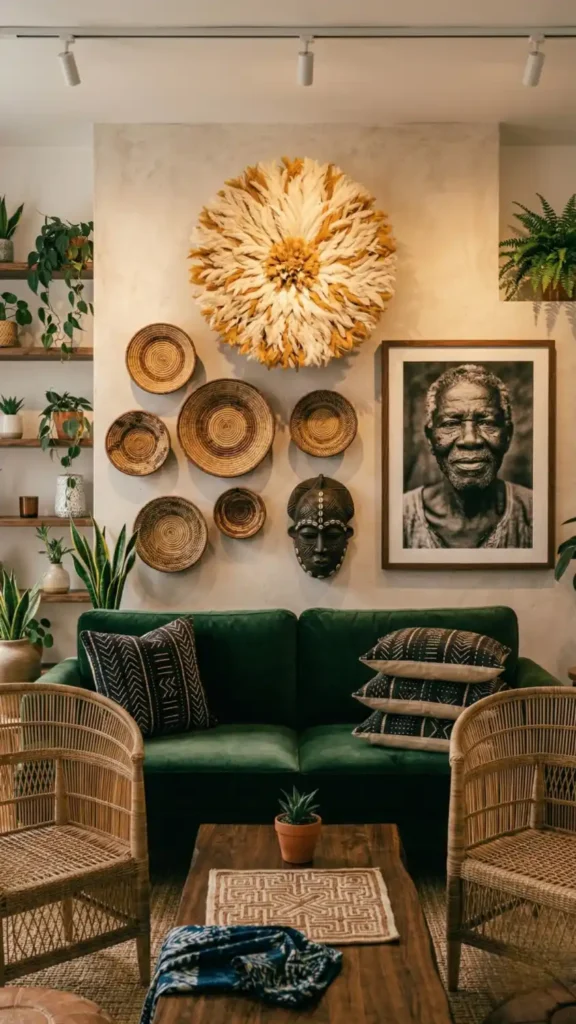
The living room wall is the room’s most publicly visible surface — and in Afro Bohemian design it functions as a gallery that operates across four distinct scales and four distinct material registers simultaneously.
The Juju hat — Bamiléké feathered headdress from Cameroon — is the wall’s primary focal point. Its circular feathered form breaks the rectangular geometry of the room with soft, organic mass. Positioned at the wall’s visual center — above the sofa or at the room’s primary focal wall — it anchors the gallery composition that everything else is arranged around.
The Tonga, Binga, or Zulu telephone wire basket gallery cluster sits to one side — five or seven baskets in graduated sizes arranged asymmetrically, their radial geometric patterns adding a second material layer at a smaller scale than the Juju hat.
A Bamileke or Fang carved mask mounted on a museum-style wall bracket adds the three-dimensional sculptural object at a third scale — smaller than the baskets, denser in surface detail, carrying the ancestral and ceremonial register that flat textile wall pieces don’t.
Large-scale film photography — grainy portrait silhouettes, African landscape compositions — completes the gallery at the fourth layer: contemporary visual language in direct conversation with traditional craft objects.
Four elements. Four scales. Four material registers. One composed gallery wall.
Color Logic: Grounded Neutrals, Heritage Accents, High Contrast
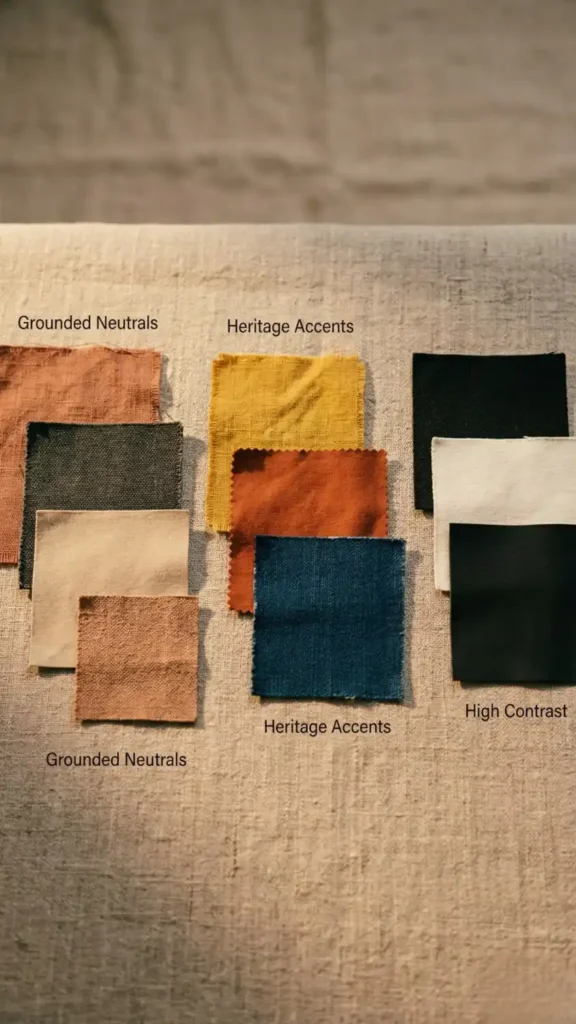
The Afro Bohemian living room palette operates in three categories — and understanding the functional role of each prevents the maximalist approach from collapsing into visual noise.
Grounded Neutrals — terracotta, charcoal, sand, clay — are the dominant. They live in the wall tone, the jute rug, the teak furniture, and the linen base textiles. The largest surface areas in the room. They provide the stability and natural warmth that hold the maximalist layers above them.
Heritage Accents — mustard yellow, burnt orange, indigo — add warmth and cultural vibrancy at the mid-layer: the kilim rug pattern, the Adire indigo floor cushions, the mustard throw draped over the cane chair. They’re the tones that reference African textile dye traditions most directly.
High Contrast — ebony, bone, matte black — sharpen the room and make the geometric patterns legible. The mud cloth’s black and cream, the Kuba cloth’s warm brown and cream, the matte black curtain rod and bookshelf frame — these are the tonal punctuation marks that prevent the earth palette from reading as undifferentiated warmth.
All three categories must be present. A room with only Grounded Neutrals reads as flat. A room with only Heritage Accents reads as busy. The High Contrast is what makes the pattern vocabulary of the textiles visible and resolved.
Lighting: Golden Hour From Multiple Sources
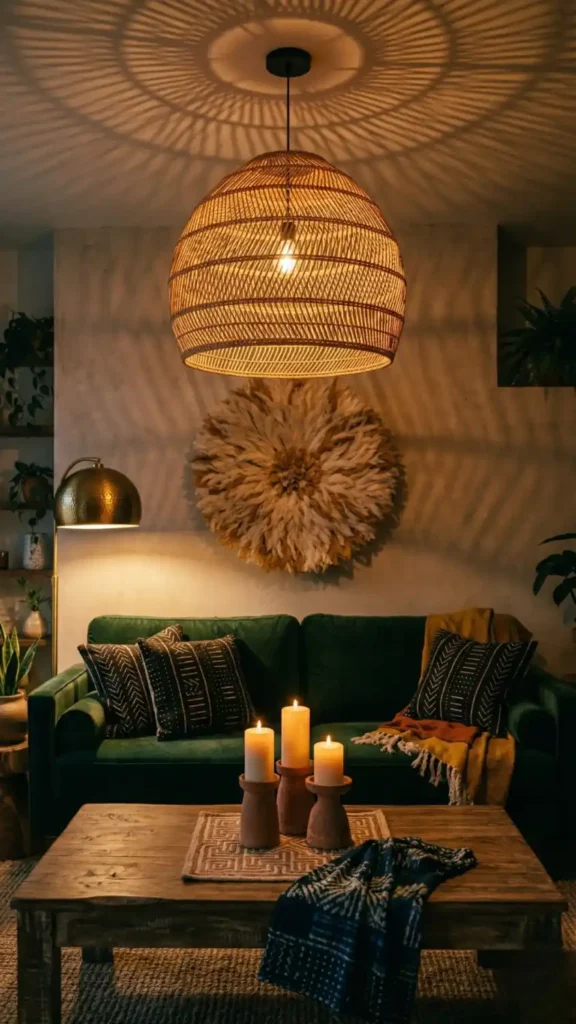
The living room lighting goal is a consistent golden hour glow maintained from the moment the overhead lights come on in the evening until the room is dark.
An oversized rattan pendant overhead — sized generously for the room, 60–80cm diameter for a standard living space — is the primary atmospheric source. The open weave casts geometric shadow projections across the ceiling and upper walls that shift as the bulb warms up, adding a visual layer the room only has after dark.
A hammered brass floor lamp beside the sofa provides the mid-height warm light that makes the textile layers on and around the seating arrangement visible at their most accurate color temperature. The hammered brass surface catches the 2700K light in multiple small shifting highlight points — a living surface quality that floor lamps with smooth metal bases can’t replicate.
Pillar candles in terracotta holders on the coffee table add the fourth light source at table level — warm flicker that no electric source replicates and that gives the room its most intimate atmospheric reading after dark.
All sources at 2700K. The sofa’s forest green velvet reads correctly under warm light — under cool white it shifts toward grey-green and loses the depth that makes it the room’s statement piece.
The Modern Industrial Contrast Layer
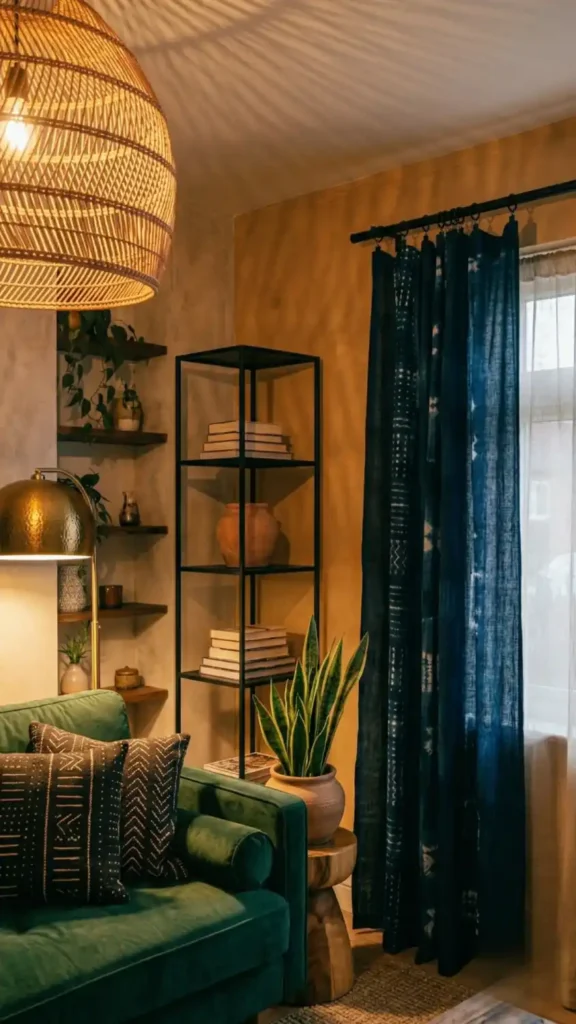
The modern industrial contrast layer is what stops the Afro Bohemian living room from reading as a themed space rather than a lived one.
Slim matte black metal bookshelves against the wall provide a contemporary linear structure that frames the organic objects displayed on them — terracotta vessels, stacked books, coiled baskets — within a clean industrial grid. The contrast between the thin black metal and the rough handmade objects creates the same productive tension as the velvet sofa beside the woven cane chair.
A minimalist matte black curtain rod holding the Adire indigo linen panels at the window completes the modern frame at the room’s vertical light-control position.
These two matte black elements — shelf and curtain rod — create a subtle visual thread of contemporary minimalism running through the room that prevents the layered heritage aesthetic from closing in on its own cultural references.
The industrial contrast doesn’t compete with the handmade vocabulary. It frames it — the way a museum frames artifacts. And that framing relationship is exactly what makes the Afro Bohemian living room feel curated rather than collected.
Botanical Life: The Jungle Layer
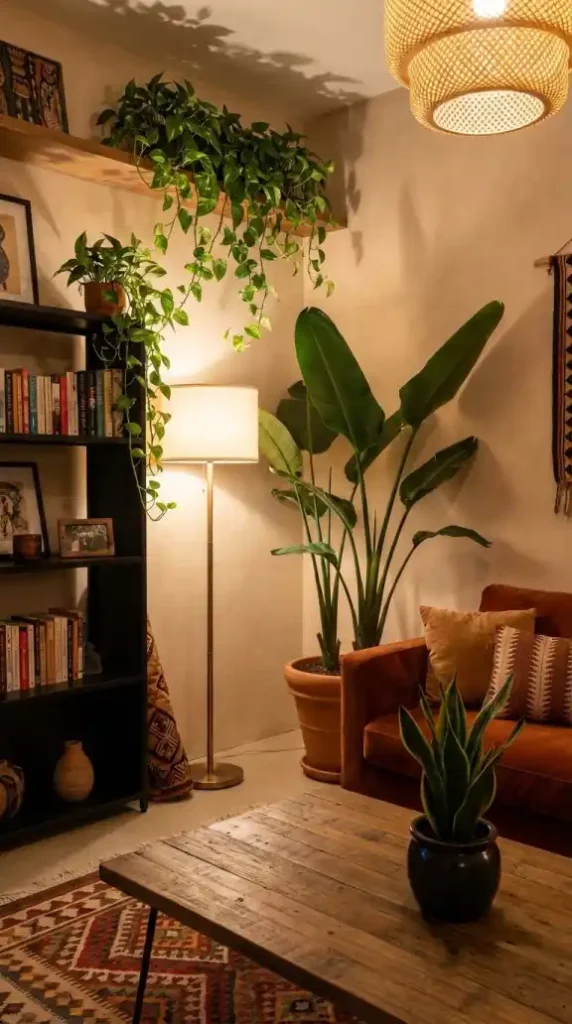
The jungle layer in the Afro Bohemian living room is structural — each plant assigned to a specific spatial zone that no furniture or object can fill.
A Fiddle Leaf Fig or Bird of Paradise at the room’s largest corner fills the floor-to-ceiling zone with botanical drama. The Bird of Paradise’s broad tropical leaf silhouette reads as a design element from across the room — a foreground presence that the eye reads alongside the sofa and coffee table rather than behind them.
A trailing Pothos or Heartleaf Philodendron at a high shelf position above the bookshelf or beside the basket gallery fills the upper wall zone where wall meets ceiling — the architectural dead zone that accumulates visual awkwardness without organic growth to address it.
A smaller structural plant — Snake Plant or ZZ Plant — on the coffee table or console adds the close-range botanical presence at the room’s most social surface.
All three in terracotta or dark ceramic pots. The container material is as important as the plant selection — plastic nursery pots visible in an otherwise correctly assembled room break the organic material logic the moment they’re seen.
Auditing Your Living Room Before You Change Anything
Walk through the space and answer these questions first:
- What is the sofa color and material? If it’s a light-toned or cool-grey upholstered sofa, identify whether reupholstering in forest green or rust velvet is feasible — or whether the sofa needs replacing as the room’s first furniture decision. The sofa is too visually dominant to be wrong and compensated for by styling.
- What color temperature are the current light sources? Replace every bulb with 2700K before evaluating any element in the room under its actual conditions.
- Is there a primary focal wall — the wall the sofa faces or the wall behind the sofa — large enough to hold a Juju hat at 60cm diameter with a basket gallery beside it? Measure before buying either piece.
- Does the current rug extend under the front legs of all seating? If not, the rug is undersized and creates visual disconnection between the floor layer and the furniture layer regardless of its pattern quality.
- Are there any cool-toned accent pieces — grey cushions, silver metallic objects, cool-white ceramics — currently in the room? Identify them. They’re the first things to replace because they break the palette coherence from the inside.
- Is there floor space in at least one corner with access to indirect natural light for a Bird of Paradise or Fiddle Leaf Fig? Identify the position before buying the plant.
The Afro Bohemian living room performs at its highest level when soulful maximalism and organic comfort are understood as the same thing rather than opposing forces.
The layered textiles are the comfort. The curated heritage artifacts are the soul. The modern industrial frame — the matte black bookshelf, the minimalist curtain rod, the arched mirror — is what keeps both readable as intentional design rather than accumulated collection.
All three operating together is what makes the room the most visually compelling space in the house — the one that makes visitors stop at the entry point before they’ve even found a place to sit.
Take the Afro Bohemian Living Room further:
- 11 Afro Bohemian Living Room Ideas for a Warm and Layered Space — Browse 11 targeted moves organized by furniture zone, wall element, and lighting position
- How to Style an Afro Bohemian Living Room — Follow the complete room-building sequence from first furniture decision to final sensory layer
- Afro Bohemian Living Room Decor Must-Haves for Beginners — Get the exact pieces and buying order if you’re building from scratch