Afro Bohemian Living Room Decor Must-Haves for Beginners
The Afro Bohemian living room looks like it took years to build.
It did — but not because it’s expensive or complicated. Because it’s layered. And layering by definition happens over time.
The good news for beginners is that the first five purchases do most of the structural work. Get those right — in the right sequence — and every subsequent addition becomes a straightforward response to what’s already in the room rather than a decision made in isolation.
This list gives you the specific pieces, the sequence, and the palette logic that holds soulful maximalism together from the first purchase to the last.
Quick Takeaway:
- The velvet sofa is the first purchase — its color sets the palette register that every rug, textile, and wall piece responds to. Buying the rug or cushions before the sofa means every subsequent decision is made without a reference point.
- The jute base rug comes before the kilim — the base determines the floor’s neutral foundation and the kilim is chosen in response to it, not independently of it.
- The Juju hat is the wall’s first purchase — it sets the gallery’s center axis and scale before any basket, mask, or photography piece is chosen.
The Palette Framework: Three Categories Before Any Purchase
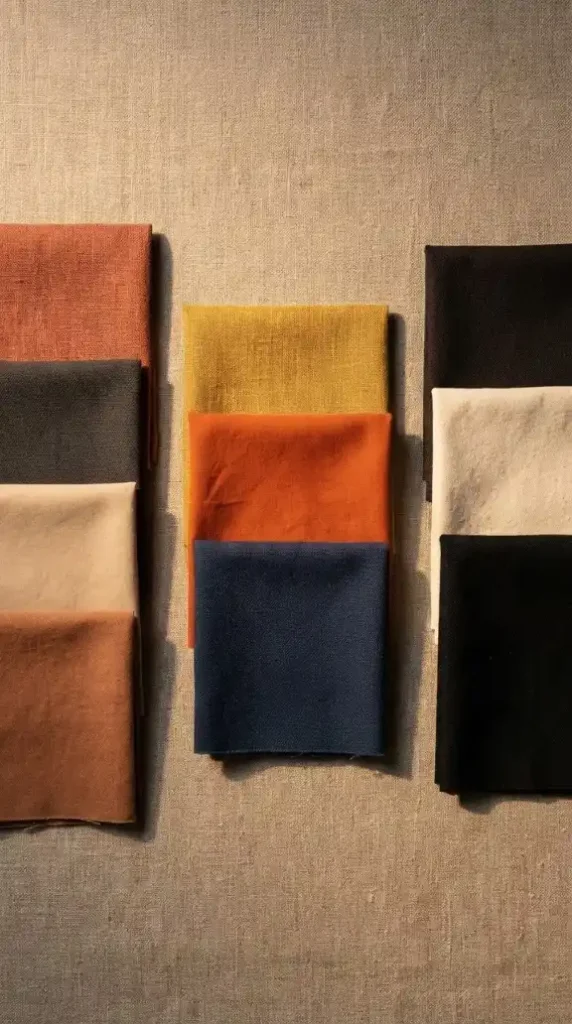
Before buying a single piece understand the three palette categories and the role each one plays.
Grounded Neutrals — terracotta, charcoal, sand, clay — are the dominant. These live in the wall tone, the jute rug, the wood furniture, and the linen base textiles. The largest surface areas. The stability that holds the maximalist layers above them.
Heritage Accents — mustard yellow, burnt orange, indigo — add warmth and cultural vibrancy at the mid-layer. The kilim rug pattern, the Adire indigo floor cushions, the mustard throw. These are the tones that reference African textile dye traditions most directly.
High Contrast — ebony, bone, matte black — sharpen the room and make the geometric patterns legible. The mud cloth’s black and cream, the Kuba cloth’s warm brown and cream, the matte black curtain rod and bookshelf frame.
Every purchase on this list sits in one of these three categories.
Buy in the right ratio — Grounded Neutral dominant, Heritage Accent supporting, High Contrast punctuating — and the soulful maximalism assembles into coherence without effort.
First Purchase: A Forest Green or Rust Velvet Sofa
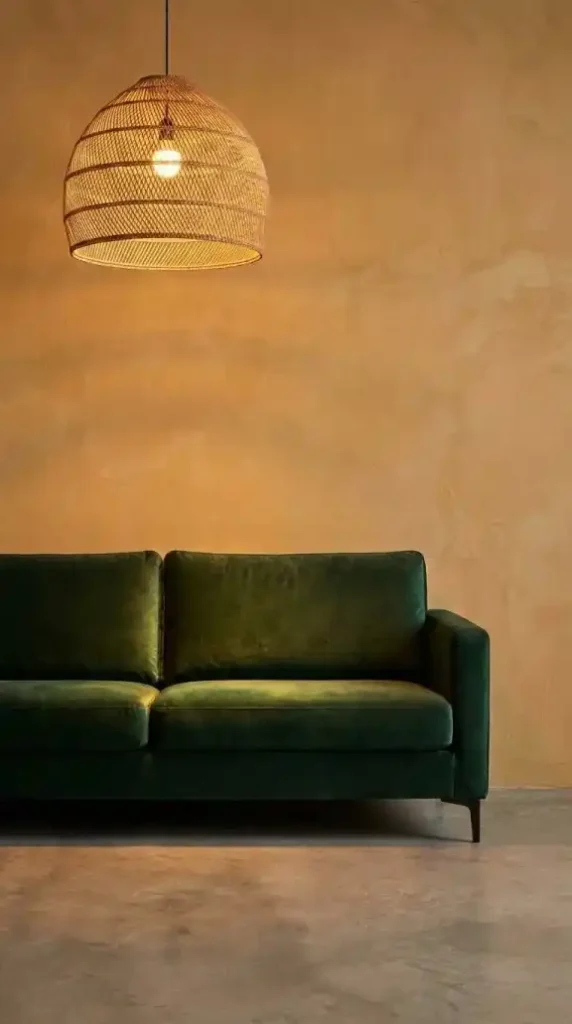
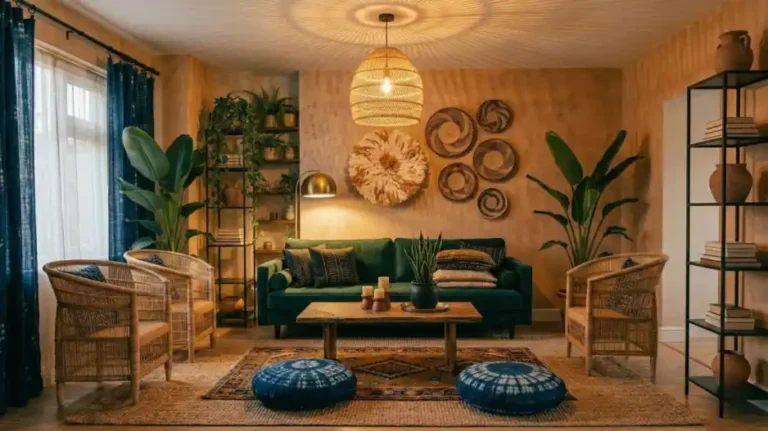
The velvet sofa is the room’s first and most consequential purchase.
Its color sets the palette register that every rug, cushion, wall piece, and accent responds to. Buying anything else before the sofa means making decisions without a reference point — which is exactly how living rooms end up feeling assembled rather than built.
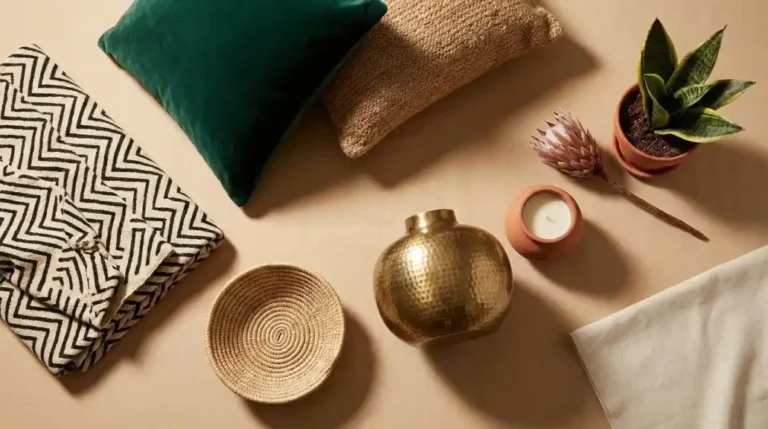
Forest green velvet sits in the Life tone category — it adds the vibrancy that prevents the earth palette from reading as flat while referencing plant-dye textile traditions. Against ochre walls and jute rugs it creates high contrast that reads as bold and culturally confident.
Rust velvet sits at the intersection of Earth tone and Heritage Accent — warmer, more immediately cohesive with the terracotta and burnt sienna palette, requiring the Life tone accent to come from elsewhere through indigo cushions or mustard throws.
Choose one. Then build everything in response to it.
The velvet pile’s tactile richness is the wildcard element that makes the room feel luxurious within the handmade aesthetic — it belongs in the same material conversation as mud cloth and Kuba cloth because all three are textile surfaces with depth at different registers of softness and structure.
Second Purchase: 2700K Warm Bulbs and a Rattan Pendant
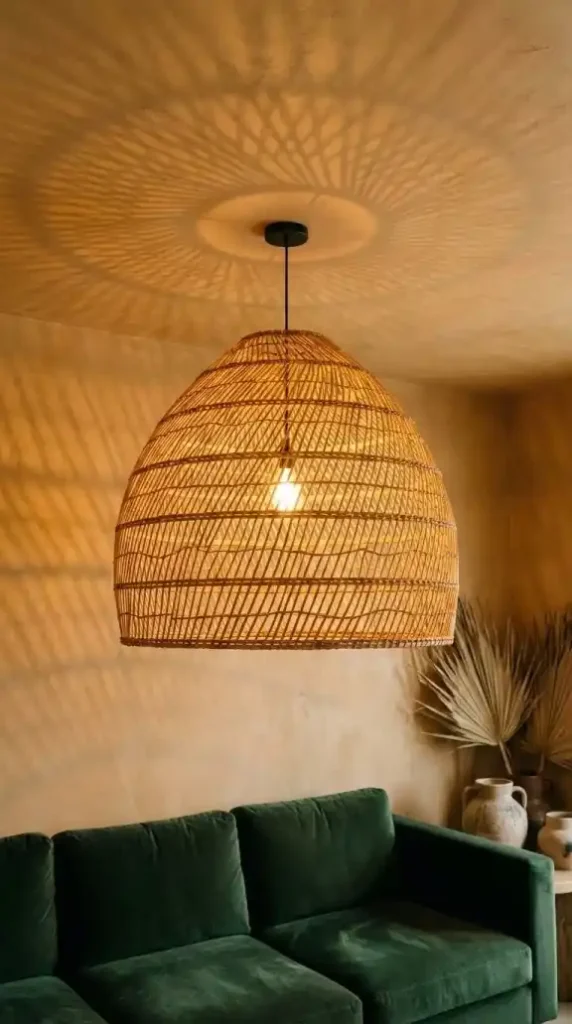
The lighting purchase comes second — before any rug, textile, or object decision.
Replace every bulb in the room with 2700K warm LED before evaluating the sofa color you just confirmed, before choosing a wall tone, before assessing whether the existing floor or ceiling reads correctly.
Every decision made under cool-white light is made under false conditions.
The rattan pendant is the living room’s primary fixture and its ceiling-level textural element simultaneously. Buy oversized — 60–80cm diameter for a standard living space.
A pendant too small for the room reads as an accessory rather than an architectural element. An oversized rattan pendant overhead reads as a design decision — and after dark its open weave casts geometric shadow projections across the ceiling that give the room a visual layer it doesn’t have during the day.
Install the pendant before placing any furniture beneath it — the pendant position determines the room’s light center and therefore the furniture arrangement that serves it correctly.
Third Purchase: A Large Jute or Sisal Base Rug
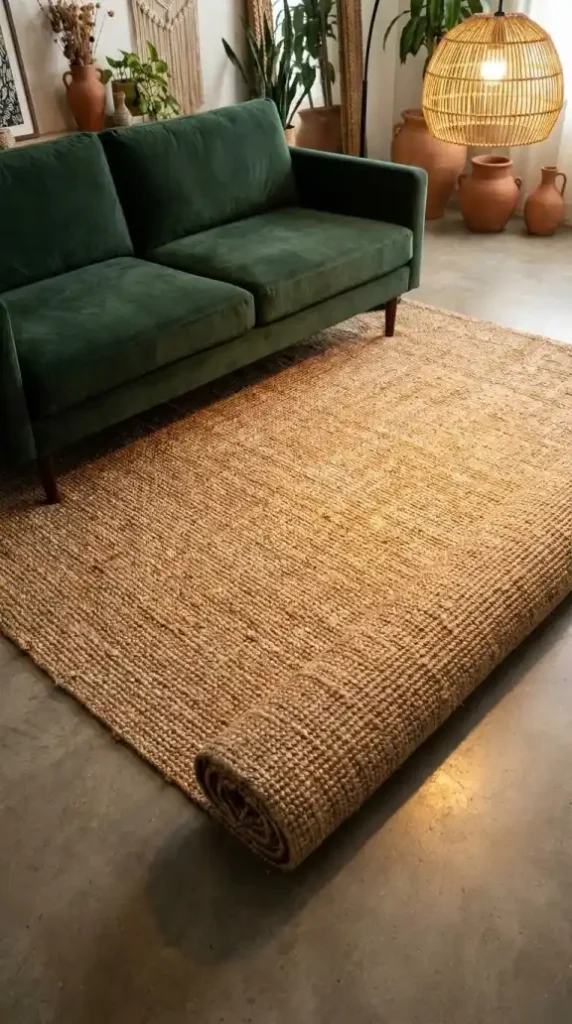
The jute or sisal base rug is the floor layer’s foundation — and it must be sized correctly before the kilim accent is chosen.
A common beginner mistake is buying the kilim first because it’s more visually exciting — and then buying a jute base to go beneath it that doesn’t extend far enough under the furniture. The jute base must extend under the front legs of the sofa, all chairs, and the coffee table.
A rug that stops at the furniture perimeter creates visual disconnection between the floor and furniture layers that no kilim layering on top can fix.
Natural honey-toned jute reads as warm and grounding under 2700K light — it confirms the Grounded Neutral palette foundation at the floor level and provides the neutral base that the kilim’s vibrant Heritage Accent pattern reads against.
Buy the largest jute rug your floor plan allows. You can always trim visual weight with the kilim layer above. You can’t compensate for a jute base that’s too small.
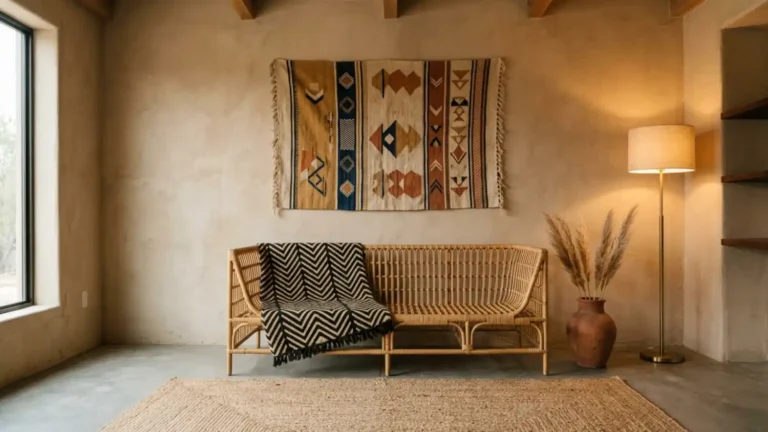
Fourth Purchase: A Hand-Knotted Kilim or Beni Ourain
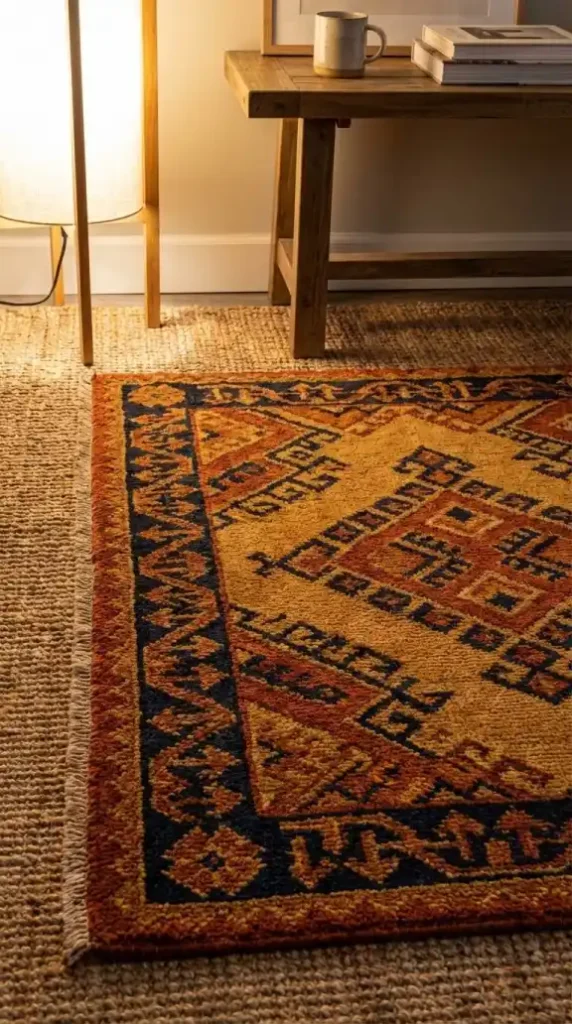
The kilim accent rug is chosen after the jute base is in place — because the kilim’s color palette needs to respond to the jute’s neutral honey tone and the sofa’s velvet color rather than be selected in isolation.
A hand-knotted kilim in ochre, burnt orange, and deep indigo introduces all three palette categories at the floor level simultaneously: Grounded Neutral in the ochre, Heritage Accent in the burnt orange, Life tone in the indigo.
A geometric Beni Ourain in cream and charcoal is the alternative for rooms where the sofa is already carrying significant Heritage Accent or Life tone color — the Beni Ourain’s High Contrast palette provides balance rather than amplification.
Size the kilim to cover approximately one third of the jute base’s visible surface. Large enough to read as a design layer. Small enough that the jute base beneath remains the dominant floor material.
The layered composition — rough jute ground, dense kilim accent — creates the floor depth that a single rug at any price point can’t replicate.
Fifth Purchase: Mud Cloth and Kuba Cloth Cushion Set
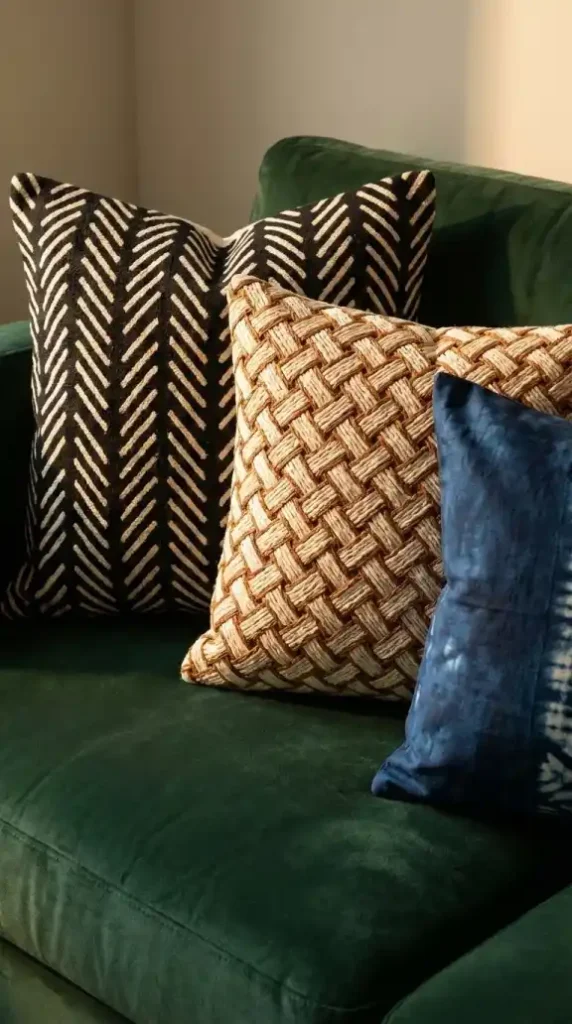
The sofa textile layer runs on three distinct African textile traditions — each at a distinct pattern scale and palette category.
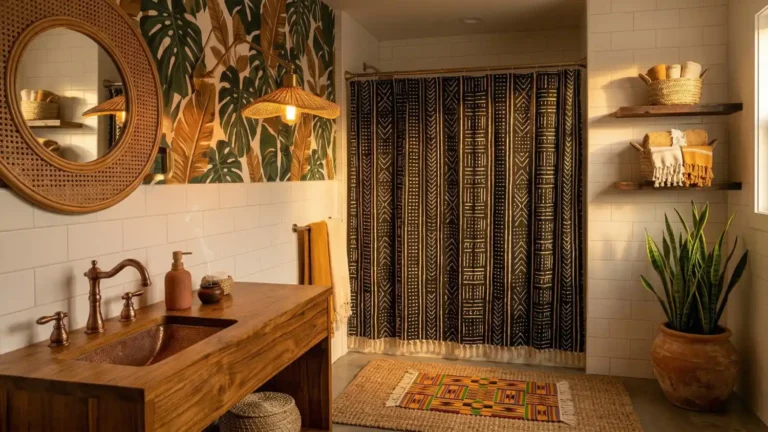
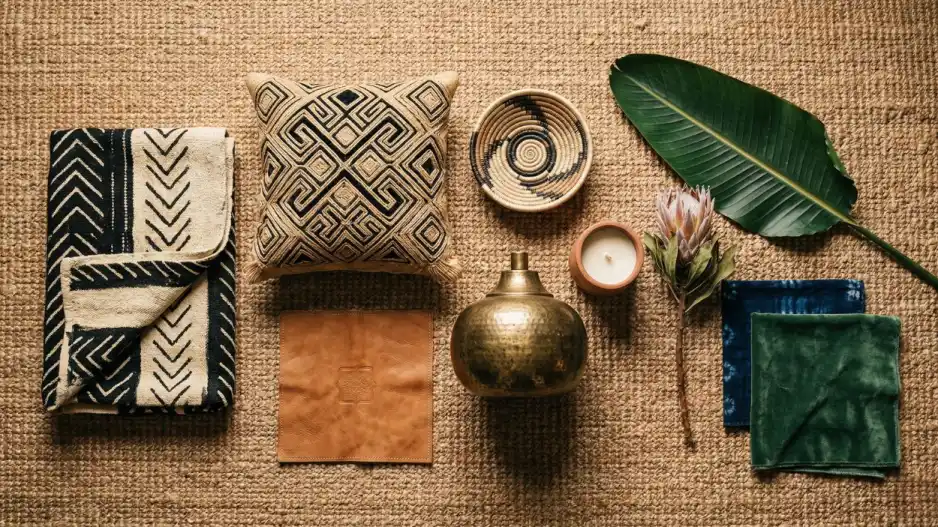
Malian mud cloth cushion covers in black and cream chevron: the High Contrast component at the most visible sofa position. The raised cotton weave texture reads as tactilely distinct against the velvet pile even before the pattern is registered.
Kuba cloth cushion cover in cream and warm brown interlocking geometric: the maximalist pattern density layer at a different geometric scale than the mud cloth. The raffia-inspired surface adds visual richness without competing at the same scale.
Yoruba Adire indigo batik cushion: the Life tone cooling accent at the sofa’s forward position or as an oversized floor cushion on the kilim in front. The hand-dyed wax-resist indigo introduces Heritage Accent color at the most intimate seating level.
Buy the mud cloth cushions first if budget requires prioritizing. They deliver the High Contrast palette component that makes the room’s geometric pattern vocabulary legible — and they sit directly against the velvet pile where the material contrast between rough cotton weave and plush velvet is most productive.
Sixth Purchase: A Live-Edge Teak or Mango Coffee Table
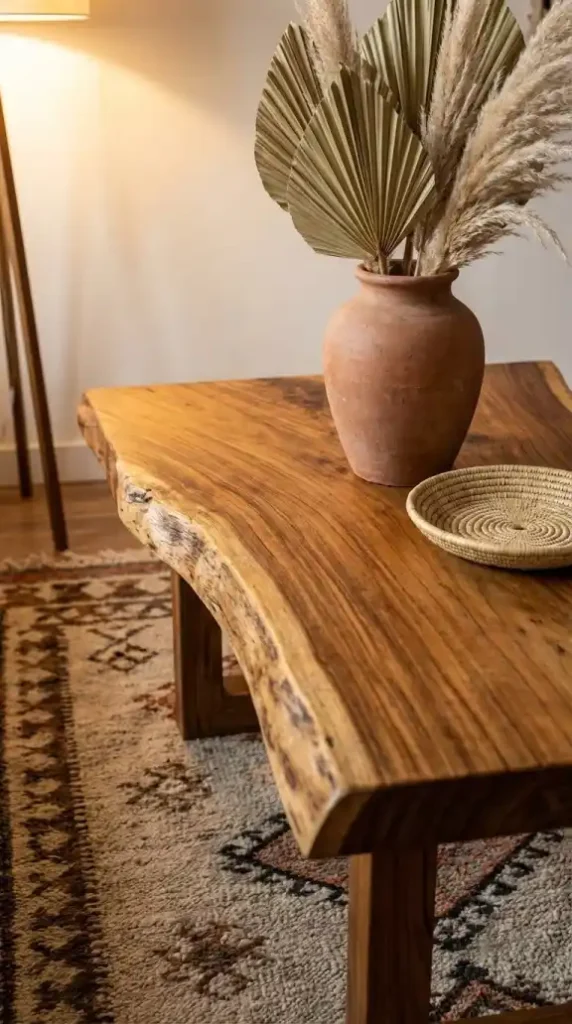
The live-edge reclaimed teak or mango wood coffee table is the living room’s grounding furniture centerpiece — and it carries more visual weight per square meter than any other piece in the room.
The live edge — the natural irregular boundary of the wood slab retained rather than cut square — reads as a found material object as much as a furniture piece. It carries the same material honesty as the mud cloth throw and the terracotta vessel: visible origin, visible process, visible imperfection as a feature.
Dark teak with deep grain variation sits within the Grounded Neutral palette category at the furniture scale — providing the dark value anchor that prevents the earth tones above the floor layer from reading as undifferentiated warmth.
Buy the coffee table before the side tables or console. It’s the floor-level furniture piece the eye reads most directly from the sofa position — and its material quality sets the standard that all other wood objects in the room respond to.
Seventh Purchase: A Juju Hat for the Primary Wall
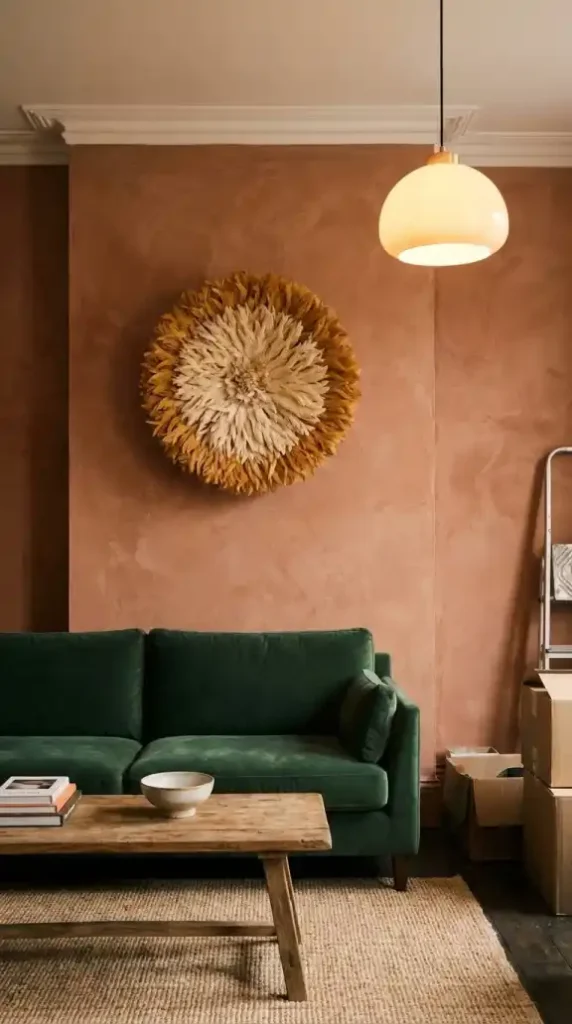
The Juju hat is the wall’s first purchase — mounted before the basket gallery, before the carved mask, and before any framed photography.
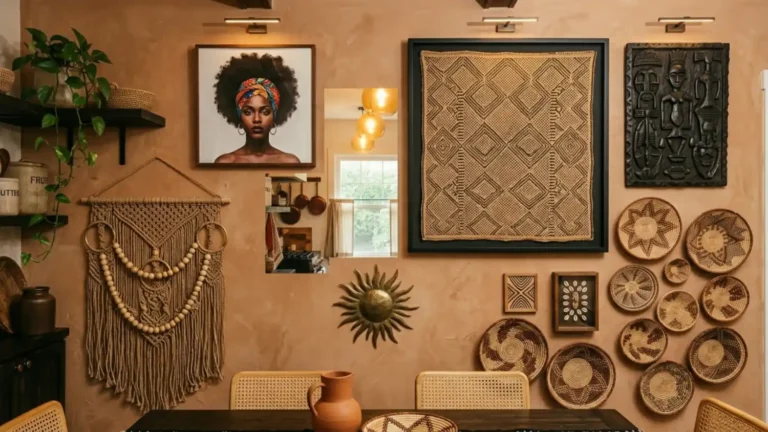
The Bamiléké feathered headdress from Cameroon is the wall gallery’s center axis — the piece that sets the position and scale that every subsequent wall element organizes around.
Buy large: 60–80cm diameter minimum.
A small Juju hat reads as a decorative accessory. A large Juju hat reads as an architectural element — the circular feathered form breaking the rectangular geometry of the sofa, the wall, and the room with soft organic mass that draws the eye immediately.
Cream and ochre feather colorways sit directly within the Grounded Neutral palette and work against warm sand, ochre, or terracotta walls without requiring palette calculation. Black feathered Juju hats sit in the High Contrast category — more dramatic, higher commitment, most effective against warm sand walls where the dark feathers have a clear light tone to read against.
Start with cream and ochre. It’s the most palette-forgiving entry point for a first wall purchase.
Eighth Purchase: A Tonga or Binga Basket Cluster
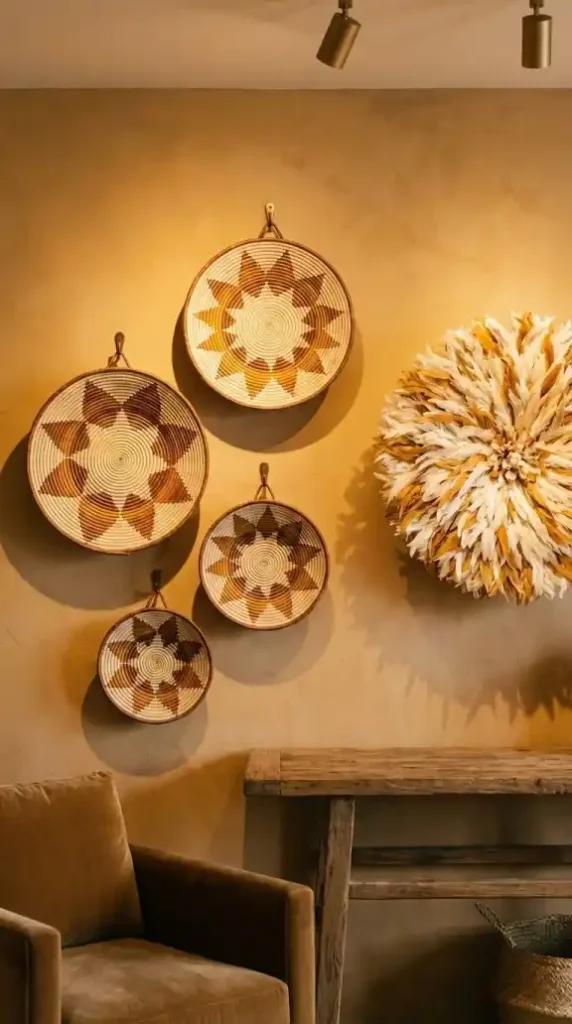
The Tonga or Binga basket gallery is the wall’s second purchase — chosen and arranged in response to the Juju hat already mounted.
Five baskets in graduated sizes arranged asymmetrically beside the Juju hat — not centered, not mirrored, not in a grid. The asymmetric arrangement creates visual movement across the wall. The size graduation creates natural height variation within the cluster.
Tonga baskets carry radial geometric patterns in cream, ochre, and warm brown that sit directly within the Grounded Neutral and Heritage Accent palette categories.
Zulu telephone wire baskets are the alternative for rooms that need a contemporary material note — their telephone wire construction references traditional Zulu weaving in a modern industrial material that connects the basket gallery to the room’s matte black contrast layer.
A combination of both — Tonga coiled grass beside Zulu telephone wire — creates material contrast within the gallery itself that a single basket type can’t achieve.
Ninth Purchase: Malawi Cane Chairs and a Leather Pouf
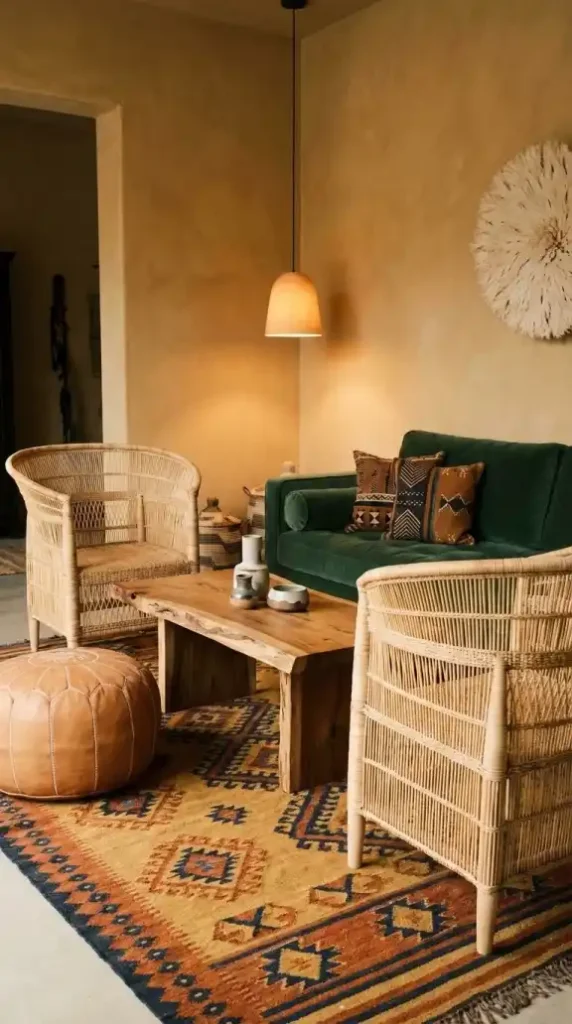
Malawi cane chairs or rattan peacock chairs paired with a leather Moroccan or Nigerian pouf complete the living room’s seating arrangement at two distinct material registers.
The Malawi cane chairs introduce the airy tropical silhouette that the velvet sofa’s visual weight needs as a counterpoint.
Their open weave structure keeps the seating zone visually light — the eye passes through the cane to the rug beneath, maintaining the room’s spatial openness that solid upholstered chairs would close down.
One Moroccan or Nigerian leather pouf in tan or chocolate brown beside one cane chair adds ground-level flexible seating at the seating arrangement’s lowest visual height.
The smooth patinated leather surface adds a material register — aged, warm, rich in surface variation — that none of the woven or carved pieces provide.
Buy the cane chairs before the pouf.
The chairs define the seating arrangement’s form. The pouf fills in the ground level in response to where the chairs land — asymmetrically beside one chair, on the kilim surface, at the lowest seating position in the arrangement.
Tenth Purchase: A Hammered Brass Floor Lamp
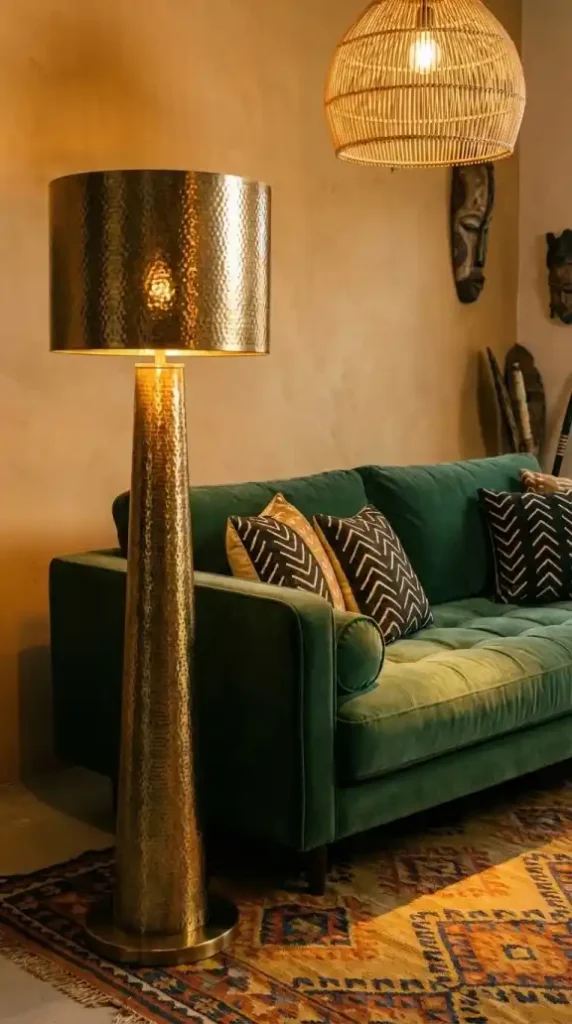
A hammered brass floor lamp beside the sofa completes the three-height lighting architecture that the living room’s golden hour glow depends on.
The rattan pendant handles the overhead atmospheric source. The hammered brass floor lamp handles the mid-height warm source that makes the sofa’s velvet pile and textile layers visible at their most accurate color temperature.
The hammered surface creates multiple small light-catch points that shift as viewing angles change — a living metallic quality that smooth floor lamps eliminate.
Position it beside the sofa at the arm height — angled slightly toward the sofa rather than straight up — so the warm light rakes across the velvet pile and mud cloth cushions at an angle that reveals both materials at maximum texture depth.
This positioning also creates the lamp’s shadow zone behind it — the deep corner shadow that gives the room its sense of atmospheric depth after dark.
What to Buy Last — Not First
Two categories that beginners consistently buy too early:
The carved mask and large-scale photography.
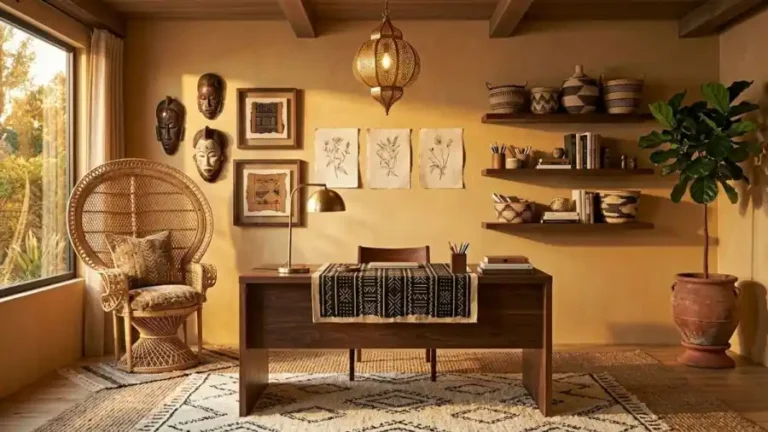
Both belong in the wall gallery — but both are secondary wall elements that respond to the Juju hat and basket cluster already in position. Bought before those anchor pieces exist, the mask and photography have no gallery composition to join. They read as isolated wall objects rather than components of a composed heritage gallery.
The matte black bookshelf and curtain rod.
The modern industrial contrast frame is the last layer added — because its role is to frame what’s already assembled, not to lead the composition. Installed before the heritage and handmade layers exist, the matte black elements become the room’s dominant visual thread rather than its subtle contemporary frame. Wait until the sofa, rugs, textiles, wall gallery, and greenery are all in place before introducing the industrial contrast layer.
The Beginner Buying Sequence at a Glance
Before making any purchase answer these questions:
- Is the room’s current lighting at 2700K warm? If not replace every bulb before evaluating the sofa color, wall tone, or any existing rug or textile under its actual conditions.
- What is the largest undecorated wall surface in the room? Measure the width and height before buying the Juju hat. The hat diameter needs to sit within the wall width with clearance on both sides and at least 30cm below the ceiling — a hat too large for the wall position reads as crowded rather than dramatic.
- Does the current floor covering allow a large jute rug to be laid on top? If existing carpet conflicts with the earth palette the jute base needs to be large enough to cover the majority of the visible carpet surface — account for that in the size selection before purchasing.
- Is there at least one corner with access to indirect natural light for a Bird of Paradise or Fiddle Leaf Fig? Identify the position before buying the plant — light availability determines long-term plant health and therefore the botanical layer’s structural contribution to the room.
- What furniture is already in the room? Identify any pieces with high-gloss finish, cool-toned upholstery, or strongly elevated contemporary leg profiles. These are the pieces most likely to create visual tension with the Afro Bohemian layer — and knowing about them in advance lets you compensate through textile and object choices rather than being surprised after everything else is in place.
Ten pieces. One palette framework. The full beginner living room.
The velvet sofa sets the color commitment. The 2700K pendant and bulbs reveal it correctly after dark. The jute base rug grounds the floor plane. The kilim adds pattern and warmth at the seating center. The mud cloth and Kuba cloth cushions complete the sofa’s textile hierarchy. The live-edge coffee table grounds the furniture layer at center. The Juju hat anchors the wall gallery. The basket cluster extends it into the geometric pattern vocabulary. The cane chairs and leather pouf complete the seating arrangement at airy and ground-level registers. The hammered brass floor lamp closes the three-height lighting architecture.
Each piece earns its place by doing something no other piece on the list is already doing.
That’s not a shopping list. That’s a room-building system — and the living room is where soulful maximalism performs at its fullest when every layer of that system is operating correctly together.
Expand your Afro Bohemian living room knowledge:
- Afro Bohemian Living Room: The Complete Style Guide — Understand the complete system covering textiles, wall galleries, greenery, and lighting in full depth
- 11 Afro Bohemian Living Room Ideas for a Warm and Layered Space — Apply 11 specific room ideas once your starter pieces are in place
- How to Style an Afro Bohemian Living Room — Walk through the step-by-step styling sequence after your foundation is assembled