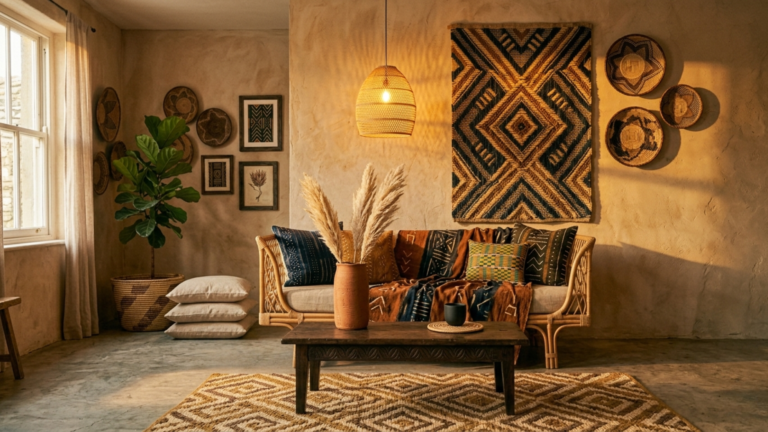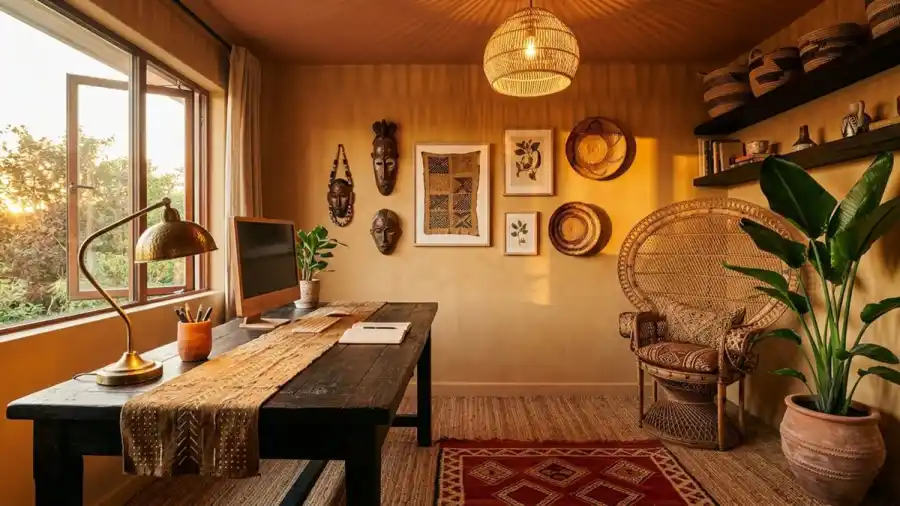
11 Afro Bohemian Office Ideas for a Warm and Productive Space
The Afro Bohemian office has one design rule that every other room ignores.
Concentrate the maximalism at the walls and floor. Keep the desk clear.
In the living room, the sofa surface can carry three textile layers simultaneously. In the bedroom, the bed is the canvas for the full layering system. In the office, the desk is a cognitive tool — and visual complexity at a cognitive tool creates fatigue rather than richness.
These 11 ideas apply soulful maximalism with that principle as the organizing logic. Each one places the cultural depth, organic texture, and heritage pattern where the working eye rests rather than where it processes — so the room feels deeply Afro Bohemian and deeply functional simultaneously.
Quick Takeaway:
- The desk surface holds three objects maximum — a brass lamp, a terracotta stationery holder, and a mud cloth runner. Everything else belongs at the walls, shelves, floor, and corners.
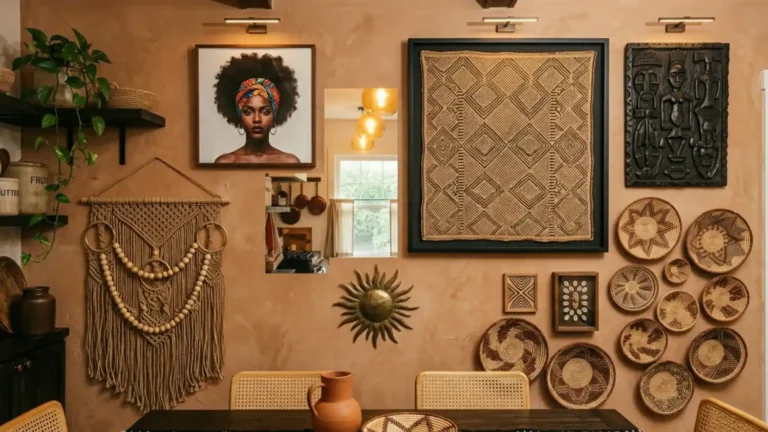
- The gallery wall is the office’s primary aesthetic investment — African masks, Kuba cloth fragments, botanical prints, and Bolga baskets operating at four distinct scales simultaneously.
- The Bolga basket is the office’s most functional aesthetic piece — it conceals cable management and tech accessories inside a traditional West African craft object visible from every position in the room.
1. Keep the Desk Surface Minimal and Tactile
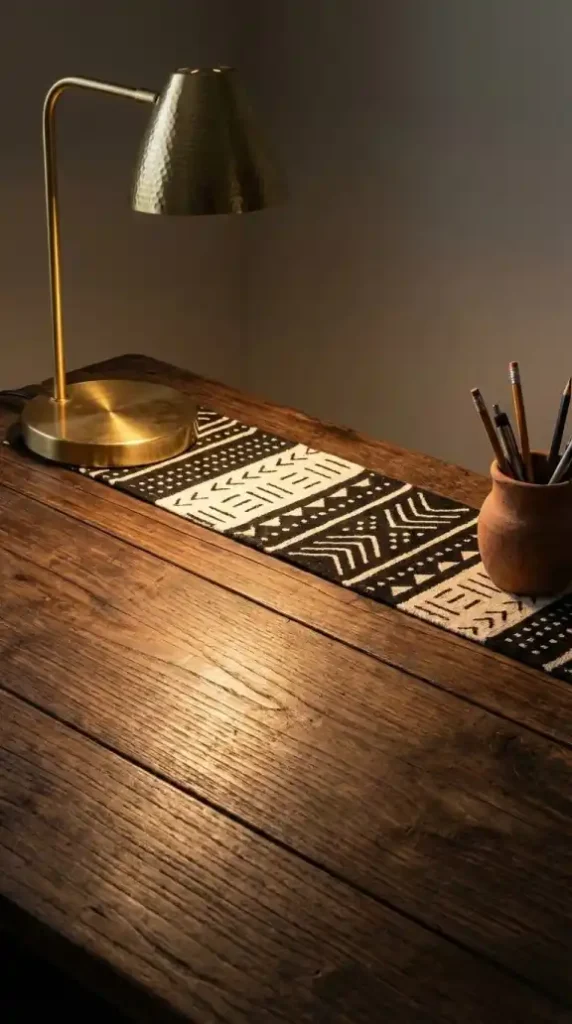
The desk surface is the office’s continuous cognitive processing zone — the surface the working eye returns to every few seconds throughout the day.
Visual complexity at this zone creates fatigue. A clear tactile desk surface creates focus.
Three objects maximum. One brass desk lamp for warm directed task light. One terracotta vessel for functional stationery storage. One short mud cloth runner that adds natural fiber texture at close range without introducing the pattern complexity that a fully decorated desk surface would create at sustained viewing distance.
The mud cloth runner earns its place because it’s tactile rather than visually demanding — the working hand rests on it, the working eye passes over it.
Everything beyond these three objects belongs at the walls, shelves, floor, and corners — the peripheral zones where the working eye rests rather than processes.
This isn’t a compromise of the Afro Bohemian aesthetic. It’s the aesthetic applied at its most intelligent.
2. Build a Reclaimed Wood Desk With Carved Detail
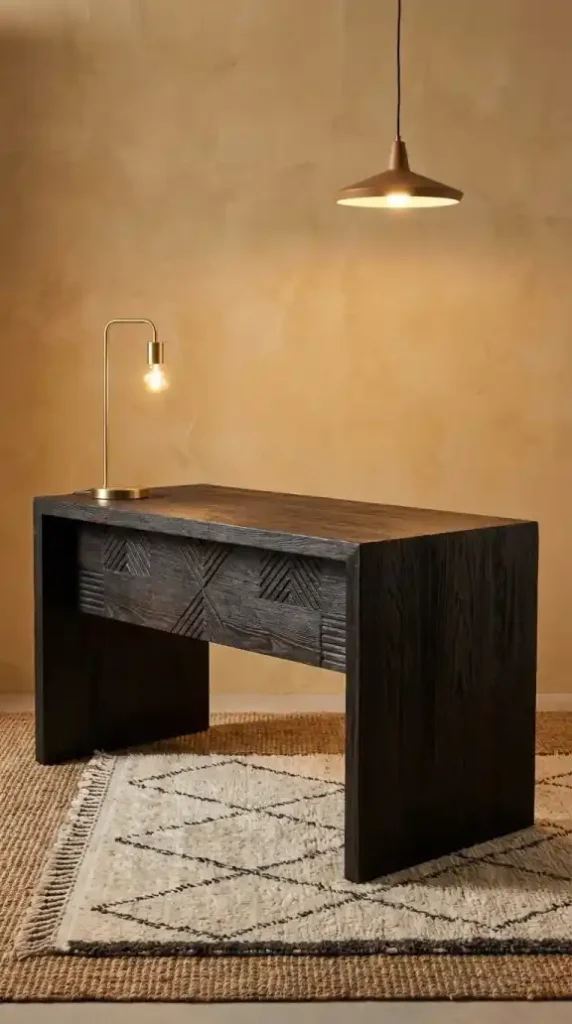
A reclaimed wood desk in dark walnut or ebony stain with hand-carved geometric motif detail on the desk face is the office’s primary furniture statement.
The carved detail visible from the seated work position provides the cultural heritage reference at the closest viewing distance in the room — without occupying any desk surface area.
The working eye passes over it rather than processing it. The hand occasionally touches the carved surface during thinking pauses. The detail registers as depth and history rather than demanding attention.
Reclaimed wood with visible grain variation develops patina with use — the desk surface that deepens and warms over years of daily contact rather than wearing down and looking tired.
This is the Afro Bohemian aesthetic’s most important furniture quality: materials that improve with time rather than degrade with it.
3. Install Dark Wood Floating Shelves for Display Storage
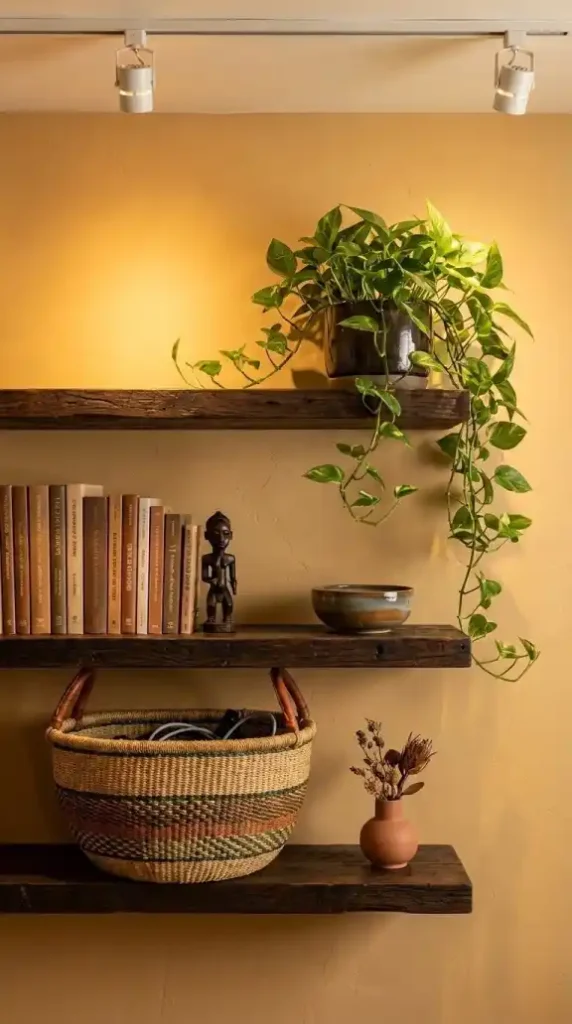
Dark reclaimed wood floating shelves are the office’s primary functional display surface — the zone where Bolga basket cable storage, book organization, terracotta objects, African figurines, and cascading greenery operate simultaneously as storage and aesthetic layer.
Three shelf levels. Each styled with a distinct combination of the three surface types: one rough, one smooth, one open or structural.
Bottom shelf: a large Bolga basket concealing cable management supplies — rough coiled exterior, functional interior — beside a small terracotta vessel.
Middle shelf: books in earth-tone spines stacked at varying heights beside a small African carved statue and a glazed ceramic bowl. Smooth, rough, and reflective surfaces in the same shelf section.
Top shelf: a trailing Pothos in a dark ceramic planter — the cascading vines filling the upper wall zone above the shelving with organic movement that softens the hard architectural line between shelf and ceiling.
The shelves do more work per square meter than any other element in the office. They carry the storage function, the display function, the cable management function, and the greenery function simultaneously.
4. Use Bolga Baskets for All Cable and Tech Storage
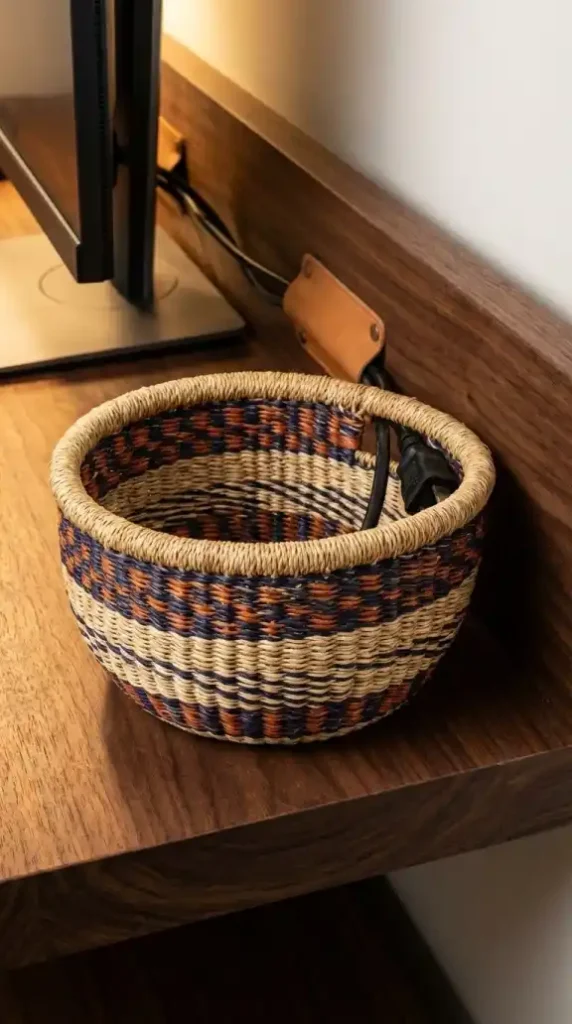
Bolga baskets from Ghana are the office’s most functionally important aesthetic piece — and they belong in the tech storage role before the decorative one.
A Bolga basket positioned at the desk surface or shelf beside the monitor conceals a power strip and cable management system inside its woven exterior. From the desk position and the room entry point it reads as a traditional West African craft object. From the back — out of the primary sightline — every cable exits through the open weave in an organized system.
This is the tech-organic balance at its most precise application: modern office infrastructure contained within a traditional craft object that contributes to the aesthetic rather than disrupting it.
Leather cord organizers along the desk back edge and shelf rear face route remaining visible cables through a material that reads as cohesive with the leather pouf and patina vocabulary — tan or deep brown leather rather than plastic cable clips.
The Bolga basket’s multicolor coiled pattern also contributes to the Heritage Accent palette layer at the shelf position — earth tones in the grass base with mustard, indigo, and rust accent colors woven through the pattern.
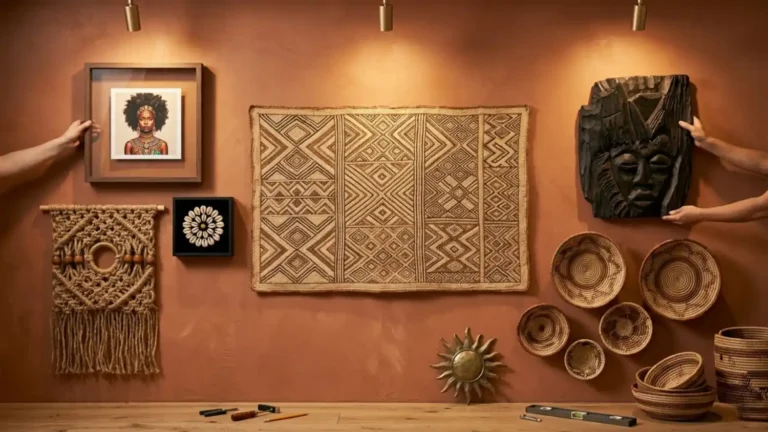
5. Build the Gallery Wall in Four Layers
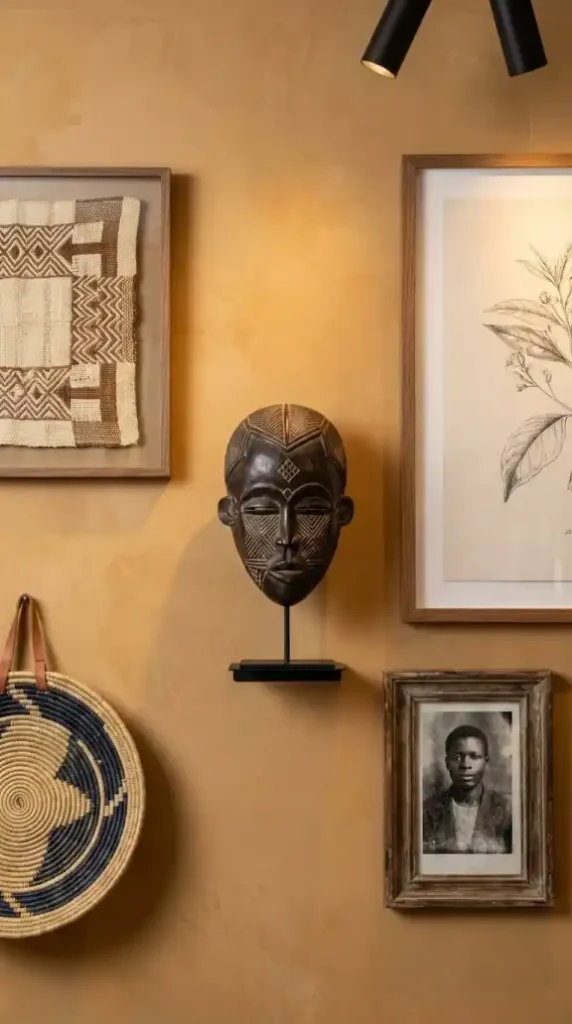
The gallery wall is the office’s primary aesthetic investment — the heritage display that provides visual richness at the peripheral zone where the working eye rests rather than processes.
Four layers. Four scales. Four material registers.
Layer one: an African carved wooden or brass mask on a museum bracket at the gallery’s center axis. The piece with the most cultural weight and most three-dimensional surface detail. Its carved relief catches warm track light in deep highlight and shadow that flat framed pieces can’t replicate.
Layer two: a framed Kuba cloth textile fragment — stretched and mounted like art, its geometric raffia-inspired weave pattern adding texture at the mid-scale gallery layer.
Layer three: botanical sketches and vintage photography in dark wood frames at the tertiary scale — contemporary visual language in direct conversation with the traditional craft objects beside them.
Layer four: a Bolga or Zulu basket hung as a wall element at the gallery’s outer position — the circular woven form that breaks the rectangular geometry of framed pieces with organic logic.
Four layers. Asymmetric arrangement. One composed heritage gallery that deepens the longer it’s looked at.
6. Create a Reading Nook With a Rattan Peacock Chair
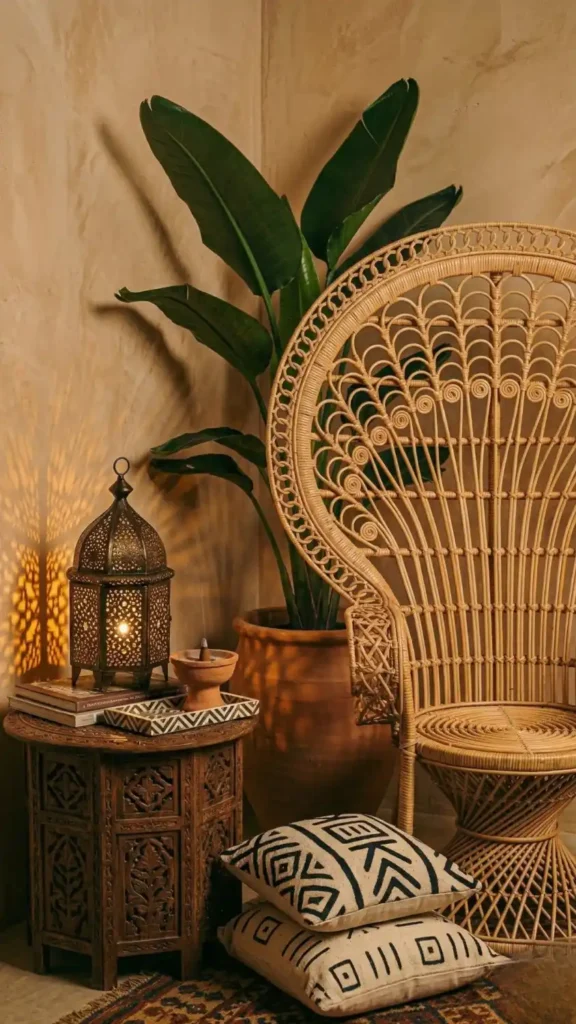
The reading nook is the office’s secondary zone — the place for creative thinking, reading, and the less task-focused work that benefits from a different physical and visual position than the desk provides.
A rattan peacock chair or Malawi cane chair with a mud cloth or Kuba cloth cushion defines the reading nook as a distinct cognitive space within the office.
The fan-shaped open weave back of the peacock chair frames the person seated in it — creating a visual enclosure that the open office doesn’t provide. That sense of contained space within a larger room creates the psychological shift from task-focused to contemplative thinking.
A small dark wood side table beside the chair holds a Moroccan lantern — the reading nook’s dedicated light source — and a sandalwood or frankincense incense burner that adds the sensory layer to the creative thinking zone.
A Bird of Paradise in a terracotta pot directly behind the chair fills the corner with broad tropical leaf presence that frames the reading nook as a distinct botanical zone within the office.
The nook works at approximately 80cm square of floor space. It doesn’t require a dedicated alcove or separate room section — just a corner with a chair, a side table, a lamp, and a plant.
7. Layer the Office Floor With Jute and Moroccan Berber
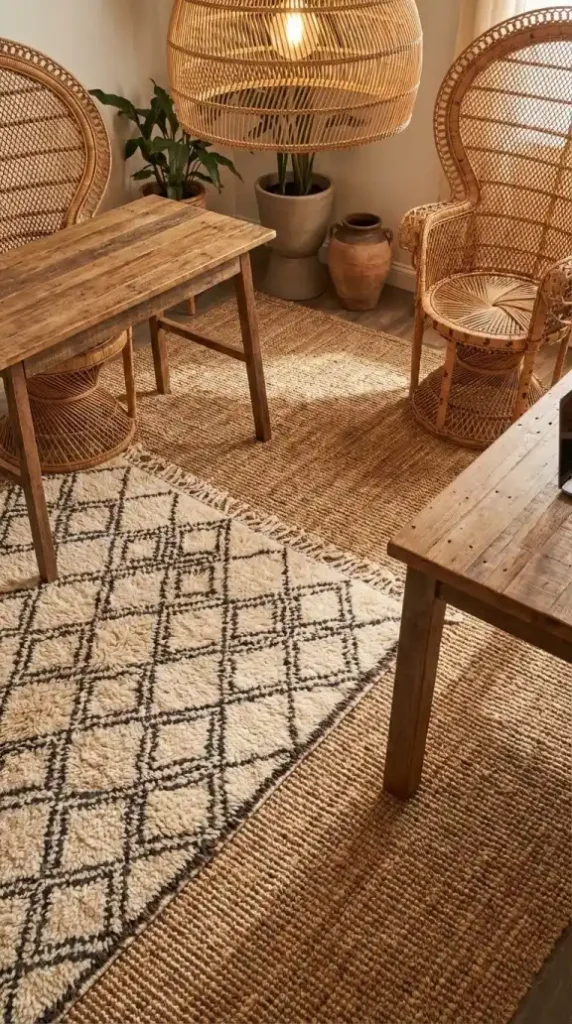
The office floor layer applies the two-rug logic with one functional consideration specific to the workspace: desk chair caster compatibility.
A large jute or sisal base rug covers the full working zone — extending under the desk, the reading nook, and all floor-level office furniture. Natural jute handles daily foot traffic and rolling chair use without the pile-compression damage that denser wool rugs experience under caster wheels.
A smaller Moroccan Berber rug in cream and charcoal geometric diamond pattern layered on top at the desk chair’s visual center adds Heritage Accent pattern at the floor’s most prominent position.
Position the Berber so the desk chair rolls primarily on the jute base rather than the Berber pile — the jute handles the mechanical stress, the Berber carries the aesthetic layer.
A flat-woven kilim in the reading nook corner is the floor complement to the Berber at the desk zone — dense flat weave with no pile to compress under the rattan peacock chair legs, geometric pattern in earth tones connecting the nook floor to the desk zone’s rug composition.
8. Hang Indigo Batik or Mud Cloth Curtains
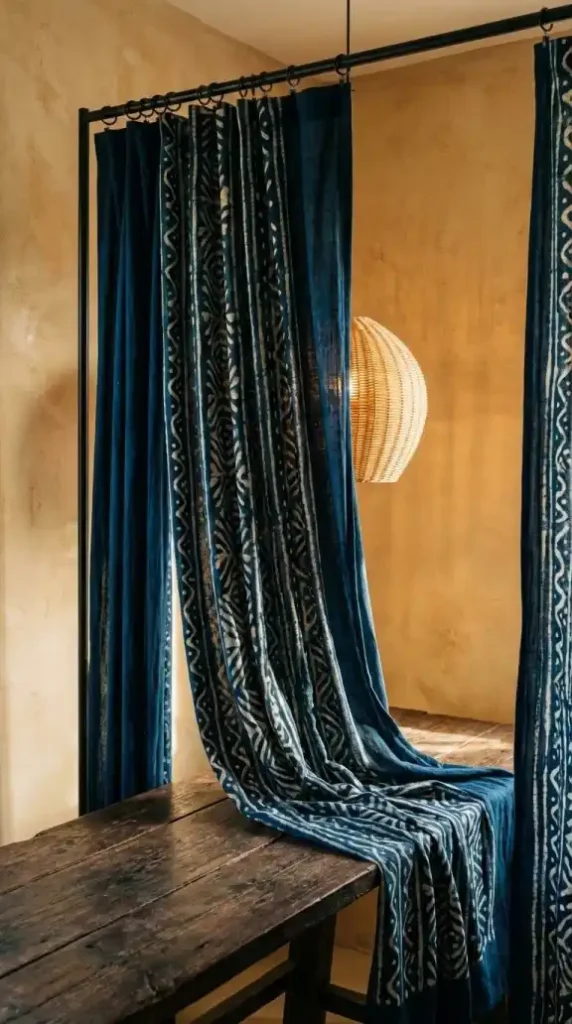
Indigo batik or mud cloth curtains at the office window introduce the African textile tradition at the room’s largest vertical textile position — the one surface that the working eye encounters at a peripheral distance throughout the day.
Deep indigo Yoruba batik panels — hand-dyed wax-resist patterns in indigo and cream — provide the cool contrast to the warm earth palette that prevents the office from reading as monochromatic warmth.
The hand-dyed indigo filters the afternoon light through a cool blue-toned fabric that creates a visual shift in the room’s color temperature at the window zone — warm earth tones throughout the room, cooling indigo at the natural light source.
Hung from a slim matte black curtain rod the indigo panels connect to the matte black modern minimalist thread running through the room — the curtain rod beside the Bolga baskets and the leather cord organizers as the contemporary frame that keeps the heritage aesthetic readable.
Mud cloth curtain panels are the alternative for rooms where the window wall needs the High Contrast palette component at the vertical textile position — the black and cream geometric pattern at curtain scale delivers the same visual weight as the mud cloth shower curtain does in the bathroom.
9. Set Up Three-Height Lighting Architecture
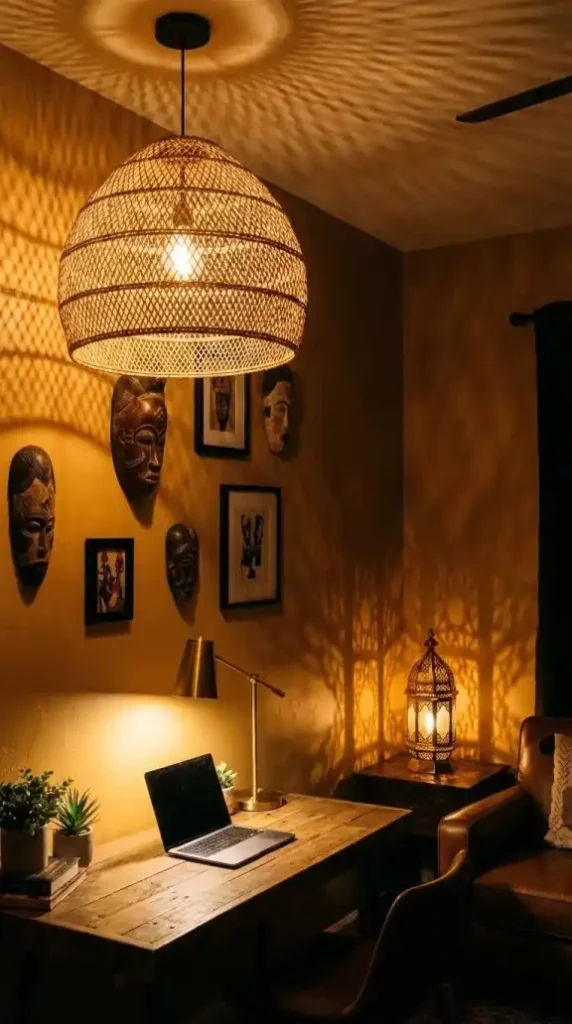
The office lighting architecture runs on three sources at three heights — each serving a distinct functional and atmospheric purpose.
An overhead raffia or rattan pendant is the room’s primary atmospheric source. Its open weave casts intricate shadow projections across the ceiling and gallery wall after dark — adding visual depth to the peripheral zones without creating direct glare at the desk work surface.
A minimalist brass desk lamp at the work surface provides focused warm task light. The brass finish bridges the contemporary and handmade registers at the desk position. Position it at the desk’s non-dominant side — left for right-handed workers, right for left-handed — so the task light rakes across the work surface from the side rather than from directly above.
A Moroccan lantern in the reading nook on a dark wood side table provides the third light source at the peripheral zone. After dark its geometric pattern projections animate the reading nook wall — creating the most atmospheric corner in the office at the zone reserved for creative thinking.
All three at 2700K. Overhead fluorescents and cool-white downlights are the single fastest way to destroy the earth pigment palette and flatten every natural material surface in the room.
10. Introduce Velvet Seating for Maximalist Balance
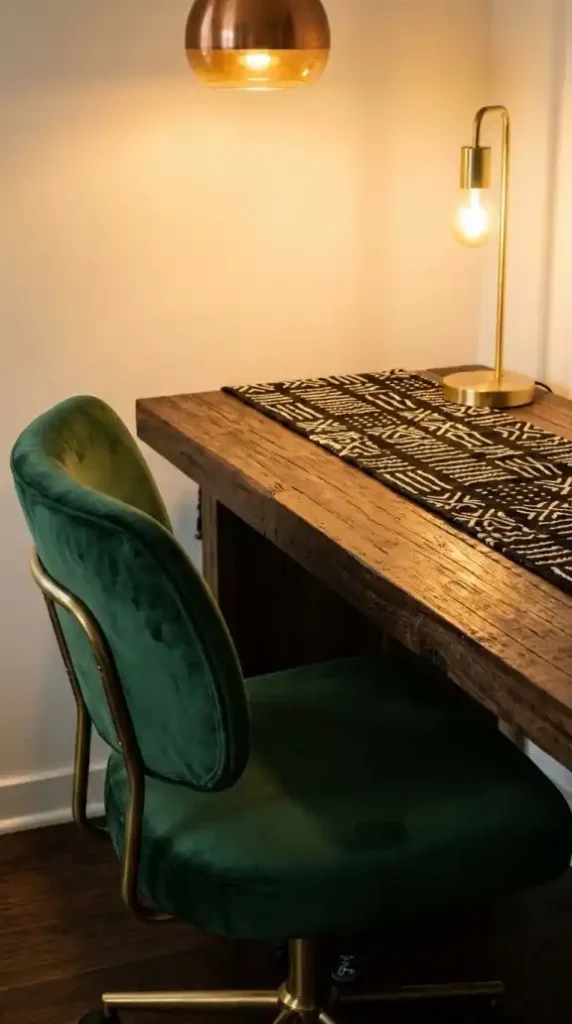
A deeply saturated velvet desk chair in forest green or rust brings the maximalist textile touch to the office’s primary functional seating position.
The velvet pile’s tactile richness reads as a material statement at the desk position without adding visual complexity to the desk surface itself — the chair’s color and texture are experienced by the person seated in it rather than processed visually while working.
Forest green velvet at the desk chair references the same Life tone palette category as the velvet sofa in the living room — bold, plant-dye adjacent, culturally confident against the warm earth tones surrounding it.
Rust velvet at the desk chair sits at the Earth and Heritage Accent intersection — warmer, more immediately cohesive with the terracotta and burnt orange palette, requiring the Life tone accent to come from the indigo curtains or mustard throw cushions elsewhere in the room.
The velvet desk chair paired with the rattan peacock chair in the reading nook creates the same productive material contrast as the velvet sofa paired with the Malawi cane chairs in the living room — luxury upholstery beside open organic weave, each making the other more legible by contrast.
11. Place Statement Greenery at Three Office Zones
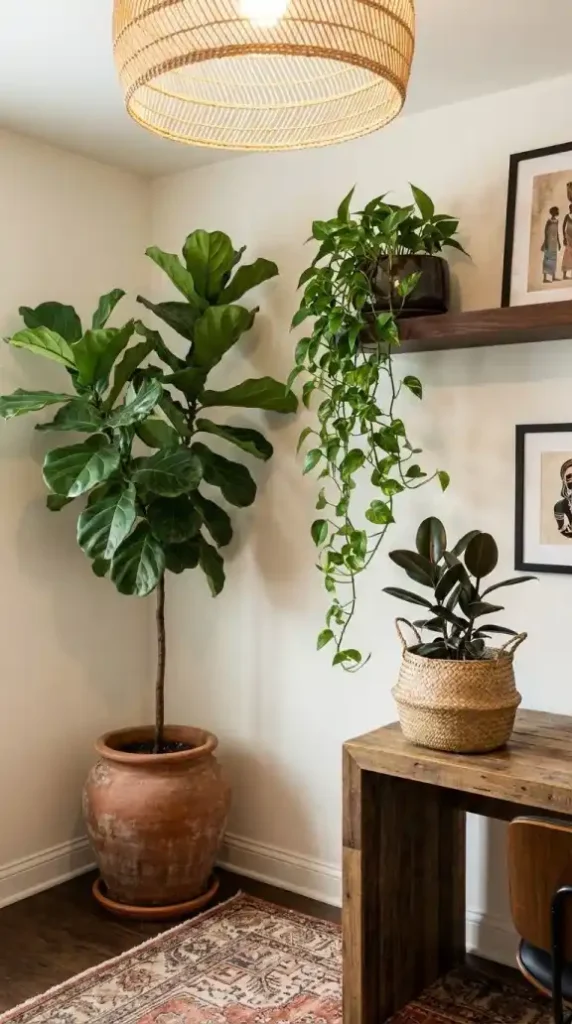
Office greenery is both structural and productivity-functional — plants reduce stress, increase focus, and improve air quality in enclosed workspaces.
Three zones. Three plants. Three spatial contributions.
The large corner zone: a Fiddle Leaf Fig or Bird of Paradise in a terracotta pot at the office’s most open corner. The broad tropical leaf silhouette fills the floor-to-ceiling zone with botanical drama — a foreground presence the working eye rests on during thinking pauses rather than processing as work content. The terracotta pot grounds the plant within the earth palette at the floor level.
The high shelf zone: a trailing Pothos or Spider Plant cascading from the top of the floating shelves. The vines fill the upper wall zone above the shelving — softening the hard architectural line between shelf top and ceiling and providing the boho cascading greenery layer the aesthetic requires at the office’s highest visual position.
The desk zone: a small Rubber Tree in a woven basket planter at the desk surface corner — positioned so it doesn’t obstruct the monitor sightline. The close-range botanical presence is the plant the working eye rests on most directly during micro-pauses between tasks. Its dark glossy leaves add a material register — smooth, deep-toned, reflective — that terracotta and woven grass surfaces don’t provide at desk scale.
Container materials vary by zone. Terracotta for the floor corner plant — grounding the large plant within the earth palette. Dark glazed ceramic for the trailing shelf plant — providing contrast against the dark wood shelf surface. Woven basket for the desk plant — keeping the desk zone within the natural fiber vocabulary without introducing a hard-surfaced ceramic container at the most intimate work position.
Auditing Your Office Before Adding Anything New
Before introducing any new element walk through the space and answer these questions:
- Stand at the desk chair position. What is the visual complexity level of the immediate desk surface? If there are more than three objects on the desk surface identify the least functional and relocate it to the shelf or remove it entirely before adding anything new to the room.
- Is there a wall large enough for a four-layer gallery composition — at least 180cm wide with 200cm of wall height? If not identify whether two adjacent walls can share the gallery elements rather than forcing all four layers onto a single wall section.
- Where is the monitor positioned relative to the gallery wall? The gallery wall should be visible as the background from the desk chair position — readable in the peripheral sightline without being directly in the working eye’s forward focus zone. Reposition the desk if necessary before building the gallery wall.
- Is there a corner with 80cm square of clear floor space for the reading nook? Identify it before buying the peacock chair. The nook needs enough clearance that the chair’s distinctive fan-shaped back is fully visible and not compressed against adjacent furniture.
- Are there visible cables and tech accessories from the desk chair position? Identify which Bolga basket size can conceal the power strip and cable management at the desk surface or shelf before buying any baskets. The basket size needs to fit the tech it’s concealing while sitting correctly on its surface position.
- What is the current light temperature? Overhead fluorescents and cool-white downlights need replacing before the earth pigment palette can be evaluated correctly in the space.
The Afro Bohemian office performs at its highest level when the maximalism and the minimalism are each applied where they belong.
The gallery wall carries the heritage depth. The floating shelves carry the craft object and storage layer. The layered rugs carry the textile richness at the floor. The reading nook carries the contemplative warmth. The Bolga baskets carry the traditional craft logic into the cable management function. The raffia pendant and Moroccan lantern carry the golden hour atmosphere after dark.
The desk carries a brass lamp, a terracotta pen holder, and a mud cloth runner.
That’s the balance. And when it’s correct the office is the room that makes work feel like something worth doing in a beautiful space — rather than a functional concession made at the expense of the aesthetic everywhere else in the house.
Dig deeper into the Afro Bohemian gallery wall:
- Afro Bohemian Wall Art: The Complete Guide —Study the full four-layer system behind symbolic textiles, figural imagery, and three-dimensional pieces
- How to Style Afro Bohemian Wall Art in Any Room — Walk through every gallery wall decision in the sequence that produces a composed result
- Afro Bohemian Wall Art Must-Haves for Beginners —Find out which pieces to prioritize first and why the mounting order matters before buying anything