How to Style Afro Bohemian Decor in Any Room
The Afro Bohemian decor system is room-agnostic — its logic applies with equal coherence to a living room, a bedroom, a hallway, or a single styled corner.
What changes between rooms is the scale of application. A living room holds the full system at maximum expression. A hallway holds a reduced version of the same logic — one High-Low pairing, one wall element, one botanical piece — that reads as part of the same design language as the rooms around it.
What doesn’t change is the sequence.
The mud cloth anchor comes first regardless of which room you’re working in. The High-Low furniture pairing comes second. The secondary textile layer third. The wall gallery fourth. The floor layer fifth. The botanical layer last.
That sequence is the system. Apply it at whatever scale the room allows and the aesthetic holds.
Quick Takeaway:
- The mud cloth anchor is always the first piece placed — it sets the geometric scale, the colorway, and the material standard that every subsequent decision responds to.
- The High-Low furniture pairing is resolved before any styling begins — one modern functional silhouette and one raw ancestral artifact at the primary furniture position in the room.
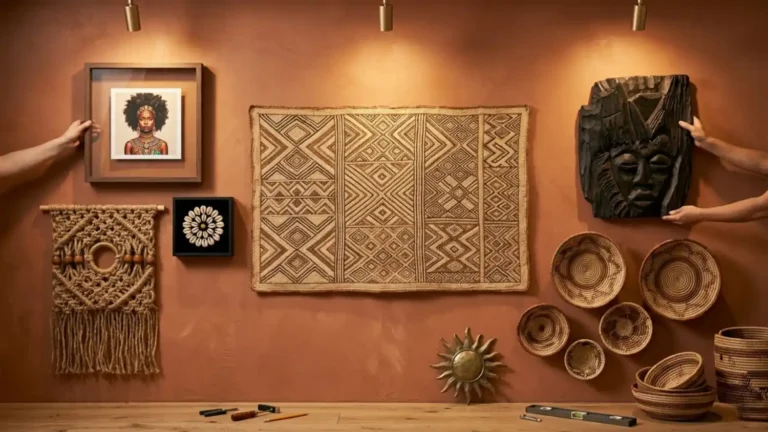
- The wall gallery is built in four layers added in sequence — basket cluster first, carved mask second, macro photography third, beaded or textile art fourth — each layer evaluated before the next is added.
Step 1: Set the Lighting Before Anything Else
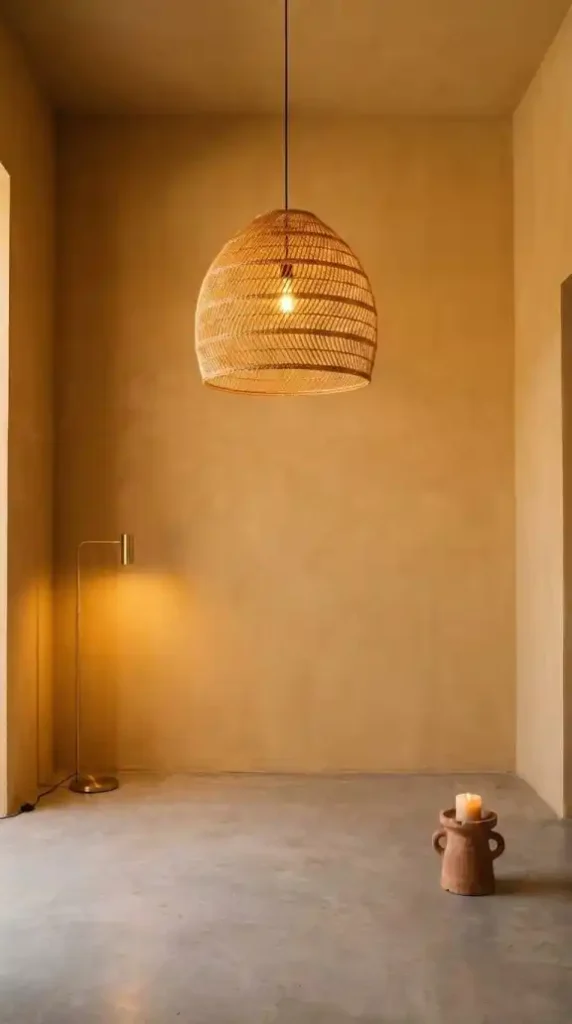
Every room in the Afro Bohemian system starts with lighting — before furniture, before rugs, before textiles.
Replace every bulb in the room with 2700K warm LED.
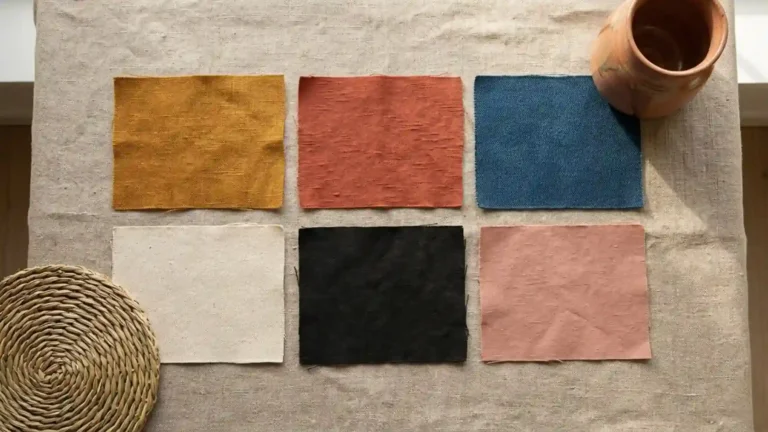
The earth pigment surfaces — the ochre plaster wall, the terracotta objects, the mud cloth’s cream tones, the dark walnut wood grain — read correctly only under warm light conditions. Every styling decision made under cool-white light is made under false conditions. The mud cloth you’re about to choose will look different under your actual warm lamp than it did in the store under fluorescent. The wall color you’re considering will shift. The wood finish will change register.
Fix the light source first. Then evaluate everything else under it.
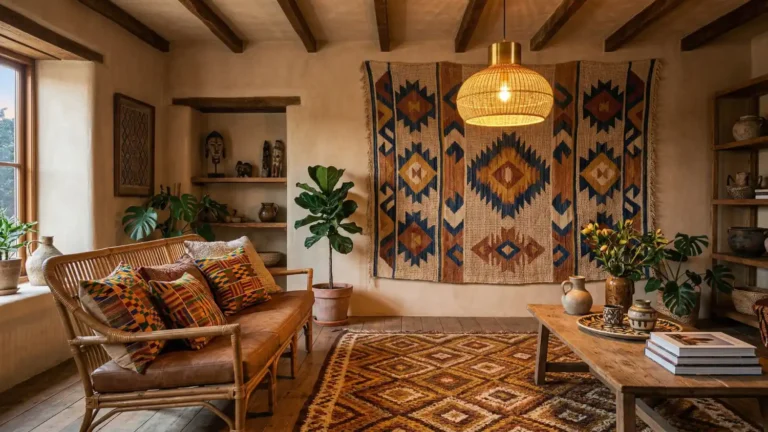
Install the rattan or raffia pendant at the room’s primary light position. A floor lamp at the secondary position. A terracotta candle holder at the object level for the third light source.
All three at 2700K. Evaluate the room’s spatial zones under these three sources — which walls receive the most light, where the shadow zones fall, which corner position receives the warmest ambient glow — before placing any furniture.
Step 2: Resolve the High-Low Furniture Pairing
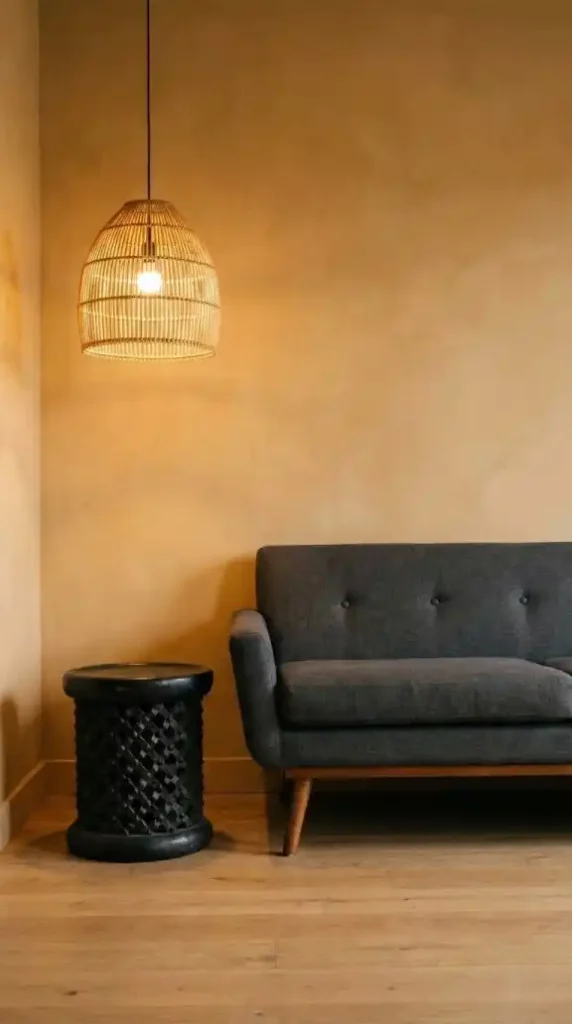
The High-Low furniture pairing is resolved before any textile or object is placed in the room — because the pairing establishes the room’s visual register that every subsequent element responds to.
Identify the High element first: the modern functional silhouette. A clean-lined mid-century sofa. A contemporary platform bed frame. A minimalist trestle desk. A simple dark-framed console. The form should be resolved and functional — not decoratively elaborate.
Then identify the Low element: the raw ancestral artifact at the same furniture scale. A hand-carved Ashanti stool beside the sofa. A Senufo stool as a bedside table. A hand-carved grain mortar as a console object. A live-edge wood slab on trestle legs as a desk.
Position both pieces and evaluate the pairing before adding anything else.
The contrast between the contemporary silhouette and the ancestral artifact should read immediately from the room’s entry point. If the High element is reading as the only dominant piece and the Low element is disappearing beside it the Low element needs to be larger, darker, or positioned closer to the High element’s primary sightline.
Live with the two pieces alone in the room for at least one day. The pairing clarity established here determines the success of every layer added after it.
Step 3: Place the Mud Cloth Anchor
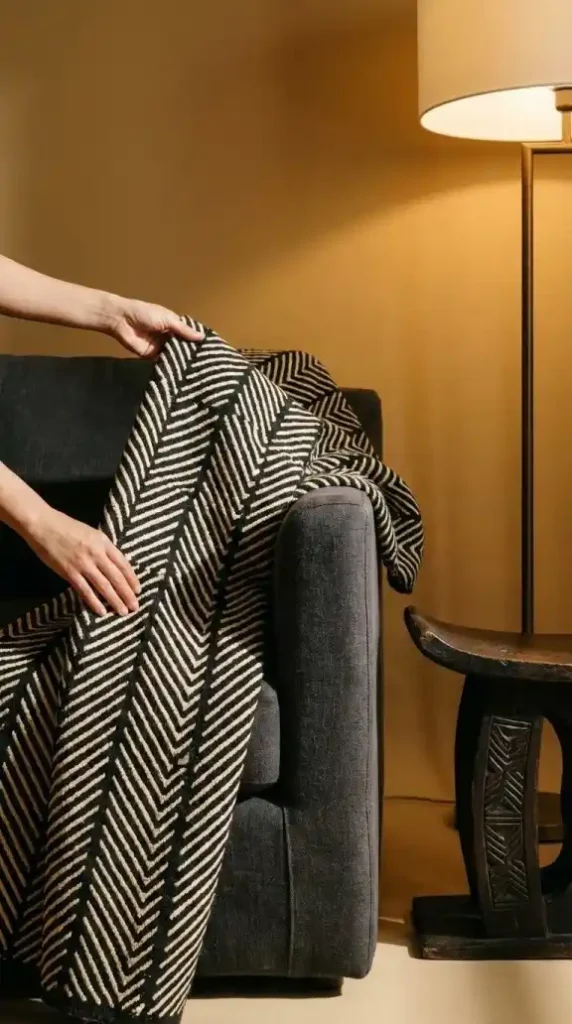
The mud cloth anchor is the room’s first textile decision — and it comes before the secondary textile layer, before the cushions, before the rug, and before any wall piece.
Drape or position the mud cloth piece at the room’s most prominent textile position.
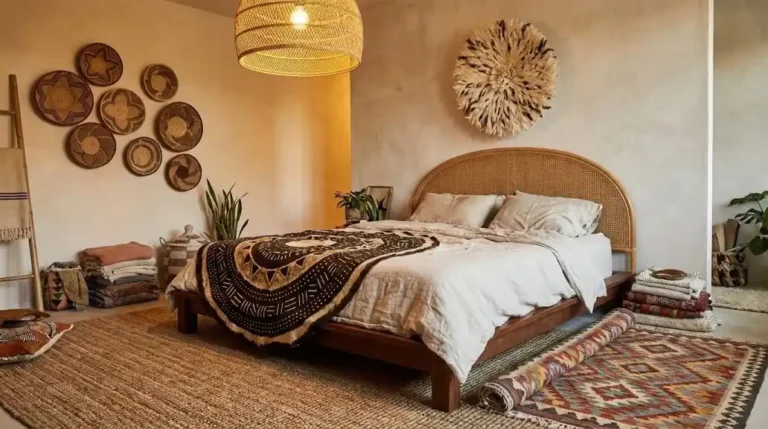
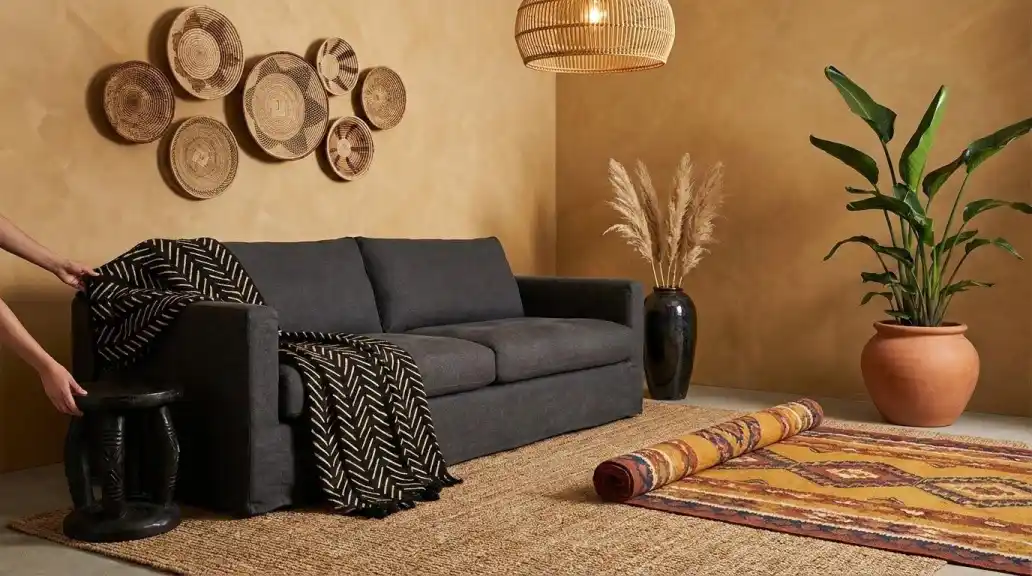
Living room: draped across the sofa arm or folded at the sofa back. Bedroom: folded at the foot of the bed. Office: laid as a desk runner. Hallway: draped over a console chair or folded on a narrow bench.
Once in place, step back and evaluate the mud cloth’s geometric scale and colorway under your 2700K lamp.
The black and cream colorway should read as High Contrast — warm black as the dominant, cream as the ground — with enough contrast ratio that the geometric pattern resolves clearly from across the room. If the black is reading as grey or the cream as cold white the light temperature is still wrong. Address the bulb before proceeding.
The mud cloth’s geometric pattern scale is now the reference that every subsequent pattern textile responds to. Write down the approximate scale of the geometric repeat — how many centimeters between geometric pattern repeats. Every secondary textile added after this should be at a distinctly different pattern scale: significantly larger or smaller than the mud cloth’s repeat. Same scale creates competition. Different scale creates depth.
Step 4: Lay the Floor Layer
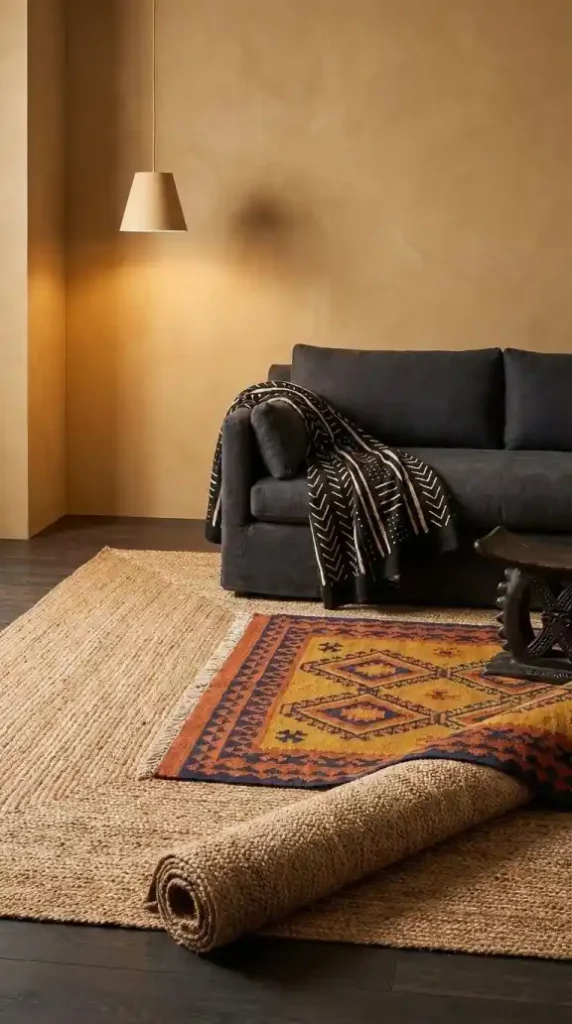
The floor layer is laid after the furniture pairing and mud cloth anchor are confirmed — because the rug’s colorway needs to respond to the mud cloth’s palette and the furniture’s tone rather than lead them.
Roll the large jute or sisal base rug out first — extending under the front legs of all primary seating and covering the full room zone. The jute base establishes the Grounded Neutral foundation at the floor level. Its honey-warm fiber tone should read as cohesive with the mud cloth’s cream tones and the warm ochre wall behind.
Then position the kilim or Moroccan Berber accent rug on top at the seating center.
The kilim’s colorway in ochre, burnt orange, and deep indigo introduces all three palette categories at the floor level simultaneously — Foundation Earth Tones in the ochre and burnt orange, Lush Accents in the indigo. Choose a kilim whose palette directly echoes the mud cloth’s cream and black with the addition of the ochre and indigo that extend the palette outward from the anchor textile.
Evaluate the three-layer floor composition — wall color, jute base, kilim accent — as a unified ground plane before adding any additional objects. The floor should read as warm, grounded, and materially rich. If it reads as flat or cool the jute tone or kilim colorway needs to be adjusted before the object and wall layers are built on top of it.
Step 5: Add the Secondary Textile Layer
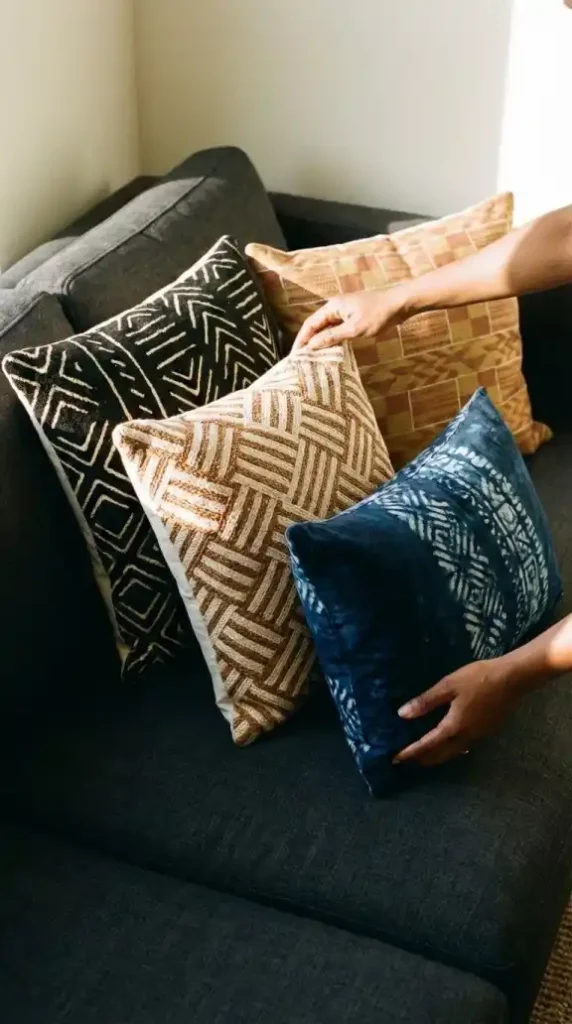
The secondary textile layer is added after the mud cloth anchor is confirmed — one textile tradition at a time, each evaluated before the next is introduced.
Kuba cloth first. Its dense raffia-inspired interlocking geometric pattern at a different scale from the mud cloth’s geometric repeat. Position it at the sofa center or as a structured wall panel — the secondary pattern anchor at a distinctly different visual scale.
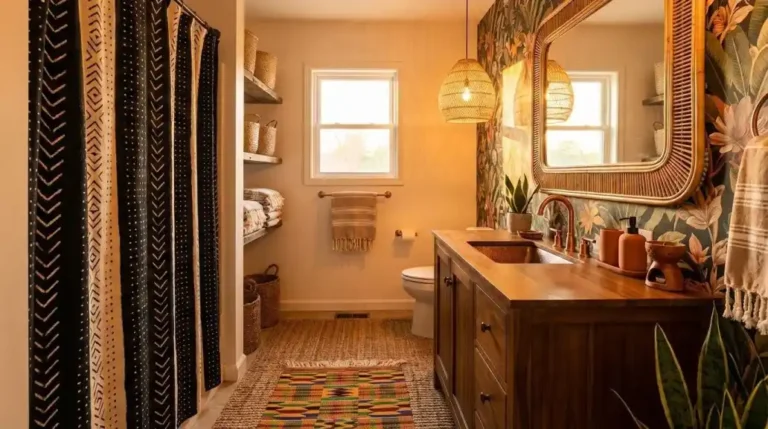
Indigo batik second. The hand-dyed wax-resist pattern in deep indigo and cream at the cushion or curtain position. The cool contrast that balances the warm earth palette dominant established by the mud cloth and the kilim.
Kente-inspired print third. The muted gold and terracotta geometric motif at the accent cushion or runner position. The vibrant Kente vocabulary translated into earth palette tones that sit cohesively within the room’s established colorway.
Add one textile tradition at a time and step back after each addition.
The instinct to add all three simultaneously is strong — resist it. Each textile tradition needs to be evaluated against the room’s existing visual weight before the next one is introduced. Over-layering at the textile level happens fast in Afro Bohemian decor and is slower to undo than to prevent.
Step 6: Style the Object Layer
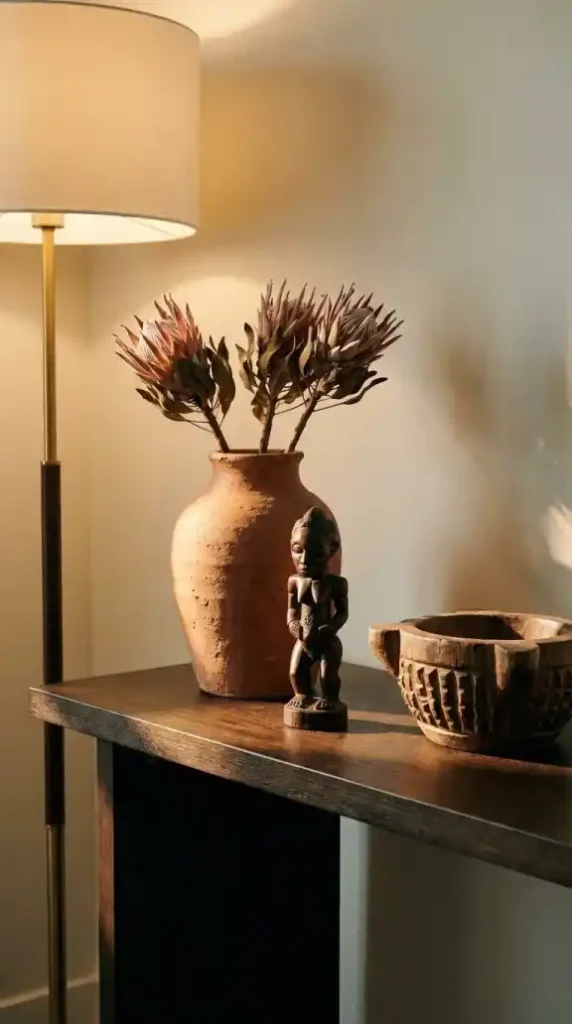
The object layer is styled after the furniture pairing, floor layer, and textile anchor are all in place — because each object needs to respond to the room’s existing material distribution rather than be chosen in isolation.
Three objects per surface. Odd number. Deliberate negative space on both sides.
The three-surface-type rule applies at every object vignette: one rough surface, one smooth surface, one open or structural surface. A terracotta vessel (rough), a dark wood carved figurine (smooth-to-carved), and a coiled grass basket (open-structural) on the same console creates the material contrast that makes each object more legible by opposition.
The repurposed ancestral object — the grain mortar used as a container, the Ashanti stool used as a side surface, the carved ceremonial vessel used as a pen holder — is the object layer’s most important contribution to the High-Low Mix at the close-range scale.
Buy one repurposed ancestral object for every room.
It doesn’t need to be large. A small hand-carved mortar on a console. A traditional gourd vessel on a shelf. A ceremonial kola nut bowl used as a key dish at the entry. The functional repurposing of an ancestral object at the daily-use scale is the most intimate expression of the High-Low principle — and the one that most clearly separates Afro Bohemian decor from aesthetic appropriation.
Step 7: Build the Wall Gallery in Four Layers
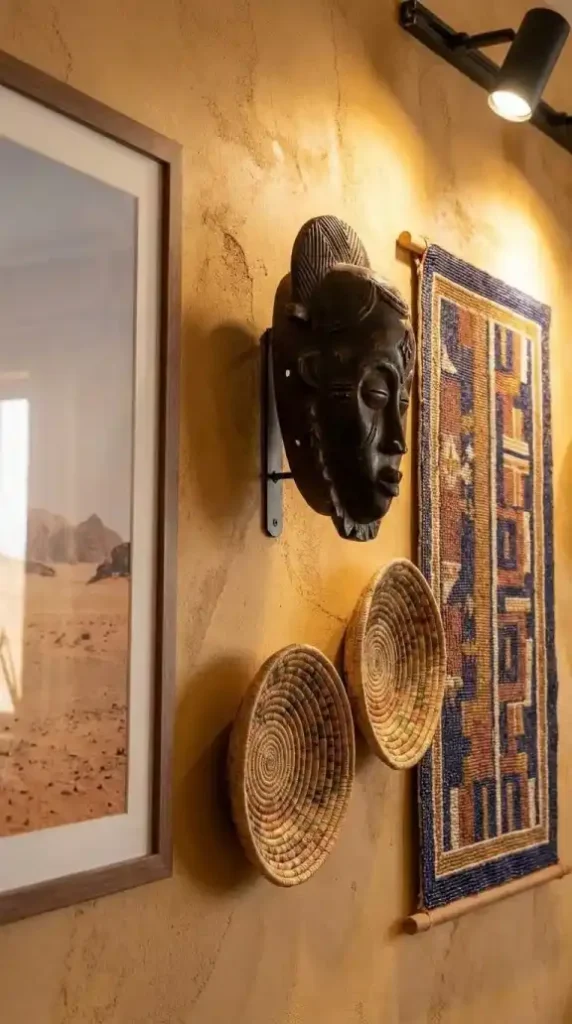
The wall gallery is built in four layers — in a specific sequence where each layer is evaluated before the next is added.
Layer one: the Tonga or Binga basket gallery cluster. Start with five to seven baskets in graduated sizes arranged asymmetrically on the wall’s primary zone. This is the gallery’s textural foundation — the element that communicates the Afro Bohemian aesthetic most immediately from the entry point. Confirm the basket arrangement reads as a composed asymmetric cluster before moving to layer two.
Layer two: the hand-carved mask. Mount it on a museum bracket at the gallery’s center axis — the focal point that the basket cluster and photography piece organize around. The mask’s three-dimensional carved surface at the gallery center creates depth that no flat-mounted piece produces. Evaluate its position relative to the basket cluster before adding anything else.
Layer three: large-scale macro photography. A 60x90cm grainy film print of an African landscape or portrait silhouette in a dark wood frame at the gallery’s secondary position — to the opposite side of the mask from the basket cluster. The photography’s smooth glass-fronted surface provides the one reflective flat element in the otherwise entirely textural gallery composition.
Layer four: Yoruba beaded art. Positioned at the gallery’s lower or outer zone — the dense bead surface catching warm track light in multiple shifting highlight points that animate the gallery wall after dark. The beaded piece completes the gallery’s material vocabulary by introducing the one surface type — densely beaded and color-shifting — that none of the other three gallery elements provides.
Step back after each layer. The gallery should read as progressively richer. If any layer tips it from rich to busy identify the most recently added element and reduce its size or increase its distance from adjacent elements before adding the next layer.
Step 8: Place the Dried Botanical Layer
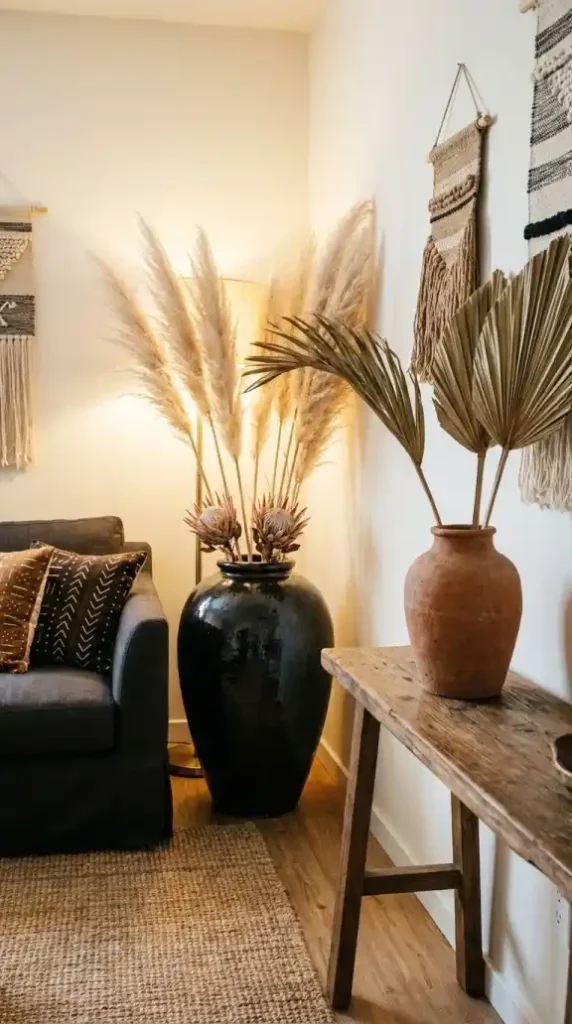
The dried botanical layer is placed before the living plants — because dried arrangements are permanent and their positions need to be confirmed before the living plant positions are determined around them.
Two positions for dried botanicals: the floor vase position and the console or shelf position.
The floor vase position: a large heavy dark glazed ceramic or oversized terracotta floor vase holding dried pampas grass, dried protea, and preserved palm fronds. The floor vase should be genuinely heavy — its visual weight and physical mass create an architectural presence at the floor level that a lightweight vessel can’t produce.
The console or shelf position: a smaller heavy ceramic vessel holding two or three dried stems — protea seed heads, dried eucalyptus, or a single preserved palm frond. This is the dried botanical layer at the close-range vignette scale.
Confirm both positions before introducing the living plants.
The living plants go into the spatial zones that the dried botanicals don’t occupy — the room’s open corners with indirect natural light access, the high shelf positions above the shelving lines. The two botanical registers should never compete for the same spatial position. They occupy distinct zones within the room’s layout.
Step 9: Place the Living Jungle Layer
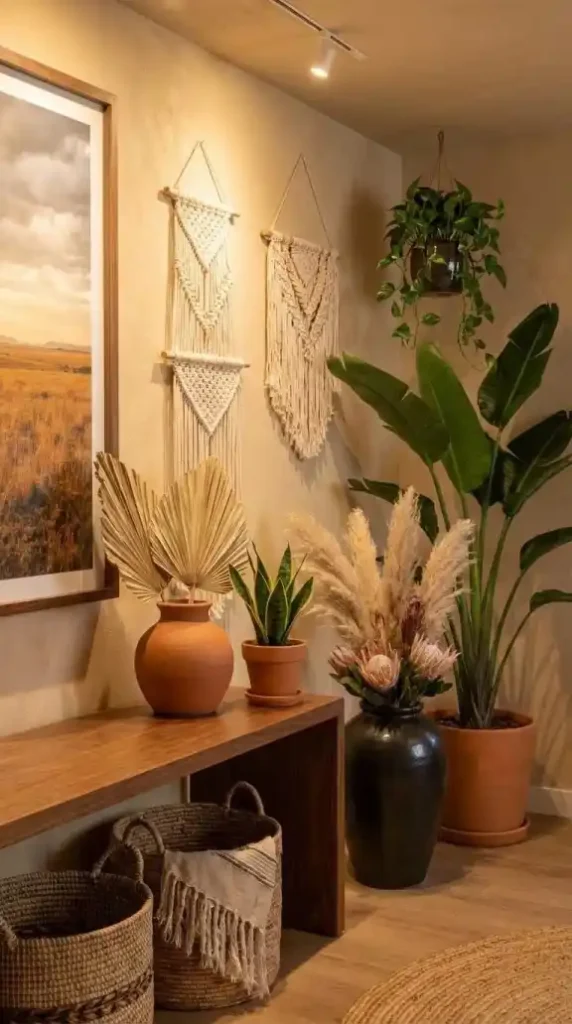
Living plants are the final element placed — because their positions are determined by the spatial gaps the assembled room reveals after every other element is in place.
Three positions. Three plants. Three distinct spatial zones.
The large corner zone: a Bird of Paradise or Fiddle Leaf Fig in a terracotta floor pot at the room’s most open corner with indirect natural light access. The broad tropical leaf silhouette fills the floor-to-ceiling zone that no furniture or object can address. This is the living jungle layer at its most architecturally significant scale.
The high shelf or upper zone: a trailing Pothos in a dark ceramic hanging planter above the highest shelf or at the uppermost wall position. The cascading vines fill the dead zone where wall meets ceiling — the architectural gap that accumulates visual awkwardness without organic growth to soften it.
The close-range zone: a Snake Plant in a terracotta pot on the console or beside the floor vase dried botanical arrangement. The Snake Plant’s strong upright vertical lines provide structural counterpoint to the soft trailing vines above and the broad horizontal Bird of Paradise leaves in the corner — three distinct plant growth habits at three distinct spatial zones in the same room.
Repot all three before they enter the room.
Terracotta for the floor corner plant. Dark glazed ceramic for the trailing hanging plant. Terracotta or woven basket for the close-range console plant.
No plastic nursery pots visible in an assembled Afro Bohemian room at any scale — the container participates in the palette as much as any other object.
Step 10: Complete the Sensory Finishing Layer
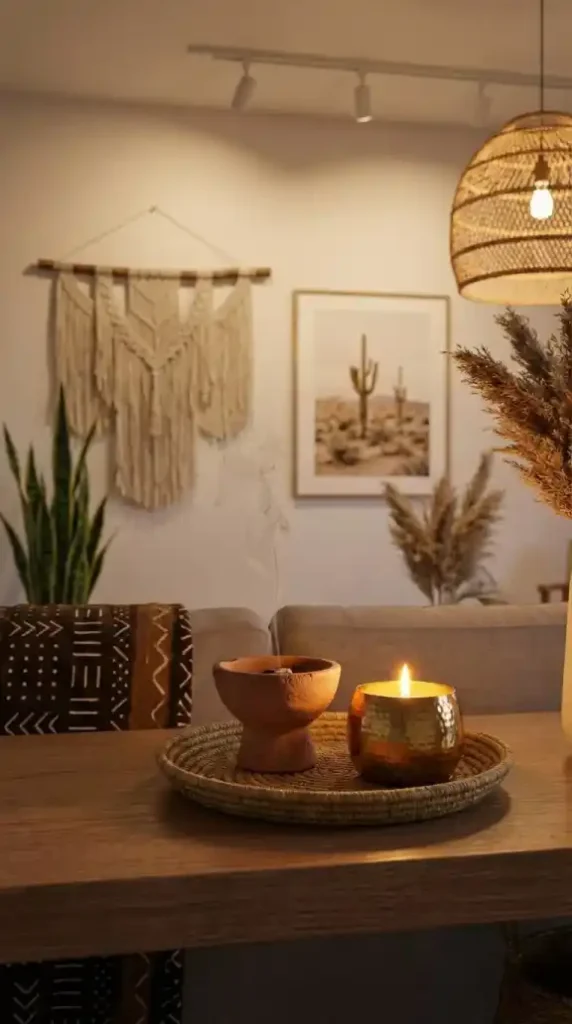
The sensory finishing layer is added last and experienced first.
Scent crosses the room before the eye has resolved any surface detail — and in an Afro Bohemian room built on cultural heritage and organic materials, scent is the layer that makes the visual composition immersive rather than merely decorative.
A terracotta incense burner with sandalwood or frankincense on the console beside the dried botanical arrangement. The earth-pigment material of the terracotta reads as cohesive with every other clay and ceramic object in the room. The scent references the same warm organic material origin as the aesthetic’s visual palette through olfactory association.
A hammered brass candle holder with an amber flame beside the incense burner. The warm flicker adds movement to the static vignette at the console position and contributes the fourth light source at object level.
A small coiled grass tray holding both the incense burner and the candle holder frames them as a composed sensory vignette — the tray does the grouping work that makes two separate objects read as a single intentional arrangement.
Light the incense and the candle. Stand at the room’s entry point. The scent and the warm flicker should reach the entry position before the eye has registered the full gallery wall or the mud cloth on the sofa.
When that sensory arrival happens before the visual one the room is complete.
Applying the System at Different Room Scales
The full ten-step sequence applies at the living room and bedroom scale. At smaller scales the system contracts without losing its logic.
At the hallway scale: one High-Low pairing — a narrow contemporary console with a hand-carved Ashanti stool beside it. One wall element — a single large Tonga basket or a framed macro photography print. One floor textile — a jute runner with a small kilim section. One plant — a Snake Plant in a terracotta pot. One sensory object — a terracotta incense burner on the console. The full Afro Bohemian system reduced to five elements across five positions. The same logic. A fraction of the scale.
At the single corner scale: the High-Low pairing in the furniture — a rattan peacock chair beside a hand-carved stool side table. The mud cloth anchor as a chair cushion. One dried botanical arrangement in a heavy ceramic floor vase. One living Bird of Paradise in a terracotta pot behind the chair. The system at its most minimal — and still immediately legible as Afro Bohemian because the High-Low logic, the mud cloth anchor, and the dual botanical register are all operating even at the smallest possible scale.
Final Room Audit Before Calling Any Room Done
Walk through the fully assembled room and answer these questions:
- Stand at the entry point. Where does the eye land first? It should land on the mud cloth anchor or the gallery wall’s primary focal element — the basket cluster or the carved mask. If the eye lands on a contemporary element first the Low register needs to increase its visual weight at the room’s primary focal positions.
- Is the High-Low Mix operating at all three scales — furniture, object, and wall art? Identify any scale where only one register is present and introduce the opposing register there before adding anything further.
- Are all four textile traditions present — mud cloth, Kuba cloth, indigo batik, and Kente-inspired print? Count them. The absent tradition is the next textile purchase regardless of how many pieces from the represented traditions already exist in the room.
- Are both botanical registers present — living tropical plants at the corner and shelf positions, dried botanicals in heavy ceramic vases at the console and floor positions? If only one register is present the botanical layer is incomplete.
- Is the repurposed ancestral object present at the close-range object scale — the grain mortar, the carved ceremonial vessel, the traditional gourd? If every object in the room was purchased as a decorative piece add one genuinely functional ancestral object in a contemporary role before the room is considered complete.
- Light the incense and the candle. Stand at the entry point. Does the scent arrive before the eye has resolved the gallery wall? If yes — the sensory layer is complete and the room is finished.
The Afro Bohemian decor system applied across any room at any scale produces the same result when the sequence is followed correctly.
The mud cloth sets the pattern anchor. The High-Low pairing sets the cultural register. The secondary textiles deepen the pattern vocabulary. The floor layer grounds the material foundation. The object layer carries the close-range cultural references. The gallery wall carries the heritage depth at the architectural scale. The dried botanicals carry the earth element. The living plants carry the jungle layer. The sensory finishing completes the immersive experience.
Ten steps. Any room. One cohesive aesthetic.
That’s the Afro Bohemian decor system — and it works not because of any single element but because of how every element responds to every other one.
What To Read Next:
- Afro Bohemian Decor: The Complete Style Guide — Understand the full High-Low Mix logic and the four textile traditions that explain why every pairing decision in an Afro Bohemian room works as a unified cultural and material system.
- 11 Afro Bohemian Decor Ideas for a Warm and Layered Home — See the High-Low principle, the mud cloth anchor, and the dual botanical register applied across 11 specific decor moves, each one building the conditions for the next.
- Afro Bohemian Decor for Beginners: What to Buy First — If the High-Low logic and four-layer wall gallery feel abstract, start here with the ten anchor pieces and the exact buying sequence that makes both principles concrete from the first purchase.